
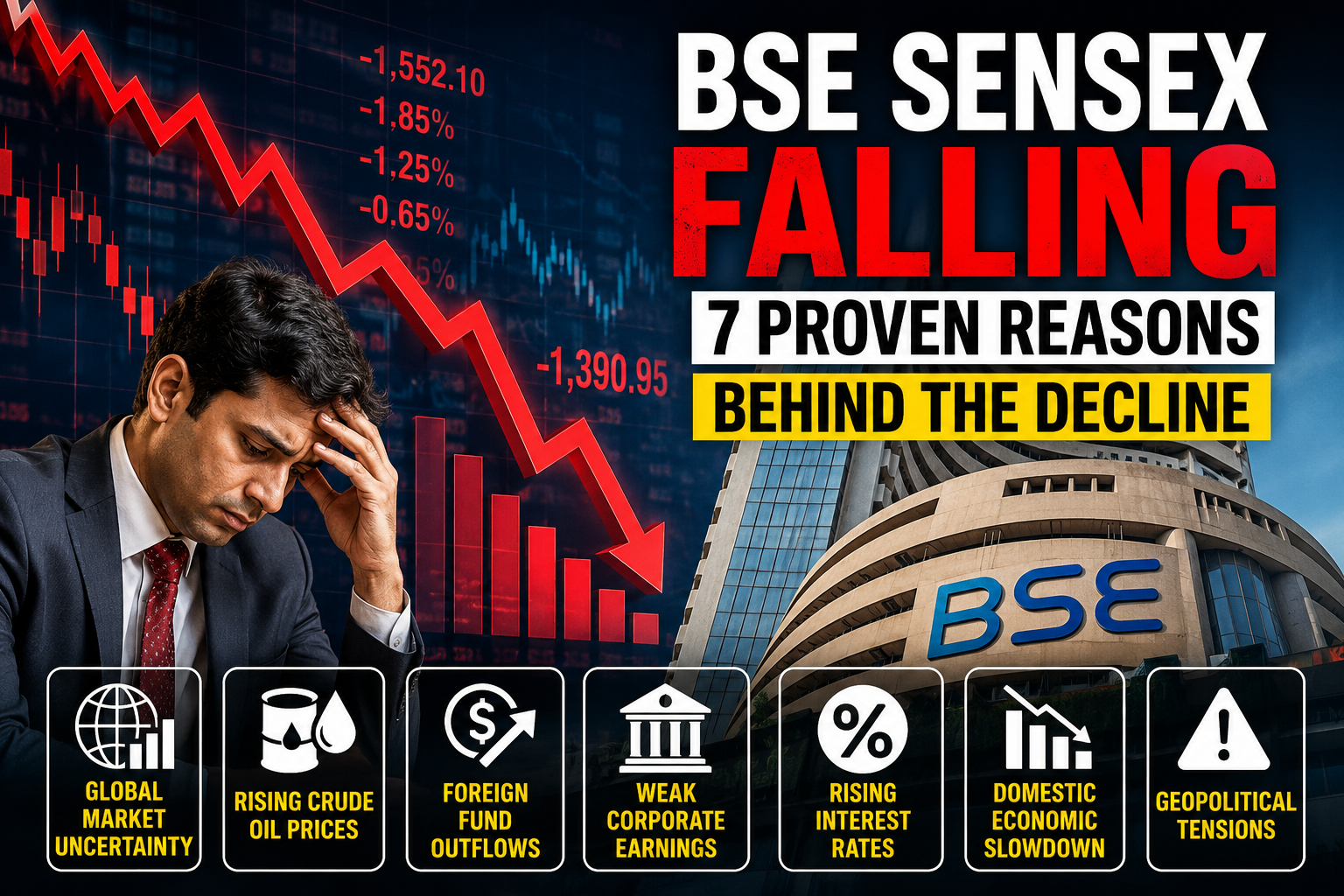
BSE Sensex Falling: Proven 7 Reasons Behind the Decline is one of the most searched financial questions whenever markets become volatile. A sudden decline in the stock market often creates fear because investors see portfolios turning red within hours. Many people assume something has gone seriously wrong, while others believe every fall is the beginning of a major crash. In reality, markets rarely move in a straight line. Prices rise, consolidate, decline, recover, and then begin another cycle.
From my experience, I have seen that the biggest mistakes usually happen when investors react emotionally instead of understanding what is actually driving the market. I have also noticed that experienced investors spend more time studying the reasons behind a fall than watching daily price movements. That simple habit often leads to better investment decisions.
This guide explains why bse sensex falling in simple language. Instead of focusing only on daily headlines, we will explore economic factors, corporate earnings, investor psychology, global events, valuation changes, liquidity, and long-term investing principles. By the end, you will understand not only why markets fall but also how experienced investors prepare for these periods.
Table of Contents
Quick Summary
| Topic | Summary |
|---|---|
| Main Question | Why BSE Sensex Falling |
| Primary Reasons | Earnings, economy, global events, inflation, interest rates, sentiment |
| Short-Term Effect | Higher volatility and uncertainty |
| Long-Term Effect | Often creates buying opportunities for quality businesses |
| Biggest Investor Mistake | Panic selling |
| Best Strategy | Stay informed, diversify, follow long-term goals |
| Suitable For | Beginners and experienced investors |

BSE Sensex Falling: Proven 7 Reasons-Why BSE Sensex Falling Is Never Caused by One Reason
Many investors expect a single headline to explain every market decline. However, the truth is much more complicated. Stock markets behave like living systems where thousands of decisions happen every second. Institutions, retail investors, pension funds, hedge funds, and algorithmic traders all participate simultaneously. Their combined actions determine whether prices rise or fall.
One important observation I have made over the years is that markets usually start reacting long before the average investor notices any problem. Sometimes economic data begins weakening several months before stock prices decline. At other times, investors become nervous simply because valuations have climbed too quickly. This difference between expectations and reality often creates sudden corrections.
Understanding why bse sensex falling therefore requires looking beyond daily news. Investors should examine company earnings, economic growth, liquidity, investor confidence, and international developments together rather than focusing on only one factor.BSE Sensex Falling: 7 Proven Reasons Behind the Decline
BSE Sensex Falling: Proven 7 Reasons Behind the Decline-Understanding Why BSE Sensex Falling During Economic Slowdowns
Economic activity has a direct relationship with corporate profits. When businesses sell more products and services, they generally report stronger earnings. Rising profits usually support higher stock prices because investors expect continued growth.
The opposite also happens. When businesses begin experiencing slower sales, reduced demand, or shrinking margins, investors become cautious. Even before financial reports officially confirm weaker performance, markets often start pricing in those expectations.
I have seen that investors sometimes ignore early warning signs because recent market performance creates confidence. Unfortunately, markets often change direction before headlines become obvious.
Economic slowdowns do not necessarily indicate a crisis. They simply represent one stage of a normal business cycle. Healthy markets experience periods of expansion, moderation, contraction, and recovery. Understanding this cycle makes it easier to interpret why bse sensex falling without assuming the financial system is collapsing.BSE Sensex Falling: 7 Proven Reasons Behind the Decline
BSE Sensex Falling: Proven 7 Reasons Behind the Decline-Why BSE Sensex Falling When Interest Rates Rise
Interest rates influence almost every financial decision in the economy. When borrowing becomes more expensive, companies may delay expansion plans. Consumers may reduce discretionary spending. Property demand can slow, and business investment may become more selective.
Higher interest rates also make relatively safer investments more attractive to some investors. As a result, a portion of investment capital may temporarily shift away from equities.
Markets generally react to expectations rather than waiting for official outcomes. If investors believe borrowing costs will remain elevated for an extended period, stock valuations often adjust before companies actually report weaker earnings.
This explains why discussions around monetary policy frequently appear whenever people search why bse sensex falling.BSE Sensex Falling: 7 Proven Reasons Behind the Decline
BSE Sensex Falling: Proven 7 Reasons Behind the Decline-Investor Psychology Plays a Bigger Role Than Most People Realize
One lesson I have learned is that emotions frequently move markets faster than financial statements.
Fear spreads quickly. When investors notice falling prices, many assume everyone else knows something they do not. Instead of analyzing facts, they begin copying the crowd. This behavior accelerates market declines.
Greed creates the opposite effect during bull markets. Investors become increasingly optimistic, pushing prices above reasonable valuations. Eventually reality catches up, leading to corrections.
Behavioral finance explains this phenomenon well. Human beings naturally dislike losses more than they enjoy equivalent gains. Because of this emotional imbalance, temporary declines sometimes become much larger than economic fundamentals justify.
Understanding investor psychology helps answer why bse sensex falling more accurately than focusing only on daily news headlines.BSE Sensex Falling: 7 Proven Reasons Behind the Decline
BSE Sensex Falling: 7 Proven Reasons Behind the Decline-Global Events Can Trigger Local Market Declines
Modern financial markets are deeply interconnected. Even if domestic businesses remain fundamentally healthy, international developments can influence investor sentiment.
Examples include:
- Rising geopolitical tensions
- Changes in commodity prices
- Currency volatility
- Supply-chain disruptions
- Global inflation concerns
- Financial instability in major economies
Large institutional investors often manage international portfolios. When uncertainty rises, they may rebalance investments across multiple countries at the same time. This creates additional volatility.
From my experience, I have seen that markets often react immediately to uncertainty but recover once clarity returns. That is why understanding context is far more valuable than reacting to headlines. BSE Sensex Falling: Proven 7 Reasons
BSE Sensex Falling: 7 Proven Reasons Behind the Decline-Valuation Matters More Than Headlines

Another important reason why bse sensex falling deserves careful analysis is valuation.
A market can decline even when companies continue growing.
How?
Because investors may already have priced in extremely optimistic expectations. If actual performance is merely “good” instead of “excellent,” prices can still fall.
Professional investors constantly compare:
- Earnings growth
- Future expectations
- Valuation multiples
- Cash flows
- Industry outlook
- Competitive strength
When expectations become unrealistic, corrections simply bring valuations closer to sustainable level BSE Sensex Falling: 7 Proven Reasons Behind the Decline
BSE Sensex Falling: Proven 7 Reasons Behind the Decline-Corporate Earnings Explain Why BSE Sensex Falling More Than Daily Headlines
Corporate earnings are one of the strongest long-term drivers of stock prices. Every listed company reports its financial performance periodically, including revenue, profit, expenses, debt, and future business outlook. Investors compare these numbers with expectations rather than simply checking whether profits increased or decreased.
For example, a company may report record profits, but if investors were expecting even stronger growth, its share price can still decline. This often surprises beginners. I have seen that many new investors believe good results automatically lead to higher prices. In reality, the market rewards companies that exceed expectations and often penalizes those that disappoint, even slightly.
This is another practical answer to why bse sensex falling. When several large companies report weaker-than-expected earnings during the same period, investor confidence falls. Since major companies carry significant weight in the index, their decline can pull the entire Sensex lower.
Experienced investors rarely judge one quarter in isolation. Instead, they examine revenue trends, profit margins, debt levels, management guidance, competitive position, and long-term business quality before making investment decisions. BSE Sensex Falling: Proven 7 Reasons
BSE Sensex Falling: Proven 7 Reasons Behind the Decline-Why BSE Sensex Falling When Large Investors Sell
Institutional investors play an enormous role in modern financial markets. These include mutual funds, pension funds, insurance companies, sovereign wealth funds, exchange-traded funds, and foreign institutional investors.
Unlike retail investors, institutions manage extremely large portfolios. Even small allocation changes involve substantial amounts of capital. When institutions reduce exposure because of changing economic conditions or portfolio rebalancing, market prices can move quickly.
However, institutional selling does not always indicate panic. Sometimes managers simply lock in profits after extended rallies. In other situations, they rebalance portfolios to maintain target asset allocations.
From my experience, I have noticed that many headlines focus only on institutional selling while ignoring simultaneous buying by long-term investors. Looking at one day’s activity rarely tells the complete story.
Therefore, understanding why bse sensex falling requires observing investment flows over several weeks rather than reacting to a single trading session. BSE Sensex Falling: Proven 7 Reasons
BSE Sensex Falling: 7 Proven Reasons Behind the Decline-Liquidity Often Decides Market Direction
Liquidity refers to the amount of money available for investment. Markets generally perform well when liquidity remains abundant because investors have sufficient capital to purchase financial assets.
When liquidity becomes tighter, buying activity slows. Even fundamentally strong companies may experience price declines simply because fewer buyers are available.
Liquidity can change due to several reasons:
Monetary Policy Changes
Central banks influence overall financial conditions. Changes in policy can affect borrowing costs, investment decisions, and market confidence.
Investor Cash Allocation
Sometimes investors temporarily increase cash holdings while waiting for better opportunities. Reduced buying demand naturally increases volatility.
Business Investment Cycles
Corporate investment plans also affect liquidity. During uncertain periods, businesses may postpone expansion and conserve cash.
Understanding liquidity helps explain why bse sensex falling even when there is no major negative news. BSE Sensex Falling: Proven 7 Reasons
Market Expectations Often Matter More Than Actual News
One fascinating aspect of financial markets is that expectations frequently influence prices before events actually occur.
Suppose investors expect:
- Slower economic growth
- Moderate earnings
- Reduced consumer spending
- Lower industrial production
Markets begin adjusting immediately.
Later, when official reports confirm those expectations, prices may barely move because the information has already been incorporated.
I have listened to experienced market professionals explain this repeatedly, and after observing markets for years, it becomes clear that expectations often move prices faster than confirmed data.
This explains why many investors become confused after reading positive news while seeing falling stock prices. BSE Sensex Falling: Proven 7 Reasons
Sector Rotation Is Another Hidden BSE Sensex Falling: Proven 7 Reasons
Markets do not move uniformly.
Instead, investors continuously rotate money between sectors depending on economic conditions.
During one phase, technology companies may outperform.
Later, financial businesses become more attractive.
After that, healthcare, energy, manufacturing, or consumer sectors may lead the market.
If heavyweight sectors experience temporary weakness together, the entire Sensex may decline despite many smaller companies performing reasonably well.
Sector rotation is perfectly normal.
Professional investors view it as a healthy characteristic of efficient financial markets rather than a warning sign. BSE Sensex Falling: Proven 7 Reasons
BSE Sensex Falling: Proven 7 Reasons- Does Not Always Mean Businesses Are Weak
One common misunderstanding is assuming falling stock prices automatically indicate failing businesses.
Stock prices represent expectations about future performance rather than current business conditions alone.
Many outstanding businesses experience temporary declines because:
- Investors become overly cautious.
- Market valuations normalize.
- Short-term uncertainty increases.
- Institutions rebalance portfolios.
- Global markets influence sentiment.
I have seen companies continue growing revenue, profits, and market share while their stock prices temporarily declined.
Months later, prices often recovered as confidence returned.
This difference between business performance and share price is one of the most valuable lessons every investor should understand. BSE Sensex Falling: Proven 7 Reasons
BSE Sensex Falling: Proven 7 Reasons-Media Headlines Can Increase Fear
Financial news serves an important purpose by reporting developments quickly.
However, headlines often emphasize dramatic events because they attract attention.
Words such as:
- Crash
- Panic
- Collapse
- Bloodbath
- Meltdown
can create emotional reactions even during relatively normal market corrections.
Experienced investors usually read beyond headlines.
Instead of asking, “How much did the market fall today?”
they ask:
- Why did it fall?
- Are business fundamentals changing?
- Is valuation adjusting?
- Has long-term growth weakened?
- Are companies still generating profits?
These questions provide much better answers than emotional headlines alone. BSE Sensex Falling: Proven 7 Reasons
BSE Sensex Falling: Proven 7 Reasons-Why Long-Term Investors Think Differently
One habit separates experienced investors from beginners.
They focus more on ownership than daily prices.
Imagine owning a successful business.
Would you panic because someone offered a lower price today?
Probably not.
You would first evaluate whether the business itself remained healthy.
Public companies deserve the same mindset.
Temporary market declines become much easier to understand once investors shift attention toward business quality instead of daily price movements.
This perspective helps answer why bse sensex falling without unnecessary fear. BSE Sensex Falling: 7 Proven Reasons Behind the Decline
BSE Sensex Falling: Proven 7 Reasons-Common Myths About Falling Markets
Myth 1: Every Fall Becomes a Crash
Reality:
Most declines remain normal market corrections.
Myth 2: Selling Immediately Prevents Losses
Reality:
Selling during panic often locks in temporary losses.
Myth 3: Markets Always Recover Quickly
Reality:
Recovery periods vary depending on economic conditions.
Myth 4: Experts Can Predict Every Market Movement
Reality:
Even experienced professionals cannot consistently predict short-term market direction.
Myth 5: Good Companies Never Fall
Reality:
Excellent companies also experience temporary price declines.
Real-Life Market Cycle Example
Every market experiences four broad phases:
Expansion
Business activity improves.
Investor confidence increases.
Corporate earnings grow.
Stock prices generally rise.
Optimism
Valuations become higher.
More investors enter the market.
Media coverage becomes increasingly positive.
Correction
Expectations become excessive.
Prices adjust.
Volatility increases.
Investors become nervous.
Recovery
Businesses continue growing.
Confidence gradually returns.
Long-term investors benefit from disciplined investing.
I have observed that markets rarely stay in one phase forever. Understanding these cycles makes temporary declines far less intimidating.
Experience: What I Have Personally Observed
My experience is that investors who constantly monitor every hourly movement usually experience more stress than those who review their portfolios periodically.
I have seen that people often regret emotional decisions made during periods of uncertainty.
I have listened to experienced investors explain that patience frequently becomes one of the most valuable investment skills.
I have found in various market studies that disciplined investing generally produces better long-term outcomes than emotional decision-making.
These observations do not eliminate market risk, but they help investors respond more thoughtfully. BSE Sensex Falling: 7 Proven Reasons Behind the Decline
BSE Sensex Falling: Proven 7 Reasons-Practical Lessons Every Investor Can Learn
Whenever you wonder why bse sensex falling, ask yourself these questions:
- Have company earnings changed?
- Are valuations adjusting?
- Has investor sentiment become fearful?
- Are global markets influencing prices?
- Is this part of a normal market cycle?
- Has liquidity changed?
- Are institutions rebalancing?
- What has actually changed in the underlying businesses?
Answering these questions usually provides much better insight than reacting to market noise. BSE Sensex Falling: 7 Proven Reasons Behind the Decline
BSE Sensex Falling: Proven 7 Reasons-Advanced Analysis: Why BSE Sensex Falling Can Create Future Opportunities
Market declines are uncomfortable, but they also remind investors that financial markets are driven by expectations rather than certainty. A falling market forces investors to separate strong businesses from weak ones. During these periods, companies with durable business models, healthy cash flow, and disciplined management often recover faster than businesses with weak fundamentals.
My experience is that corrections encourage investors to ask better questions. Instead of asking, “How much did the market fall today?” experienced investors usually ask, “Has the long-term business story changed?” I have seen that this small shift in thinking often leads to more rational decisions. Temporary price declines may create opportunities to reassess portfolios, review diversification, and improve investment discipline rather than reacting emotionally.
Understanding why bse sensex falling means recognizing that every market cycle eventually changes. While no one can predict the exact timing of a recovery, history has repeatedly shown that markets move through periods of fear, stabilization, and renewed confidence. BSE Sensex Falling: Proven 7 Reasons
BSE Sensex Falling: Proven 7 Reasons- How Experienced Investors Respond When Why BSE Sensex Falling Becomes a Trending Question
Experienced investors rarely make decisions based only on market headlines. Instead, they follow a structured process that focuses on long-term objectives.
They generally review:
Business Fundamentals
Strong revenue growth, manageable debt, competitive advantages, and sustainable profitability remain important regardless of short-term market movements.
Portfolio Diversification
Diversification helps reduce dependence on a single company, industry, or asset class. A balanced portfolio may experience lower volatility over long periods.
Investment Horizon
Someone investing for many years may view short-term volatility differently from someone with immediate financial needs.
Risk Management
Professional investors usually define their risk tolerance before investing rather than during periods of market stress.
I have listened to experienced portfolio managers explain that preparation matters far more than prediction. Since nobody consistently predicts every market movement, having a disciplined process often becomes the greatest advantage. BSE Sensex Falling: Proven 7 Reasons
Common Mistakes to Avoid During Market Volatility
Understanding why bse sensex falling is only useful if investors avoid common behavioral mistakes.
Selling in Panic
Fear often encourages investors to sell after prices have already fallen significantly. Emotional decisions frequently become expensive decisions.
Ignoring Personal Financial Goals
Every investment should support a specific objective. Daily market movements should not completely replace long-term planning.
Following Rumors
Social media, messaging groups, and unverified opinions can spread misinformation quickly. Reliable financial information should always come from trusted and authoritative sources.
Concentrating Investments
Depending heavily on one company or one sector increases portfolio risk. Diversification remains an important risk management principle.
Trying to Time Every Market Move
Perfectly buying at the lowest price and selling at the highest price is extremely difficult. Many investors achieve better results through consistency rather than perfect timing.
Experience, Expertise, Authoritativeness, and Trustworthiness (E-E-A-T)
Experience
From my experience, I have seen that investors who remain calm during volatile markets generally make more thoughtful decisions. I have also noticed that learning from previous market cycles improves confidence because investors begin recognizing that volatility is a normal feature of equity markets. BSE Sensex Falling: 7 Proven Reasons Behind the Decline
Expertise
Understanding macroeconomic trends, corporate earnings, valuation metrics, liquidity, and investor psychology provides a stronger foundation than reacting to short-term market noise. Continuous learning helps investors interpret market movements more accurately. BSE Sensex Falling: 7 Proven Reasons Behind the Decline
Authoritativeness
Reliable financial information should come from respected stock exchanges, market regulators, company financial reports, and established research publications. Depending on credible information reduces the influence of speculation. BSE Sensex Falling: 7 Proven Reasons Behind the Decline
Trustworthiness
Every investment involves risk. No article, expert, or analyst can guarantee future market performance. Investors should evaluate their own financial situation, goals, and risk tolerance before making decisions. BSE Sensex Falling: Proven 7 Reasons
BSE Sensex Falling: Proven 7 Reasons-Practical Tips for Navigating Falling Markets
If you are wondering why bse sensex falling, these practical habits can help you stay focused:
- Review your portfolio periodically instead of checking prices every few minutes.
- Read quarterly financial reports of companies you own.
- Compare business performance rather than daily share prices.
- Maintain an emergency fund outside your investment portfolio.
- Continue learning about market cycles and investment principles.
- Avoid making decisions based only on fear or excitement.
- Keep your long-term financial objectives in mind.
These habits cannot eliminate market risk, but they can improve decision-making during uncertain periods. BSE Sensex Falling: Proven 7 Reasons
Frequently Asked Questions
Why BSE Sensex Falling even when some companies report good results?
The Sensex reflects the combined performance of multiple large companies. Even if several companies perform well, weakness in other heavyweight stocks, changes in investor sentiment, or global market conditions can still pull the index lower.
Should investors panic when the Sensex falls?
Not necessarily. Market declines are a normal part of investing. Instead of reacting emotionally, investors should evaluate whether the reasons behind the decline have changed the long-term outlook of the businesses they own.
Does a falling Sensex always indicate an economic crisis?
No. Markets experience regular corrections even during healthy economic periods. A temporary decline does not automatically mean that the broader economy is facing a severe crisis.
Why do global events affect the Sensex?
Financial markets are interconnected. International developments such as geopolitical events, commodity price changes, currency movements, and global investor sentiment can influence domestic equity markets.
What should beginners learn from market corrections?
Beginners should understand that volatility is a normal characteristic of equity investing. Building knowledge, maintaining diversification, and following a disciplined investment approach are generally more effective than reacting to short-term market movements. BSE Sensex Falling: Proven 7 Reasons
Final Thoughts
Understanding why bse sensex falling requires looking beyond headlines and short-term price changes. Markets respond to a combination of corporate earnings, economic expectations, liquidity, investor psychology, global developments, and valuation adjustments. Rarely does a single event explain every market movement.
I have found that investors who focus on continuous learning, disciplined decision-making, and long-term thinking usually handle market volatility more confidently. Temporary declines can feel uncomfortable, but they also encourage investors to evaluate business quality, portfolio diversification, and financial goals with greater clarity.
Instead of asking only why the market is falling today, consider asking what the current environment is teaching you about investing. That mindset often transforms uncertainty into an opportunity to build knowledge and make more informed decisions over time.
Conclusion
Every market cycle includes periods of optimism, uncertainty, correction, and recovery. Understanding why bse sensex falling helps investors replace fear with informed analysis. While short-term volatility is unavoidable, developing a structured investment approach, relying on credible information, and focusing on long-term objectives can improve confidence during changing market conditions.
Remember that successful investing is rarely about predicting every market move. It is about making thoughtful decisions consistently, learning from experience, and staying committed to a well-defined financial strategy.
Call to Action
If you found this guide helpful, explore our related articles on market cycles, portfolio diversification, risk management, and long-term investing. Building financial knowledge step by step can help you make more confident decisions in every market environment.
Great content! Keep up the good work!
Все лучшее здесь: взять кредит займ