
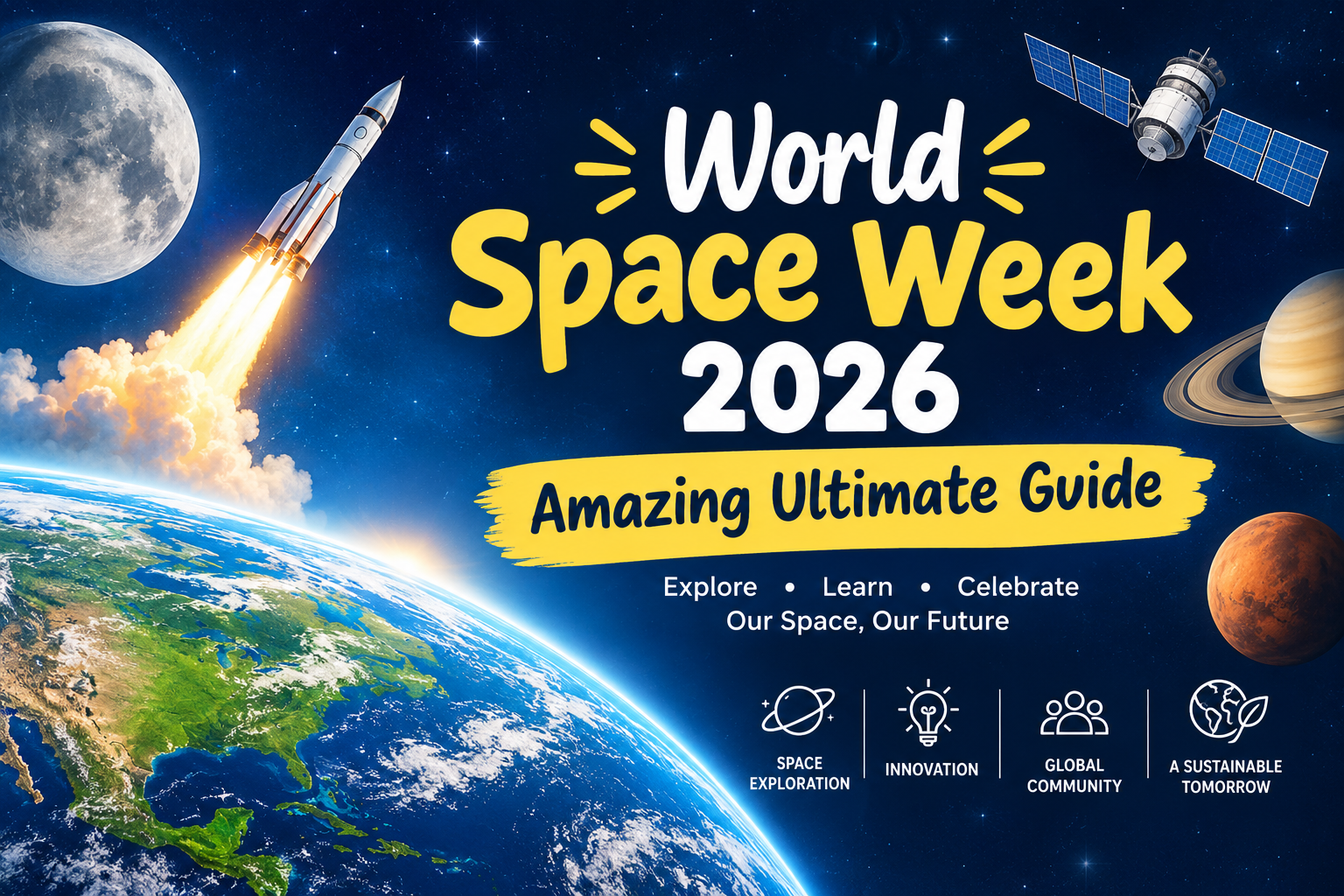
World Space Week 2026 Amazing Ultimate Guide-Have you ever looked up at the night sky and wondered how rockets travel into space, how satellites send signals around the world, or what lies beyond the planets we know? These questions are part of what makes space exploration so exciting. World Space Week 2026 gives people everywhere a chance to explore these ideas, learn about new technology, and understand how space science affects everyday life.
World Space Week 2026 takes place from October 4 to October 10, 2026. Its official theme is “Rocket Revolution,” which focuses on how changes in rocket technology are making access to space different from the past. Governments, private companies, researchers, educators, and students all have a role in this changing space landscape.
You do not need to be a scientist to enjoy this global celebration. You can learn about planets, watch a rocket launch, explore images of distant galaxies, or build a simple paper rocket at home. The most important thing is to stay curious and ask questions.
Table of Contents
World Space Week 2026 at a Glance
| Key detail | Information |
|---|---|
| Event | World Space Week 2026 |
| Dates | October 4–10, 2026 |
| Official theme | Rocket Revolution |
| Main purpose | Promote space science, technology, education, and international cooperation |
| Main topics | Rockets, satellites, astronomy, space exploration, and STEM learning |
| Who can participate? | Students, teachers, families, researchers, and space enthusiasts |
| Simple ways to join | Stargazing, science activities, educational videos, and space-themed projects |
World Space Week is an opportunity to connect scientific discoveries with real-life questions. The 2026 theme also encourages people to think about how rocket innovation could change future missions and make space more accessible.
World Space Week 2026 Amazing Ultimate Guide-What Is World Space Week 2026?
World Space Week is an international celebration of space science and technology. The United Nations General Assembly declared the observance in 1999 through Resolution 54/68. It takes place every year from October 4 to October 10, bringing educational activities and public events into one shared period
The dates have an important connection to space history. On October 4, 1957, Sputnik 1 became the first human-made satellite to orbit Earth. This achievement marked a major step in the Space Age. On October 10, 1967, the Outer Space Treaty entered into force, establishing important principles for activities in outer space.
World Space Week helps people understand why space research matters. It also encourages young people to explore science, technology, engineering, and mathematics. These subjects are often grouped under the term STEM.
For example, a student who builds a model rocket learns more than how to make an object fly. The activity can introduce motion, forces, measurement, design, and problem-solving. A family watching the Moon through a telescope may begin asking questions about craters, gravity, and the history of the solar system.
That is the real value of World Space Week 2026. It turns a large scientific subject into something people can explore through simple, enjoyable activities.
What Is the Theme of World Space Week 2026?
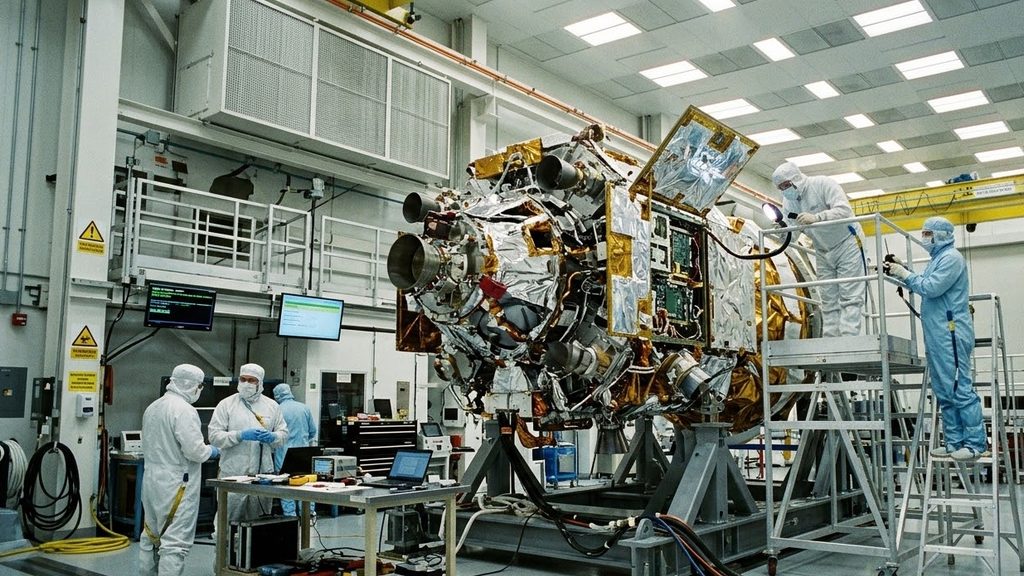
The official theme for World Space Week 2026 is “Rocket Revolution.” It highlights the rapid changes taking place in space launch technology and the growing range of organizations involved in reaching space.
In the early years of the Space Age, launching a satellite required major national resources and highly specialized technology. Today, government space agencies still play an important role, but commercial launch providers, universities, startups, and other organizations are also contributing to space missions.
This change is important because rockets carry more than astronauts. They can place communication satellites, weather instruments, scientific equipment, and Earth-observation technology into orbit. These systems support activities that people depend on every day.
Why Is the Rocket Revolution Important?
A rocket must overcome Earth’s gravity to deliver a payload into space. Engineers need to consider its weight, fuel, engines, structure, guidance systems, and destination. Every design choice can affect the cost and success of a mission.
One major area of development is rocket reusability. Instead of treating every major rocket component as disposable, some systems are designed so that parts can return to Earth and fly again. Reuse is technically challenging, but it may help reduce costs when recovery, refurbishment, and repeated launches work successfully.
Another important change is the growth of smaller satellites. Some modern missions use compact spacecraft to study Earth, test technology, or collect scientific data. Smaller payloads can create new opportunities, although they still need suitable launch services, reliable equipment, and careful planning.
The rocket revolution is not simply about making rockets look more advanced. It is about improving the way people reach space, what missions can be attempted, and how the resulting technology can serve society.
Does Better Rocket Technology Mean Space Is Easy to Reach?
No. Spaceflight remains difficult, expensive, and risky. Launch vehicles must operate under extreme conditions, and even a small technical problem can affect a mission. Engineers also need to consider orbital debris, launch safety, environmental effects, and the long-term operation of satellites.
However, continuing improvements can create more choices for researchers and mission planners. A university may be able to investigate a small satellite mission, for instance, by working with a suitable launch provider rather than developing an entire launch system itself.
World Space Week 2026 encourages people to look at both sides of this progress: the exciting possibilities and the serious engineering challenges.
7 Amazing Space Facts to Explore During World Space Week 2026
Space is full of discoveries that can change the way we see our planet. Here are seven facts that make an excellent starting point for learners of all ages.
1. Earth Is Part of a Huge Solar System
Earth may feel enormous when we travel across its surface, but it is only one of eight recognized planets orbiting the Sun. The solar system also contains moons, dwarf planets, asteroids, comets, and many smaller objects.
The Sun provides most of the energy that supports life on Earth. Its light helps plants grow, influences weather and climate, and provides the natural daylight that shapes our daily routines.
Learning about the solar system also helps explain why planets differ. Mercury has almost no substantial atmosphere, Venus has an extremely hot surface, Earth has liquid water on much of its surface, and Mars preserves evidence of a very different geological history.
A simple World Space Week 2026 activity is to make a scale model of the solar system. Choose a suitable scale, label the planets, and compare their relative sizes and distances. You will quickly discover that a model that fits neatly into a small room cannot accurately represent every distance without compromise.
That is a useful lesson in science: models help us understand complicated subjects, but every model has limits.
2. Satellites Help People on Earth Every Day
When people think about space, they often imagine astronauts floating inside spacecraft. Yet many important space services work without sending people into orbit.
Satellites support weather forecasting, navigation, communication, environmental monitoring, and disaster response. Depending on their design, they can collect images of clouds, measure changes in the atmosphere, or help scientists observe land and oceans.
Consider a severe storm approaching a coastal area. Satellite observations can help meteorologists track cloud systems and improve forecasts. Emergency planners can use this information alongside ground measurements and other data to prepare communities.
Navigation satellites provide another familiar example. Devices and services can use satellite signals to estimate location and support route planning. However, the final accuracy also depends on the receiver, surrounding buildings, signal conditions, and the navigation system being used.
These examples show why space technology is not limited to astronauts or scientific laboratories. It can influence transport, communication, agriculture, research, and public safety.
During World Space Week 2026, try identifying three technologies you use in daily life that may depend on satellite data. You may discover that space is much closer to your everyday routine than you first imagined.
3. The Moon Is Earth’s Natural Satellite
The Moon is the closest natural world to Earth and one of the easiest objects to observe in the night sky. Its appearance changes throughout the month as its position relative to Earth and the Sun changes.
These changing appearances are called lunar phases. They include the new Moon, crescent Moon, first quarter, gibbous Moon, full Moon, and the phases that follow as the cycle repeats.
A common misunderstanding is that the Moon produces its own visible light. In fact, the Moon reflects sunlight. The part we see illuminated depends on the Moon’s position in its orbit around Earth.
The Moon also influences ocean tides through its gravitational pull, working together with the Sun’s influence. The strength and pattern of tides vary with the positions of these bodies and the shape of coastlines.
You can explore the Moon without expensive equipment. Observe it on several clear nights, record its shape, and note the time and direction in which you see it. A pair of binoculars may reveal additional details, but never use binoculars or a telescope to look at the Sun.
A small observation diary is a practical way to turn World Space Week 2026 into a learning experience that continues beyond the event itself.
4. Mars May Help Us Understand the Possibility of Life Beyond Earth
Mars has attracted scientific interest for decades because it preserves signs of a past environment that was different from the cold, dry world we see today. Spacecraft have observed ancient river channels, minerals formed in the presence of water, and other features that help researchers investigate the planet’s history.
Does that mean life once existed on Mars? Not necessarily. Evidence of ancient water does not prove that life developed there. Scientists continue to investigate whether Mars ever had conditions suitable for life and whether any signs of ancient microbial life might remain.
Robotic missions are especially valuable because they can study places that are difficult or dangerous for humans to reach. Rovers examine rocks, collect measurements, and help scientists select areas for further investigation.
Mars exploration also teaches engineers how to design machines that can operate far from Earth. A rover must deal with communication delays, rough ground, dust, temperature changes, and limited power. Even simple actions can require careful planning.
For a World Space Week 2026 project, imagine designing a rover for Mars. What tools would it need? How would it obtain energy? What would it measure first? Explain your choices in a drawing or short presentation.
This activity combines imagination with scientific thinking. It also shows why space exploration requires many different skills, from computer programming and engineering to geology and communication.
5. Stars Are Powerful Natural Laboratories
Stars may look like tiny points of light, but many are enormous spheres of hot gas that produce energy through nuclear fusion. Our Sun is a star, and it provides the light and heat that make life on Earth possible.
Stars also help astronomers understand how the universe changes over time. By studying their light, scientists can estimate properties such as temperature, chemical composition, and motion. Different stars can reveal different stages of stellar development.
Some stars eventually leave behind compact objects such as white dwarfs or neutron stars. The most massive stars can collapse into black holes under suitable conditions. These outcomes depend on factors such as the star’s initial mass and its later evolution.
The elements found in stars and the material released by stellar processes are part of the story of how planets and living systems formed. Many elements important to life were produced through earlier generations of stars and other cosmic processes.
A useful activity is to compare the colours of stars in reliable astronomy photographs. Star colour can provide clues about temperature, although camera settings and image processing can affect the colours shown in pictures.
World Space Week 2026 is a good opportunity to move beyond simply admiring the night sky and begin asking what the light from distant stars can tell us.
6. Space Telescopes Let Us Study Distant Objects
Telescopes help us observe objects that are too faint or distant to study with the naked eye. Space telescopes offer an additional advantage: they can observe from above Earth’s atmosphere, which blocks or distorts some forms of light.
Different telescopes are designed to detect different wavelengths. Some observe visible light, while others study infrared, ultraviolet, X-rays, or other parts of the electromagnetic spectrum.
The James Webb Space Telescope, for example, is designed primarily to observe infrared light. Its observations help researchers study early galaxies, star formation, planetary systems, and the atmospheres of some planets beyond our solar system.
These instruments do more than produce beautiful pictures. Their data can help scientists test ideas about how stars form, how galaxies evolve, and what distant planetary atmospheres contain.
It is also important to understand that many astronomical images are processed to make scientific features easier to examine. Some images combine data from different filters or wavelengths, so their colours may not match what a human eye would see directly.
For an educational project, choose one published telescope image and investigate three things: what object it shows, which instrument captured it, and what scientists learned from the observation. Use the original science source rather than relying only on a social media caption.
7. Space Exploration Depends on Teamwork
A successful space mission is rarely the work of one person. It usually depends on engineers, scientists, software developers, technicians, mission planners, safety specialists, and many other professionals.
Imagine sending a small research spacecraft to study an asteroid. Engineers must design the spacecraft, scientists must decide what measurements matter, programmers must develop reliable software, and mission controllers must plan how to communicate with the vehicle. Specialists also need to understand the target and interpret the data returned.
International cooperation can make these missions more valuable. Different organizations may contribute instruments, technical knowledge, launch services, research facilities, or scientific expertise.
Teamwork also matters in small educational projects. A classroom group can divide responsibilities between researching planets, drawing a mission design, checking facts, and presenting findings. Everyone contributes to the final result.
One important lesson is that space science is not only for people who build rockets. It also needs clear writers, designers, educators, mathematicians, project managers, and people who can explain complicated ideas in simple language.
World Space Week 2026 provides an opportunity to show young learners that curiosity can lead to many different careers. The first step might be a simple question about the Moon, followed by a science project, a new skill, or a lifelong interest in discovery.
How to Celebrate World Space Week 2026
You do not need a large budget, a telescope, or a special location to take part. The best activity is one that helps you learn something new and share it with others.
Organize a Space Science Activity at School
Teachers can use World Space Week 2026 to connect classroom lessons with real discoveries. A short presentation about rockets can introduce forces and motion, while a lesson about satellites can explain orbits, communication, and Earth observation.
Students can work in small teams to create a solar system model, prepare a poster about a space mission, or explain how a satellite helps monitor weather. Older students might compare launch systems or investigate the engineering challenges of reusable rockets.
A good project should ask students to explain what they learned rather than simply copy facts. For example, instead of making a poster that only names the planets, students could explain why the planets have different temperatures or why their distances from the Sun matter.
Schools can also invite a science educator or astronomy enthusiast to speak about research and careers. If a live speaker is not available, a recorded educational talk from a reliable science organization can be a useful alternative.
Try Stargazing With Family or Friends
Stargazing is one of the simplest ways to enjoy space science. Choose a safe location with a clear view of the sky, allow your eyes time to adjust to the darkness, and begin by identifying bright objects.
A free astronomy app or a printed sky chart may help you identify constellations and planets. Check the date and location settings before using an app, since the objects visible in the sky change with time and place.
You do not need to recognize everything. Start with one object and learn a few facts about it. On another evening, try finding something new.
If the sky is cloudy, you can still participate by using a virtual planetarium, examining astronomical images, or watching a recorded telescope observation.
Build a Simple Paper Rocket
A paper rocket is a useful introduction to design and testing. Use paper, a straw, and tape to make a small model that can be propelled by air from a straw. Keep the design simple and use only safe, lightweight materials.
Before launching, ask participants to predict how changing the rocket’s shape or fin size might affect its flight. Test one change at a time and record the results.
This is not a model of a real rocket in every detail. However, it introduces the scientific process: make a prediction, perform a test, observe the result, and improve the design.
Keep the activity supervised, aim only at an open and safe area, and never launch objects toward people, animals, roads, or buildings. Avoid compressed-gas devices, fire, homemade fuels, and other hazardous propulsion methods.
The main goal is to understand how testing and design work together.
Watch a Space Mission or Science Documentary
A good space documentary can help explain the people, machines, and scientific questions behind a mission. Choose material from a space agency, university, planetarium, or trusted science educator.
Instead of watching passively, write down three questions before you begin. For example, you might ask how the spacecraft travels, how it sends information to Earth, and what scientists hope to discover.
After watching, summarize the answers in your own words. This simple approach makes the experience more useful for students and adults alike.
For World Space Week 2026, you could focus on rocket development, satellite technology, lunar exploration, Mars missions, or the search for planets beyond our solar system.
Share One Space Fact Every Day
A simple way to celebrate the week is to learn and share one reliable space fact each day from October 4 to October 10.
You could explore a different subject each day: space history, rockets, the Moon, satellites, Mars, telescopes, and future exploration. Share your findings through a classroom display, a family discussion, a short blog post, or a social media update.
Check the information before publishing it. A striking image or exciting headline is not always accurate, and some space claims circulating online are exaggerated or outdated.
If you use a photograph, verify its source and licence. Credit the creator when required, and do not assume every image found online is free to reuse.
A small daily learning habit can be more valuable than trying to cover every subject at once.
How Rocket Technology Is Changing Space Exploration
Rocket technology is central to the 2026 theme because a launch vehicle determines how a spacecraft begins its journey beyond Earth. The rocket must produce enough thrust to overcome gravity and accelerate its payload to the required speed and trajectory.
However, reaching space is only the beginning. A mission may need to place a satellite into a specific orbit, send a probe toward another planet, or carry supplies to a space station. Each task requires a different combination of performance, precision, reliability, and cost.
Reusable Rockets and Their Potential Benefits
Traditional launch systems often discard major components after use. Reusable systems aim to recover and fly certain components again. Depending on the rocket design, this may involve returning a booster to a landing site or recovering hardware after a flight.
Reuse can potentially reduce the cost of launching future payloads. Yet it is not automatically cheaper in every situation. Recovery systems, inspections, refurbishment, and testing all require time and resources.
The wider benefit depends on how reliably a vehicle can fly again and how much work is needed between launches. Engineers must balance these practical questions with safety and performance.
Reusable technology is one reason the rocket revolution is an interesting subject for students. It shows how a design problem can involve physics, materials, software, economics, and environmental considerations at the same time.
Small Satellites and New Research Opportunities
Small satellites have opened new possibilities for universities, research teams, and companies. They can be used to test instruments, study Earth’s environment, demonstrate communication systems, or investigate new spacecraft technology.
Their smaller size does not mean that every mission is simple. Designers must work within strict limits on mass, power, communications, and available space. A small satellite also needs a suitable orbit and a reliable way to send its data back to Earth.
For students, small-satellite missions offer a practical way to learn about systems engineering. A project might begin with a simple question, such as how to measure temperature in orbit, and then develop into a design involving sensors, power supplies, data storage, and communications.
This is a useful lesson from World Space Week 2026: major scientific progress often begins with a focused question and a carefully tested solution.
Why Space Science Matters in Everyday Life
Space research may seem far removed from daily routines, but its applications are often surprisingly familiar. Satellite services and scientific measurements can support weather forecasting, transport, agriculture, environmental research, and emergency planning.
Weather Forecasting and Environmental Monitoring
Weather satellites observe cloud patterns and other features of Earth’s atmosphere. Their measurements help forecasters understand developing weather systems and track changes over large areas.
Earth-observation satellites can also collect information about vegetation, water, land use, and environmental change. Researchers may compare observations over time to study drought, flooding, coastal changes, or the effects of natural disasters.
These measurements do not replace ground observations. Instead, they provide another source of evidence that can help scientists build a fuller picture of what is happening.
Navigation and Communication
Navigation systems use satellite signals to help receivers estimate their position. This technology supports many activities, from finding a destination to coordinating transport and tracking equipment.
Communication satellites can relay information over long distances, including to places where ground-based networks are limited. Their usefulness depends on factors such as coverage, available capacity, equipment, and the type of service being provided.
These examples demonstrate why space technology is not only about exploring distant worlds. It can also improve our understanding of Earth and support services that connect people across great distances.
Space Research and New Skills
The development of space systems requires knowledge in many fields. Students who explore astronomy may become interested in physics, coding, mathematics, electronics, robotics, or scientific communication.
These skills can also be useful beyond the space sector. Learning to analyze data, test an idea, solve a technical problem, and explain a result can support work in many industries.
World Space Week 2026 can therefore be a starting point for learning that continues throughout the year.
A Simple Seven-Day World Space Week 2026 Learning Plan
The following plan is suitable for individuals, families, clubs, and classrooms. You can adjust the activities to fit your time, available equipment, and level of experience.
| Date | Suggested topic | Practical activity |
|---|---|---|
| October 4 | Space history | Learn about Sputnik 1 and the beginning of the Space Age |
| October 5 | Rockets | Build and test a safe paper rocket |
| October 6 | Satellites | Explain how satellites support one everyday service |
| October 7 | The Moon | Record the Moon’s appearance or explore a lunar map |
| October 8 | Mars and planets | Design a fictional planetary exploration mission |
| October 9 | Space telescopes | Study an image from a reliable astronomy source |
| October 10 | The future of space | Present one idea for a useful future space mission |
These are suggested activities, not an official daily schedule. You can change the order to suit your interests.
How to Get More From Each Activity
At the start of each activity, write down one question you want to answer. During the activity, record observations or useful information. At the end, explain what you learned and identify any question that remains unanswered.
This three-step process makes learning more active. It also helps children and adults distinguish between a prediction, an observation, and a conclusion.
For example, a paper rocket might travel farther after you change its shape. That observation does not automatically prove the shape was the only cause. You may need to repeat the test while keeping other conditions as similar as possible.
This is the kind of careful thinking that supports real scientific work.
Common Mistakes to Avoid During World Space Week 2026
One common mistake is assuming that space science requires expensive equipment. In reality, many useful activities need only paper, a pencil, a clear sky, or access to reliable educational material.
Another mistake is sharing dramatic but unverified claims. Space discoveries often involve uncertainty, and early reports can change as scientists collect more evidence. Check official mission updates and established research sources before presenting a claim as fact.
It is also easy to focus only on astronauts and forget the technology that supports uncrewed missions. Robotic spacecraft, satellites, landers, and telescopes contribute greatly to scientific research without carrying people.
Finally, avoid treating every activity as a competition. A successful learning experience does not require the biggest model, the most advanced telescope, or the most impressive presentation. A clear explanation of one scientific idea can be just as valuable.
World Space Week 2026 is about making space science more accessible and encouraging people to keep asking questions.
Frequently Asked Questions About World Space Week 2026
When is World Space Week 2026?
World Space Week 2026 takes place from October 4 to October 10, 2026. It is an annual international celebration of space science and technology.
What is the official theme of World Space Week 2026?
The official theme is “Rocket Revolution.” It explores how developments in launch technology are changing access to space and creating opportunities for new missions and organizations.
Who can participate in World Space Week 2026?
Anyone interested in space can participate. Students, teachers, families, researchers, astronomy clubs, and other interested people can organize or join educational activities.
Why is World Space Week celebrated?
World Space Week promotes awareness of space science and technology, encourages science education, inspires young people, and supports international cooperation in space-related activities.
How can I celebrate World Space Week at home?
You can observe the night sky, learn about planets, build a safe paper rocket, watch an educational space documentary, or explore images from space telescopes. You can also share what you learn with friends and family.
Why are rockets important for space exploration?
Rockets carry satellites, scientific instruments, supplies, and spacecraft beyond Earth’s atmosphere. Improvements in launch technology may create new opportunities for research, communication, navigation, and planetary exploration.
Is World Space Week only for science students?
No. World Space Week is open to people with different backgrounds and levels of knowledge. You can participate through simple activities, educational videos, discussions, or astronomy observations without having advanced scientific training.
Conclusion: Make World Space Week 2026 a Learning Opportunity
World Space Week 2026 is an opportunity to explore the science, technology, and ideas that help humanity understand the universe. Its theme, “Rocket Revolution,” draws attention to changes in launch technology and the growing range of people and organizations contributing to space exploration.
From rockets and satellites to the Moon, Mars, distant stars, and powerful telescopes, space offers countless opportunities to learn. These subjects also connect with everyday life through navigation, communication, weather forecasting, and environmental monitoring.
You do not have to be an astronaut or a professional scientist to take part. Choose one activity, ask a question, investigate the answer, and share what you discover. If you are a teacher, introduce a simple space project. If you are a parent, explore the night sky with your children. If you enjoy writing, publish a clear and carefully researched explanation of a space topic.
The most valuable outcome is not simply remembering a list of facts. It is developing the habit of asking questions and looking for reliable answers.
Start with one small discovery during World Space Week 2026, and let your curiosity take you further.
How to Make World Space Week 2026 More Interesting for Everyone
World Space Week 2026 is a great opportunity to make space science interesting for people of all ages. You do not need a telescope, expensive equipment, or advanced scientific knowledge to take part. Simple activities, educational videos, group discussions, and small science projects can help people understand space in an enjoyable way.
The theme, “Rocket Revolution,” makes this year especially suitable for learning about rockets, satellite launches, reusable launch vehicles, and the future of space travel. Schools, colleges, families, science clubs, and online communities can all find creative ways to celebrate World Space Week 2026.
World Space Week 2026 Activities for Schools and Colleges
Schools can celebrate World Space Week 2026 by arranging activities that combine learning with creativity. Instead of limiting the celebration to speeches, teachers can encourage students to explore scientific ideas through practical demonstrations, teamwork, and research.
A space quiz is one easy activity to organize. Questions can cover the planets, the Moon, Indian space missions, famous astronauts, satellites, and rocket technology. Students can participate individually or in teams, making the event educational and enjoyable.
Another idea is to arrange a space poster competition. Students can create posters about rocket launches, planetary exploration, protecting Earth through satellite data, or the future of human spaceflight. The posters can be displayed in classrooms, libraries, or school corridors.
Colleges can organize discussions about careers in space science, engineering, astronomy, robotics, and satellite technology. Inviting a scientist, engineering professional, or astronomy enthusiast to speak can help students understand how classroom subjects connect with real space research.
Simple Science Experiments for World Space Week 2026
Practical experiments can make space science easier to understand. Students should always perform experiments under appropriate adult supervision and follow basic safety rules.
One popular demonstration is the balloon rocket experiment. Thread a long piece of string through a drinking straw and tie the string tightly between two stable points. Inflate a balloon without tying its opening, attach it to the straw with tape, and release it. The escaping air pushes the balloon forward along the string.
This experiment demonstrates a basic principle of rocket motion: gases moving backward can push a vehicle forward. However, a balloon is not a rocket engine, and the demonstration does not reproduce the complex conditions of a real rocket launch.
Students can also build paper models of rockets and compare different shapes. They can investigate how fins, nose cones, and mass distribution affect the stability of a paper rocket. If launching models, use only safe, lightweight designs and follow the teacher’s instructions. Never use fire, explosives, pressurized containers, or homemade rocket propellants.
The Role of ISRO in India’s Space Journey
India has developed important capabilities in space research, satellite services, launch vehicles, and planetary exploration. The Indian Space Research Organisation, commonly known as ISRO, has played a major role in this journey.
India’s space programme supports communication, weather forecasting, disaster management, navigation, agriculture, and scientific research. These services show that space technology is not limited to astronauts and distant planets. It also helps solve problems here on Earth.
Chandrayaan-3 was an important milestone for India. In August 2023, its lander successfully touched down near the Moon’s south polar region, and the Pragyan rover carried out surface experiments. The mission helped advance India’s lunar exploration programme and encouraged greater interest in space science.
The Mars Orbiter Mission, also known as Mangalyaan, demonstrated India’s ability to send a spacecraft to Mars. Launched in 2013, it entered Mars orbit in 2014. The mission became an important achievement in India’s space exploration history.
During World Space Week 2026, students can learn about these missions and discuss what they reveal about scientific planning, engineering, teamwork, and the challenges of exploring other worlds.
How Satellites Help People in Everyday Life
Satellites are among the most useful products of space technology. Although many satellites operate far above Earth, their services influence everyday activities around the world.
Weather satellites help scientists observe clouds, storms, and other atmospheric conditions. Their observations support weather forecasting and help authorities prepare for certain natural hazards.
Communication satellites can help deliver television broadcasts, telephone connections, and internet services, particularly where ground-based networks are limited. Navigation satellite systems help compatible devices calculate locations and support transport, mapping, and logistics.
Earth observation satellites collect information about land, oceans, forests, water resources, and changing environmental conditions. Scientists and public agencies can use this information to monitor floods, droughts, crop conditions, and other developments.
World Space Week 2026 is a useful time to explore these applications. Understanding satellite technology helps explain why investment in space research can have benefits beyond scientific discovery.
Why Rocket Technology Matters for the Future
Rocket technology is essential because spacecraft need enough speed to overcome Earth’s gravity and reach their intended destinations. Rockets carry satellites into orbit and send robotic spacecraft toward the Moon, Mars, and other targets.
The process requires careful calculations, reliable engines, lightweight structures, guidance systems, and extensive testing. A launch vehicle must generate enough thrust to lift its payload while managing fuel use, heat, vibration, and changing conditions during flight.
Reusable rockets are one important development in launch technology. Some rocket systems are designed so that parts of the vehicle can return and be used again after suitable inspection and refurbishment. Reuse can reduce certain launch costs, although the overall savings depend on the vehicle, its maintenance needs, and how frequently it flies.
The “Rocket Revolution” theme of World Space Week 2026 offers a chance to discuss these developments without assuming that every new rocket design is automatically cheaper, safer, or more environmentally friendly. Scientific progress depends on testing, evidence, and careful evaluation.
How to Celebrate World Space Week 2026 at Home
Families can celebrate World Space Week 2026 without spending much money. A simple activity each day can help children and adults learn more about the universe.
Choose one evening to observe the Moon, if weather and visibility allow. Use a reliable astronomy application or sky guide to identify visible planets and constellations. Never look directly at the Sun through binoculars, a telescope, or any optical device without suitable certified solar equipment.
Families can also watch an educational documentary, read a book about the solar system, or create a wall chart showing the planets in order. Younger children may enjoy drawing astronauts and spacecraft, while older students can research a space mission and explain its scientific purpose.
Another helpful activity is to discuss how space technology affects daily life. Try identifying the ways satellites support weather reports, navigation, communication, or environmental monitoring. This can turn an ordinary family conversation into a useful science lesson.
Common Myths About Space Exploration
Space exploration is exciting, but popular explanations sometimes create misunderstandings. World Space Week 2026 is an opportunity to separate scientific facts from common myths.
One common misconception is that there is no gravity in space. Gravity exists throughout space. Astronauts aboard the International Space Station appear weightless mainly because the station and its occupants are continuously falling around Earth together.
Another misconception is that the seasons happen because Earth moves much closer to or farther from the Sun. Earth’s seasons are mainly caused by the tilt of its rotational axis. As Earth travels around the Sun, different regions receive different angles and durations of sunlight.
People may also assume that every planet could support human life if the right technology were available. In reality, planets have very different temperatures, atmospheres, pressures, and surface conditions. Human missions beyond Earth require extensive life-support systems and careful planning.
Learning the evidence behind these facts makes space science more reliable and interesting. It also encourages people to ask questions instead of accepting every claim they see online.
World Space Week 2026 and the Importance of Scientific Thinking
Space exploration shows why scientific thinking matters. A spacecraft mission is not successful simply because someone has an exciting idea. Engineers and scientists must test equipment, calculate risks, analyze data, and prepare for unexpected problems.
Scientific thinking also means accepting that knowledge can change when new evidence becomes available. Space missions often reveal results that lead researchers to revise earlier explanations or ask new questions.
Students can practise this approach by choosing a space-related question, finding trustworthy sources, comparing the evidence, and explaining what they learned in their own words. Official space agency websites, scientific institutions, and educational resources are good starting points.
For anyone creating an article about World Space Week 2026, this is also an important principle: use verified dates, accurate mission information, and trustworthy references. Avoid presenting unconfirmed announcements or speculative discoveries as established facts.
Frequently Asked Questions About World Space Week 2026
When is World Space Week 2026 celebrated?
World Space Week 2026 is celebrated from October 4 to October 10. It is an annual international observance dedicated to space science, technology, and their contributions to society.
What is the theme of World Space Week 2026?
The official theme for World Space Week 2026 is “Rocket Revolution.” It highlights rockets and launch technology and provides a starting point for learning about access to space and future exploration.
Who can participate in World Space Week 2026?
Anyone can participate, including students, teachers, families, scientists, engineers, astronomy clubs, colleges, and interested members of the public. Activities can range from reading about space to organizing educational events.
How can students celebrate World Space Week 2026?
Students can participate in space quizzes, poster competitions, science demonstrations, astronomy observations, and presentations about space missions. They can also research satellites, rocket technology, and careers in space science.
Why is World Space Week important?
World Space Week helps people understand the scientific, technological, educational, and practical importance of space exploration. It encourages curiosity and highlights how space technology supports life on Earth.
How is ISRO connected to World Space Week 2026?
ISRO provides an excellent example of India’s contributions to space research and technology. Students can explore its satellite programmes, launch vehicles, and missions such as Chandrayaan-3 and the Mars Orbiter Mission as part of their World Space Week learning.
What does the Rocket Revolution theme mean?
The theme encourages people to explore the technology that launches spacecraft and satellites. Topics include rocket engines, launch vehicles, reusable rocket systems, and the engineering challenges of sending payloads into space.
Can World Space Week 2026 be celebrated online?
Yes. People can share educational presentations, attend online talks, watch space agency videos, participate in virtual quizzes, and publish articles about space science. Online activities can help reach people who cannot attend events in person.
Final Conclusion: Make World Space Week 2026 a Week of Discovery
World Space Week 2026 is more than a celebration of rockets and spacecraft. It is an opportunity to understand the universe, appreciate scientific progress, and explore how space technology supports everyday life.
The “Rocket Revolution” theme encourages people to learn about launch vehicles, satellite missions, reusable rockets, and the engineering behind space exploration. It also creates opportunities for students to ask questions, build simple models, and consider careers in science and technology.
You do not need to be a scientist to take part. Reading about a space mission, observing the night sky, creating a school project, or sharing a reliable educational resource can make the week meaningful.
By celebrating World Space Week 2026 with curiosity and accurate information, we can encourage more people to explore science and think about the future of space exploration.
REFRANCE-World Space Week 2026 Amazing Ultimate GuideWorld Space Week 2026 Amazing Ultimate Guide World Space Week 2026 Amazing Ultimate Guide World Space Week 2026 Amazing Ultimate Guide World Space Week 2026 Amazing Ultimate Guide World Space Week 2026 Amazing Ultimate Guide World Space Week 2026 Amazing Ultimate Guide World Space Week 2026 Amazing Ultimate Guide World Space Week 2026 Amazing Ultimate Guide World Space Week 2026 Amazing Ultimate Guide
World Space Week 2026 Amazing Ultimate Guide World Space Week 2026 Amazing Ultimate Guide World Space Week 2026 Amazing Ultimate Guide World Space Week 2026 Amazing Ultimate Guide World Space Week 2026 Amazing Ultimate Guide World Space Week 2026 Amazing Ultimate Guide World Space Week 2026 Amazing Ultimate Guide World Space Week 2026 Amazing Ultimate Guide World Space Week 2026 Amazing Ultimate Guide World Space Week 2026 Amazing Ultimate Guide World Space Week 2026 Amazing Ultimate Guide World Space Week 2026 Amazing Ultimate Guide World Space Week 2026 Amazing Ultimate Guide World Space Week 2026 Amazing Ultimate Guide World Space Week 2026 Amazing Ultimate Guide
World Space Week 2026 Amazing Ultimate Guide World Space Week 2026 Amazing Ultimate Guide World Space Week 2026 Amazing Ultimate Guide World Space Week 2026 Amazing Ultimate Guide World Space Week 2026 Amazing Ultimate Guide World Space Week 2026 Amazing Ultimate Guide World Space Week 2026 Amazing Ultimate Guide World Space Week 2026 Amazing Ultimate Guide World Space Week 2026 Amazing Ultimate Guide World Space Week 2026 Amazing Ultimate Guide World Space Week 2026 Amazing Ultimate Guide World Space Week 2026 Amazing Ultimate Guide World Space Week 2026 Amazing Ultimate Guide World Space Week 2026 Amazing Ultimate Guide World Space Week 2026 Amazing Ultimate Guide
World Space Week 2026 Amazing Ultimate Guide World Space Week 2026 Amazing Ultimate Guide World Space Week 2026 Amazing Ultimate Guide World Space Week 2026 Amazing Ultimate Guide World Space Week 2026 Amazing Ultimate Guide World Space Week 2026 Amazing Ultimate Guide World Space Week 2026 Amazing Ultimate Guide World Space Week 2026 Amazing Ultimate Guide World Space Week 2026 Amazing Ultimate Guide World Space Week 2026 Amazing Ultimate Guide World Space Week 2026 Amazing Ultimate Guide World Space Week 2026 Amazing Ultimate Guide
World Space Week 2026 Amazing Ultimate Guide World Space Week 2026 Amazing Ultimate Guide World Space Week 2026 Amazing Ultimate Guide World Space Week 2026 Amazing Ultimate Guide World Space Week 2026 Amazing Ultimate Guide World Space Week 2026 Amazing Ultimate Guide World Space Week 2026 Amazing Ultimate Guide World Space Week 2026 Amazing Ultimate Guide
World Space Week 2026 Amazing Ultimate Guide World Space Week 2026 Amazing Ultimate Guide World Space Week 2026 Amazing Ultimate Guide World Space Week 2026 Amazing Ultimate Guide World Space Week 2026 Amazing Ultimate Guide World Space Week 2026 Amazing Ultimate Guide World Space Week 2026 Amazing Ultimate Guide World Space Week 2026 Amazing Ultimate Guide World Space Week 2026 Amazing Ultimate Guide World Space Week 2026 Amazing Ultimate Guide World Space Week 2026 Amazing Ultimate Guide World Space Week 2026 Amazing Ultimate Guide World Space Week 2026 Amazing Ultimate Guide