
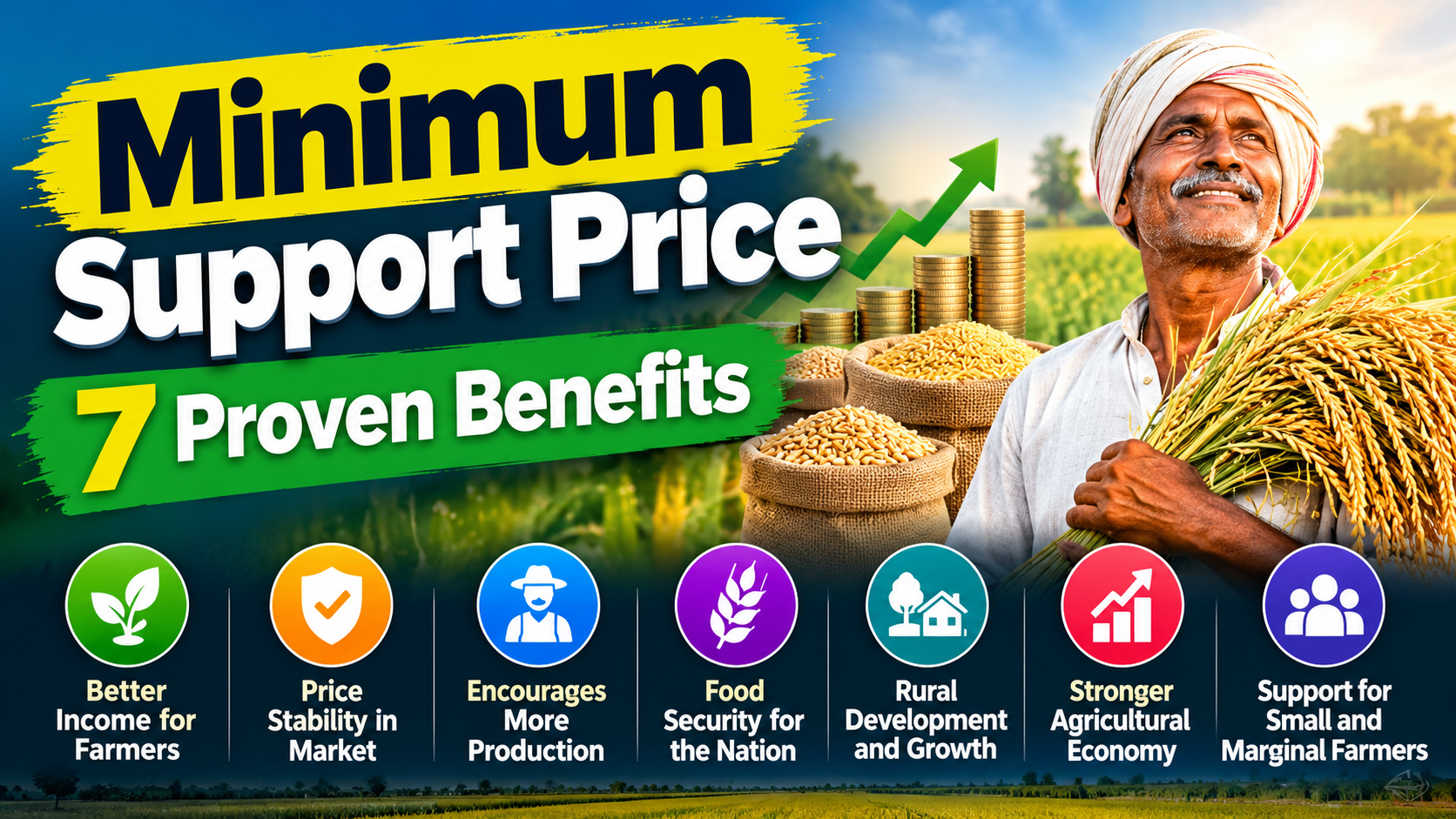
Minimum Support Price 7 Proven Benefits Minimum Support Price can play an important role in protecting farmers from sudden changes in crop prices. Imagine a farmer who spends months preparing the soil, buying seeds, arranging water, and caring for crops. After all that hard work, the harvest is finally ready. However, when the farmer reaches the market, there may be more crops available than buyers need. Prices can fall sharply, leaving the farmer with less money than expected.
This is one of the major challenges in agriculture. Farmers often make production decisions long before they know the final selling price. Weather, market demand, transport costs, storage facilities, and changing trade conditions can all affect their earnings. Minimum Support Price is one policy approach designed to reduce some of this uncertainty by establishing a support price for eligible agricultural products.
However, a support price does not automatically guarantee that every farmer will receive that amount. The actual benefit depends on how the policy operates, which crops are covered, whether purchasing arrangements are available, and how easily farmers can access them. Understanding these details helps farmers, consumers, students, business owners, and policymakers see both the advantages and limitations of this system.
In this guide, we will explore seven important benefits of Minimum Support Price, examine practical examples, explain its limitations, and discuss how a well-designed support system can contribute to a more stable agricultural economy.
Table of Contents
Quick Summary: Why Minimum Support Price Matters
Minimum Support Price is a government price-support mechanism intended to protect eligible agricultural producers against very low market prices. Its effectiveness depends on how the system is designed and implemented.
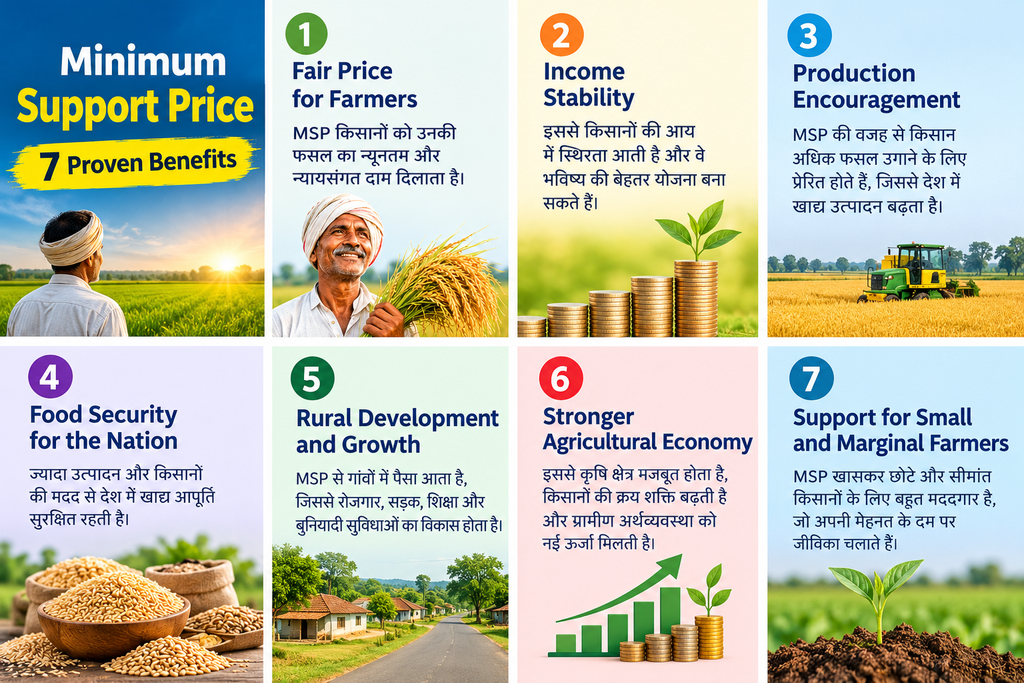
The seven main benefits are:
- Income protection: Helps reduce the risk of selling eligible crops at extremely low prices.
- Better planning: Gives farmers a reference point when making production decisions.
- Access to credit: A more predictable income outlook may help farmers plan borrowing and repayments.
- Food security: Can support the production and procurement of essential crops.
- Rural economic activity: More stable farm earnings can support spending in rural communities.
- Market confidence: Reduces some uncertainty about crop prices.
- Agricultural development: Can support investment in farming when combined with effective infrastructure and other policies.
The key point is that announcing a support price is not the same as guaranteeing that every farmer can sell every unit of produce at that price. Procurement, market access, crop coverage, storage, and transparent implementation all matter.
Minimum Support Price 7 Proven Benefits-What Is Minimum Support Price?
Minimum Support Price is a price-support policy through which a government establishes a minimum reference or support price for selected agricultural products. Depending on the country and the policy design, the government may purchase eligible produce, support prices through other mechanisms, or combine different forms of assistance.
The main purpose is to reduce the risk that farmers will receive very low prices during periods of excess supply or weak demand. Agricultural production differs from many other businesses because farmers often cannot quickly stop producing when market prices fall. Seeds have already been planted, resources have already been used, and crops must be harvested at the right time.
For example, imagine a farmer who expects to sell a crop for 100 monetary units per bag. After harvesting, a sudden increase in supply pushes the market price down to 65 units. The farmer may struggle to recover production costs. A well-designed support-price policy can help reduce this risk if the farmer and crop qualify and an effective mechanism exists to deliver the support.
However, the exact meaning of Minimum Support Price varies between countries. Some systems use government purchasing, while others rely on different agricultural price-support arrangements. Therefore, readers should check the rules that apply in their own location rather than assuming that every support-price announcement works in the same way.
The World Trade Organization also discusses market price support in its agricultural policy framework. Its explanation shows why the design of these programmes matters for both domestic agriculture and international trade. Read the WTO explanation of domestic agricultural support.
7 Proven Benefits of Minimum Support Price
1. Minimum Support Price Can Help Protect Farm Income
One of the most important benefits of Minimum Support Price is the potential to protect farmers from severe price declines. Farming income can change considerably from one season to another. A successful harvest does not always lead to a successful financial outcome because the selling price may fall when many farmers bring the same crop to market.
A support-price policy can reduce some of this uncertainty by establishing a price level that guides eligible sales or government purchasing. When farmers have a reliable way to access the support, they may be better positioned to recover production expenses and plan for the next growing season.
Consider a hypothetical farmer whose total production cost is 70 units per bag. If the market price falls to 60 units, the farmer receives less than the amount spent on production, before considering any additional household or business expenses. If an effective support arrangement allows the farmer to sell eligible produce for 85 units, the financial outcome improves. These figures are illustrative and do not represent an actual government rate.
Nevertheless, the benefit depends on real access. If a farmer cannot reach an authorised purchasing centre, faces strict eligibility conditions, or grows a crop that is not covered, the announced support price may offer little practical protection.
Minimum Support Price should therefore be viewed as one part of farm-income protection, alongside crop insurance, better market information, affordable credit, storage, and access to multiple buyers.
2. It Helps Farmers Make Better Production Decisions
Farmers must often decide what to grow before they know how much their harvest will earn. These decisions involve seed purchases, land preparation, labour, irrigation, fertiliser, machinery, and many other expenses. A sudden fall in crop prices can turn an apparently sensible decision into a financial problem.
Minimum Support Price can provide a useful reference point when farmers compare the possible returns from different crops. If the support policy is credible and the farmer can access it, the expected price may help inform decisions about planting, input use, and production costs.
For example, imagine that a farmer is choosing between two crops. One crop has a potentially high market return but also has highly unpredictable prices. The other has a more dependable support arrangement. The farmer may compare the expected revenue, cost of production, water requirements, growing period, and risks before deciding which crop is more suitable.
However, the support price should not be the only factor in this decision. A crop can still produce a loss if yields are poor, input costs rise, or the support system is difficult to access. Similarly, a high support price does not automatically make a crop suitable for every region.
Good agricultural planning requires farmers to consider soil quality, local weather, available water, market demand, and the cost of production. Minimum Support Price is most useful when it provides dependable information without replacing careful financial and agricultural planning.
3. It May Improve Access to Credit and Financial Planning

Farming often requires money long before any income arrives. Farmers may need to pay for seeds, fertilisers, equipment, irrigation, hired labour, transport, and repairs. In many cases, they must manage these expenses for months before receiving payment for their crops.
Minimum Support Price may help with financial planning by giving farmers a reference price for eligible produce. When purchasing arrangements are dependable, farmers can make more informed estimates of their possible revenue. This information may help them prepare a budget, compare borrowing options, and plan how to repay a loan after harvest.
Imagine a farmer preparing a seasonal budget. The farmer estimates the likely harvest, calculates production costs, and considers several possible selling prices. A credible support arrangement provides another reference point for this calculation. The farmer can then assess whether the expected income is sufficient to cover expenses and repay borrowing.
However, an announced support price does not guarantee loan approval or repayment. Banks and other lenders may also examine land records, existing debt, credit history, repayment capacity, and other financial information. Crop failure, delayed payments, and unexpected expenses can still create difficulties.
For this reason, Minimum Support Price works best as one input in a wider financial plan. Farmers should use conservative revenue estimates, keep records of production costs, and avoid borrowing on the assumption that a particular selling price is certain. Reliable payment systems and accessible financial services are just as important as the price announcement itself.
4. It Can Support Food Security

Food security means that people have reliable access to sufficient, safe, and nutritious food. Agricultural price-support policies can contribute to this goal when they encourage the production of essential crops and work alongside effective food procurement, storage, distribution, and nutrition programmes.
Minimum Support Price can help reduce some of the financial uncertainty faced by farmers who grow important food crops. If the policy makes production more predictable and the supported crops meet actual demand, it may encourage continued investment in food production.
For example, consider a region that depends on grain production for its food supply. Farmers face changing input costs, unpredictable weather, and fluctuating market prices. A dependable support arrangement may help eligible farmers plan their next season with greater confidence. When combined with suitable storage and distribution systems, this can contribute to a more reliable food supply.
However, price support alone cannot guarantee food security. A country may produce enough food but still have households that cannot afford it. Poor roads, food waste, unequal access to markets, inadequate storage, and distribution problems can also affect availability and affordability.
There is another important consideration: governments need to balance the interests of producers and consumers. If a policy raises the cost of food without suitable safeguards, lower-income households may face additional pressure on their budgets.
Therefore, an effective Minimum Support Price system should be connected to wider food policies. These may include better storage, reduced post-harvest losses, efficient transport, targeted food assistance, and support for nutritious crop production.
The objective should be to create a food system that supports farmers while ensuring that consumers can access food at reasonable prices.
5. It Can Strengthen Rural Economies

Agriculture supports more than the people who grow crops. It also creates demand for transport, machinery, repair services, storage, packaging, wholesale trading, food processing, and many other activities.
When farmers earn a more dependable income, they may be better able to pay workers, purchase farming supplies, repair equipment, and meet household expenses. Some of this money circulates through local businesses, supporting economic activity beyond the farm itself.
For example, imagine a farming community where many households depend on a seasonal harvest. If farmers receive better prices for eligible crops and are paid on time, local shops, transport operators, equipment suppliers, and service providers may benefit from increased spending. The effect can extend throughout the community.
Minimum Support Price may contribute to this process when the support reaches a meaningful number of farmers. However, the size of the benefit depends on how much produce is covered, how payments are distributed, and whether farmers can access the programme.
The policy also has limits. If benefits are concentrated among larger producers or certain regions, smaller farmers and communities growing other crops may receive less support. Higher farm income in one area does not automatically mean that all rural households become financially secure.
To strengthen rural economies, price support should be combined with rural roads, reliable electricity, irrigation, agricultural training, affordable financial services, storage facilities, and opportunities for local processing businesses.
These improvements can help farmers move beyond simply selling raw produce. They can also create jobs, reduce avoidable losses, and improve the ability of rural businesses to serve customers throughout the year.
6. It Can Improve Confidence in Agricultural Markets

Agricultural markets can be difficult to predict. Prices may change because of weather conditions, harvest sizes, transportation costs, international trade, consumer demand, or changes in the availability of competing products.
Farmers who have limited access to market information may be particularly vulnerable. They may have to sell quickly because they need cash, lack storage, or cannot afford to transport their produce elsewhere. Under these conditions, they may have little bargaining power.
Minimum Support Price can improve market confidence by providing a known reference price for eligible crops. Where the support is credible and accessible, farmers can compare private offers with the available support arrangement and make a more informed selling decision.
For instance, a farmer who receives a low offer from a local trader may compare it with the relevant support price and investigate whether an eligible purchasing option is available. This can improve the farmer’s understanding of the market and the choices available.
Still, a reference price is not a substitute for competition or accurate market information. Farmers also need to know the quality requirements, transport expenses, payment timelines, and conditions attached to each selling option.
An effective market system should provide clear price information, transparent weighing, reliable quality assessment, and accessible complaint procedures. Multiple buyers can also improve competition by giving producers more opportunities to sell.
Minimum Support Price is therefore most useful when it strengthens farmers’ choices rather than leaving them dependent on a single purchasing channel. Better information and greater market access can help turn a price announcement into a practical advantage.
7. It Can Encourage Long-Term Agricultural Development

Agricultural development requires investment over many seasons. Farmers may need to improve irrigation, purchase better equipment, adopt suitable seeds, protect soil health, and learn new cultivation methods. These decisions often involve costs today in exchange for benefits in the future.
Minimum Support Price can support long-term development when it reduces some of the uncertainty surrounding eligible crop sales. A farmer who has greater confidence in the potential return may be more willing to plan production carefully and invest in improvements.
For example, a farmer considering a more efficient irrigation system may compare the cost of installation with the expected benefits over several years. More predictable farm revenue can make this decision easier to evaluate, although it does not guarantee that the investment will be profitable.
The design of the policy is important. If support consistently favours a narrow range of crops, farmers may have less incentive to explore other crops even when local conditions would support diversification. This can create problems if the supported crops require excessive water, damage soil quality, or produce more supply than the market needs.
A stronger agricultural strategy should connect price support with research, farmer training, improved seeds, efficient water use, soil conservation, crop diversification, and access to new markets.
Governments should also review support arrangements as production costs, consumer needs, technology, and environmental conditions change. Policies that worked well in one period may require adjustments later.
The ultimate objective should not be to keep every farmer dependent on a government price. It should be to build an agricultural sector that is productive, resilient, environmentally responsible, and capable of providing dependable livelihoods.
How Minimum Support Price Works in Practice
The details differ between countries, but a price-support system generally involves several important steps.
Setting the Support Price
The responsible authority assesses factors such as production costs, market conditions, expected supply, demand, and wider agricultural objectives. It then announces or establishes a support price under the relevant policy.
The method used to determine that price can significantly affect its usefulness. If production costs rise rapidly but the support price does not adjust appropriately, the real protection offered to farmers may weaken.
Establishing Eligibility
The policy specifies which crops, producers, qualities, quantities, and selling periods qualify for support. These conditions matter because not every crop or farmer necessarily receives the same treatment.
Farmers need clear information about documentation, quality standards, delivery locations, deadlines, and any registration requirements.
Arranging Purchasing or Other Support
Depending on the system, eligible produce may be purchased by a government agency or supported through another policy mechanism. An announced price is only as useful as the process that makes the support available.
If purchasing centres are too far away, have limited capacity, or experience delays, farmers may struggle to benefit. Efficient administration and accessible markets are essential.
Making Payments and Monitoring Results
Farmers need accurate weighing, transparent records, and payments within a reasonable period. Authorities should monitor whether the programme reaches its intended beneficiaries and whether the outcomes justify the costs.
Monitoring should also consider unintended effects, such as excess production, storage pressure, environmental damage, and higher costs for consumers.
A successful policy is not measured only by the announced price. It must also be evaluated by the support farmers actually receive and the wider effects on agriculture and society.
Minimum Support Price Example: A Simple Case Study
Consider a fictional farmer named Alex who grows a crop on a small farm. The example is designed to explain the economics of price support; it does not represent an actual farmer, country, or government programme.
Alex produces 100 bags of a crop during the season. Each bag costs 70 monetary units to produce, including seeds, labour, fertiliser, irrigation, and other direct expenses.
The total production cost is therefore 7,000 units. After harvest, the market price falls to 60 units per bag because many farmers have harvested the same crop at the same time.
If Alex sells all 100 bags at this price, the revenue is 6,000 units. That is 1,000 units below the estimated production cost, before any additional expenses that were not included in the calculation.
Now suppose a support programme offers an effective purchasing price of 85 units per bag for all 100 eligible bags. Under this hypothetical arrangement, the revenue would be 8,500 units. The amount remaining after the stated production cost would be 1,500 units.
This comparison illustrates how Minimum Support Price can reduce the impact of falling market prices when the farmer can actually sell eligible produce through the support mechanism.
However, several details matter. If only 40 bags qualify for support and the remaining 60 must be sold at the market price of 60 units, total revenue would be 7,000 units: 3,400 units from the supported bags and 3,600 units from the other bags. That would cover the stated production cost but leave nothing for other uncounted expenses.
The lesson is simple: the announced price, the quantity covered, the actual selling arrangement, and the costs of reaching the buyer all influence the final outcome. A support price cannot be evaluated properly without considering these factors together.
Limitations of Minimum Support Price
Minimum Support Price can provide meaningful benefits, but it is not a complete solution to every agricultural problem. Understanding its limitations helps readers evaluate the policy realistically.
Unequal Access to Support
Farmers do not all have the same access to purchasing centres, transport, market information, or official procedures. A producer living near an accessible collection centre may find it easier to use a support programme than someone farming in a remote area.
Small farmers may also have less flexibility when arranging transport or waiting for payment. Policies need to consider these differences so that support does not disproportionately benefit producers who are already better connected to markets.
Government and Administrative Costs
When governments purchase and store large quantities of crops, they may incur substantial costs. These can include purchasing operations, transportation, handling, storage, quality checks, and the management of unsold stocks.
If a programme is poorly planned, public resources may be used inefficiently. Governments therefore need clear purchasing rules, accurate demand estimates, suitable storage, and regular evaluation.
Possible Effects on Consumer Prices
A policy that supports producer prices may also affect the prices paid by consumers. The outcome depends on how the system operates, how much produce is purchased, whether supplies reach the market, and what other policies are in place.
This creates a genuine policy challenge: farmers need viable incomes, while consumers need affordable food. A well-designed agricultural strategy must consider both groups.
Production and Environmental Risks
If price support strongly favours particular crops, farmers may choose those crops even when they are not the best fit for local soil, water availability, or environmental conditions. Over time, this can encourage excessive production of some crops while other useful crops receive less attention.
Price policies should therefore be reviewed alongside water management, soil conservation, climate resilience, and crop diversification.
Market Distortions and International Trade
Government price support can influence production, domestic prices, and trade. These effects are one reason agricultural support policies are discussed under international trade rules.
The World Trade Organization explains that certain forms of domestic agricultural support are subject to specific rules and limits. The exact treatment depends on the type of measure and the applicable commitments. Read the WTO guide to agricultural support categories.
These limitations do not mean that every support programme is ineffective. They mean that policy design matters. Support should be transparent, financially manageable, accessible to intended beneficiaries, and consistent with relevant legal obligations.
How to Make Minimum Support Price More Effective
The effectiveness of Minimum Support Price depends on more than the number announced by a government. Practical improvements can make the difference between a policy that looks useful on paper and one that delivers real benefits.
Improve Market Access
Farmers need accessible purchasing centres, reliable transport, clear eligibility rules, and accurate information about selling options. Remote communities should not be left out simply because the cost of reaching a market is too high.
Ensure Timely Payments
Delayed payments can create serious cash-flow problems for farmers who need money to repay loans or prepare for the next season. Transparent records, clear payment timelines, and effective complaint systems can improve trust in the programme.
Strengthen Storage and Processing
Better storage can reduce post-harvest losses and give farmers more choices about when to sell. Local processing facilities can also turn raw crops into higher-value products, creating employment and new business opportunities.
Storage is not a complete solution, however. Farmers need to consider crop quality, spoilage risks, storage costs, and the possibility that prices may fall further.
Support Crop Diversification
Farmers should have access to information about different crops, local demand, soil conditions, water requirements, and potential returns. A balanced agricultural policy can help prevent excessive dependence on a narrow range of supported products.
Publish Clear and Reliable Information
Authorities should explain which crops qualify, how prices are determined, what quantities can be purchased, where farmers can sell, and how payments work. Public reporting on actual procurement and programme outcomes can help farmers make better decisions and improve accountability.
Measure Real Outcomes
A policy should be assessed using practical results rather than announcements alone. Useful measures include the number of farmers reached, the quantity of produce purchased, payment delays, administrative costs, effects on farm income, consumer prices, and environmental outcomes.
These steps can help make Minimum Support Price part of a wider agricultural development strategy rather
Minimum Support Price and the Role of Farmers in the Economy
Farmers play a central role in the economy because they produce food and supply raw materials to many industries. Their financial stability can influence rural employment, food production, agricultural investment, and the demand for goods and services.
Minimum Support Price can contribute to this stability when it provides effective protection against falling crop prices. However, agricultural progress also depends on productivity, market access, technology, education, infrastructure, and the ability to respond to changing consumer needs.
A farmer who receives a reasonable price but faces high transport costs may still struggle financially. Similarly, a farmer who produces a good harvest but lacks suitable storage may have to sell quickly. These examples show why price support should work alongside practical improvements throughout the agricultural supply chain.
A stronger agricultural economy gives farmers more choices. They can compare buyers, understand market prices, reduce waste, improve the quality of their produce, and explore opportunities for processing or direct sales. In the long run, these options can be just as important as protection from low prices.
Frequently Asked Questions About Minimum Support Price
What is Minimum Support Price in simple words?
Minimum Support Price is a government-established support price for selected agricultural products. Depending on the programme, it may be supported by government purchasing or another mechanism intended to protect eligible producers against low market prices.
What are the seven main benefits of Minimum Support Price?
The seven main benefits are potential protection against low crop prices, improved production planning, more informed financial decisions, support for food security, stronger rural economic activity, greater market confidence, and encouragement for long-term agricultural development.
The actual benefits depend on the programme’s design and whether farmers can access the support in practice.
Does Minimum Support Price guarantee that every farmer will receive the announced price?
No. An announced support price does not automatically guarantee that every farmer can sell all their produce at that price. Eligibility rules, crop coverage, procurement arrangements, quality requirements, and market access all affect the outcome.
How can Minimum Support Price help small farmers?
It can help small farmers by providing a reference price and, where effective purchasing arrangements exist, reducing the risk of selling eligible crops at very low prices. However, small farmers may face difficulties related to transport, documentation, storage, and access to purchasing centres.
Can Minimum Support Price increase food prices for consumers?
It can influence consumer prices, but the outcome depends on procurement, market supply, distribution, and other government policies. A well-designed system needs to balance reasonable returns for farmers with access to affordable food for consumers.
Does Minimum Support Price help the rural economy?
It can support rural economic activity when farmers receive better and more predictable earnings. Additional spending may benefit local shops, transport providers, agricultural suppliers, and service businesses. However, these benefits depend on how widely the support reaches farmers and how the wider economy responds.
Is Minimum Support Price enough to solve farmers’ financial problems?
No. Price support alone cannot resolve every agricultural challenge. Farmers may also need affordable credit, crop insurance, irrigation, storage, better roads, reliable market information, modern equipment, and access to multiple buyers.
Why is Minimum Support Price important for agricultural planning?
It provides a price reference that farmers can consider when deciding which crops to grow and how much to invest. However, farmers must also evaluate production costs, local conditions, expected demand, water availability, and the risks associated with each crop.
Conclusion: Building a Stronger Agricultural Future
Minimum Support Price can be an important tool for reducing agricultural price uncertainty and supporting farmers’ livelihoods. When a support programme is accessible, reliable, and well managed, it can help eligible producers make better decisions about crop production, financial planning, and future investment.
Its potential benefits extend beyond individual farms. More dependable farm income can support rural businesses, contribute to food production, and encourage investment throughout the agricultural supply chain. Nevertheless, these outcomes are not automatic. Poor access, limited procurement, administrative delays, excessive public costs, and environmental concerns can reduce the effectiveness of a support policy.
The most practical approach is to treat Minimum Support Price as one part of a broader agricultural strategy. Farmers also need better infrastructure, efficient storage, fair markets, reliable information, and opportunities to diversify their income. Policymakers must consider farmers’ needs alongside consumer affordability, public spending, and environmental sustainability.
Ultimately, a strong agricultural system should help farmers earn a viable income while producing food efficiently and responsibly. Understanding both the benefits and limitations of Minimum Support Price is an important step towards evaluating how agricultural policies can contribute to that goal.
REFRANCE-Minimum Support Price 7 Proven Benefits Minimum Support Price 7 Proven Benefits Minimum Support Price 7 Proven Benefits Minimum Support Price 7 Proven Benefits Minimum Support Price 7 Proven Benefits Minimum Support Price 7 Proven Benefits Minimum Support Price 7 Proven Benefits Minimum Support Price 7 Proven Benefits Minimum Support Price 7 Proven Benefits Minimum Support Price 7 Proven Benefits Minimum Support Price 7 Proven Benefits Minimum Support Price 7 Proven Benefits Minimum Support Price 7 Proven Benefits Minimum Support Price 7 Proven Benefits Minimum Support Price 7 Proven Benefits Minimum Support Price 7 Proven Benefits
Minimum Support Price 7 Proven Benefits Minimum Support Price 7 Proven Benefits Minimum Support Price 7 Proven Benefits Minimum Support Price 7 Proven Benefits Minimum Support Price 7 Proven Benefits Minimum Support Price 7 Proven Benefits Minimum Support Price 7 Proven Benefits Minimum Support Price 7 Proven Benefits Minimum Support Price 7 Proven Benefits Minimum Support Price 7 Proven Benefits Minimum Support Price 7 Proven Benefits Minimum Support Price 7 Proven Benefits Minimum Support Price 7 Proven Benefits Minimum Support Price 7 Proven Benefits Minimum Support Price 7 Proven Benefits Minimum Support Price 7 Proven Benefits
Minimum Support Price 7 Proven Benefits Minimum Support Price 7 Proven Benefits Minimum Support Price 7 Proven Benefits Minimum Support Price 7 Proven Benefits Minimum Support Price 7 Proven Benefits Minimum Support Price 7 Proven Benefits Minimum Support Price 7 Proven Benefits Minimum Support Price 7 Proven Benefits Minimum Support Price 7 Proven Benefits Minimum Support Price 7 Proven Benefits Minimum Support Price 7 Proven Benefits Minimum Support Price 7 Proven Benefits Minimum Support Price 7 Proven Benefits Minimum Support Price 7 Proven Benefits Minimum Support Price 7 Proven Benefits Minimum Support Price 7 Proven Benefits
Minimum Support Price 7 Proven Benefits Minimum Support Price 7 Proven Benefits Minimum Support Price 7 Proven Benefits Minimum Support Price 7 Proven Benefits Minimum Support Price 7 Proven Benefits Minimum Support Price 7 Proven Benefits Minimum Support Price 7 Proven Benefits Minimum Support Price 7 Proven Benefits Minimum Support Price 7 Proven Benefits Minimum Support Price 7 Proven Benefits Minimum Support Price 7 Proven Benefits Minimum Support Price 7 Proven Benefits Minimum Support Price 7 Proven Benefits Minimum Support Price 7 Proven Benefits Minimum Support Price 7 Proven Benefits Minimum Support Price 7 Proven Benefits