
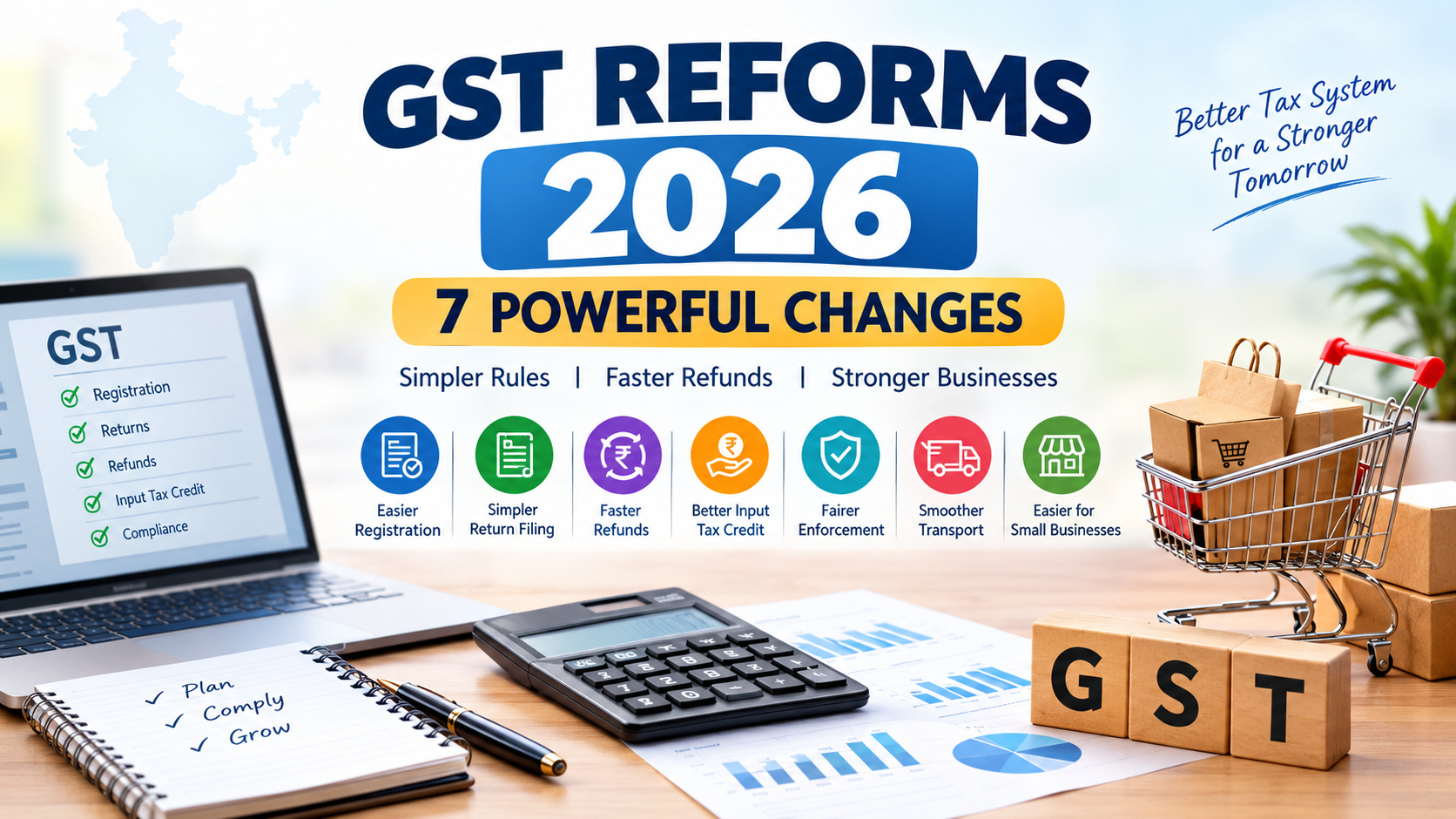
GST Reforms 2026 7 Powerful Changes-GST Reforms 2026 is an important topic for consumers, business owners, shopkeepers, service providers, and anyone who wants to understand how taxes affect everyday life. Have you ever wondered why the price of a product changes even when its quality remains the same? Or why a small business must spend time and money managing tax returns? Changes to a goods and services tax system can influence these situations in different ways.
The main purpose of GST is to collect tax on the supply of goods and services through a structured system. However, tax rules need regular review because businesses, technology, consumer habits, and economic conditions continue to change. Governments may update tax rates, filing procedures, credit rules, digital systems, or compliance requirements to improve how the system works.
GST Reforms 2026 should therefore be understood as a topic covering possible areas of tax reform, as well as any officially announced changes in the relevant jurisdiction. Not every proposed change becomes a law, and not every reform applies worldwide. This guide explains seven important areas to watch, how they may affect ordinary people and businesses, and how readers can prepare without relying on rumours or unverified claims.
Table of Contents
Quick Summary of GST Reforms 2026
The latest GST reform announcements in India focus on making tax administration simpler, improving refunds, reducing unnecessary compliance burdens, and creating clearer rules for businesses. The recommendations from the 57th GST Council meeting on October 8, 2026, cover registration, tax returns, input tax credit, penalties, enforcement, and trade facilitation.
| Reform area | What it aims to improve |
|---|---|
| 1. Easier registration | Clearer guidance and simpler applications |
| 2. Better return filing | More accurate reporting and fewer mismatches |
| 3. Faster refunds | Better access to money tied up in tax claims |
| 4. Input tax credit | Clearer processes for eligible tax credits |
| 5. Fairer enforcement | Changes to prosecution and penalty provisions |
| 6. Smoother transportation | More controlled, intelligence-based checks |
| 7. Easier small-business compliance | Simpler procedures and support for eligible sellers |
These are India-specific recommendations, not a universal GST rulebook. Their legal effect and implementation dates depend on the relevant notifications and amendments.
GST Reforms 2026 7 Powerful Changes-What Are GST Reforms 2026

GST reforms are changes made to a goods and services tax system to improve the way tax is collected, reported, and managed. Depending on the country, these changes may cover tax rates, registration, refunds, digital invoices, tax credits, penalties, or business reporting requirements.
The goal is to make tax rules easier to follow while ensuring that governments collect the revenue required for public services. A good reform should also reduce unnecessary paperwork, improve transparency, and give businesses greater confidence when planning their costs.
In India, the latest GST Reforms 2026 announcements build on earlier changes to tax rates and exemptions. The 57th GST Council meeting focused mainly on administrative and procedural improvements rather than announcing an entirely new tax system.
For example, imagine a small business that sells household products. Its owner must maintain invoices, calculate tax, file returns, and manage eligible tax credits. If the rules are unclear or the online process is difficult, the owner may spend valuable time correcting mistakes instead of serving customers.
Simpler registration, clearer instructions, and better digital tools can reduce that burden. However, a proposed reform does not automatically mean every business will receive a tax reduction or immediate financial benefit.
Why Do GST Reforms Matter to Ordinary People?
GST can affect the final price consumers pay for many goods and services. When the applicable tax rate changes, the tax portion of a bill may rise or fall. However, the final price also depends on production costs, transport, demand, competition, and the seller’s pricing decisions.
Consider a product with a pre-tax price of 1,000 currency units. At a hypothetical GST rate of 18%, the tax would be 180 units, making the total 1,180 units. At 5%, the tax would be 50 units, making the total 1,050 units.
This example only explains the mathematics. It does not mean that GST Reforms 2026 have reduced the rate on every product from 18% to 5%. The applicable rate must be checked for the specific product or service and jurisdiction.
For consumers, the practical lesson is simple: check the actual tax rate and the final invoice rather than assuming every price will fall after a reform announcement.
Why Are GST Reforms Important for Small Businesses?

Small businesses often have fewer employees and less money to spend on accounting support. Even a small reporting mistake can take time to correct, while delayed refunds can affect money available for stock, salaries, rent, and other expenses.
A more predictable GST system can help business owners plan their cash flow and reduce avoidable administrative work. However, businesses should continue to maintain accurate invoices and records, even when filing procedures become easier.
The value of a reform is not measured only by how many new rules it introduces. It is also measured by whether people can understand those rules and follow them without unnecessary confusion.
GST Reforms 2026: Change 1 — Easier GST Registration
Registration is often the first major tax-related task for a business entering a GST system. Depending on local law, a business may need to register after crossing a turnover threshold or when another registration requirement applies. The exact rules differ across jurisdictions.
A difficult registration process can delay business operations. Applicants may struggle to understand which documents are required, how to complete the form, or why an application needs additional information.
The GST Council’s October 2026 recommendations in India aim to improve registration guidance, simplify applications, and make the online process easier to navigate. The government has also described a framework for automatic registration in specified eligible cases.
How Could Easier Registration Help?
Imagine a small online seller who wants to expand sales to more customers. The owner may need to understand registration requirements before making that move. Clearer instructions and better online guidance can help the seller identify the required information and avoid preventable errors.
A simpler process can also benefit accountants and tax professionals who assist multiple businesses. When applications are easier to understand, less time may be spent explaining basic requirements or correcting incomplete forms.
Nevertheless, easier registration does not mean that every applicant automatically qualifies. Businesses must still meet the applicable legal conditions and provide accurate information.
What Should Business Owners Do?
Business owners should first check whether registration is legally required for their activities. They should then prepare the necessary identity, address, business, and financial details according to the applicable rules.
They should also use the official tax portal and read current guidance before submitting an application. Avoid relying on old social media posts, unofficial agents, or outdated checklists when the requirements may have changed.
The main benefit of this GST reform area is greater clarity. When a business understands the process from the beginning, it can reduce avoidable delays and start managing its tax responsibilities with more confidence.
GST Reforms 2026: Change 2 — Simpler and More Accurate Return Filing

Tax return filing is a regular responsibility for many registered businesses. It involves reporting sales, purchases, tax collected, eligible credits, and the amount payable under the applicable rules.
Problems can arise when the information in invoices does not match the figures reported in returns. A business may enter the wrong amount, record an invoice twice, or fail to reconcile its purchase and sales records before filing.
These errors can create additional work and may lead to notices, delayed credit claims, or corrections. Therefore, GST Reforms 2026 place important attention on improving the accuracy and management of return-related information in India.
The GST Council has recommended improvements to return reporting and reconciliation, including better alignment between different GST forms and clearer reporting of certain tax liabilities and input tax credit adjustments.
Why Does Accurate Filing Matter?
Suppose a business records sales worth 500,000 currency units in its accounting software but reports a different figure in its tax return. The mismatch may occur because an invoice was missed or a transaction was entered incorrectly.
The business may then need to review its records, identify the difference, and make any permitted correction. This takes time that could have been spent on customer service or business development.
Better reporting tools can help reduce such errors, but technology alone cannot guarantee correct returns. Businesses must still enter accurate information and review their figures before filing.
Practical Steps to Improve Return Filing

Keep sales and purchase records updated throughout the reporting period instead of waiting until the deadline. Reconcile invoices regularly and compare accounting records with the figures available on the official tax portal.
Use accounting software only when it suits the size and needs of the business. A small shop may need a simple, reliable recordkeeping process, while a larger company may require automated reconciliation and professional accounting support.
Most importantly, never assume that a return is correct simply because software has prepared it. Review the figures, check unusual transactions, and seek qualified tax advice when a rule is unclear.
The purpose of this reform area is to support more accurate reporting and reduce avoidable compliance difficulties. Businesses should still follow the filing rules and deadlines currently applicable to them.
GST Reforms 2026: Change 3 — Faster GST Refunds
A tax refund can make a real difference to a business’s financial health. When money remains tied up in a refund claim, the business may have less cash available to purchase materials, pay employees, or meet everyday expenses.
This is especially important for businesses that export goods or services and for businesses that qualify for refunds under specific tax rules. A lengthy refund process can create financial pressure even when a business has enough customers and receives regular orders.
The GST Council’s October 2026 recommendations in India include measures intended to improve refund processing, reduce manual intervention, and make eligible refunds more predictable. Some proposals involve system-based processing and faster acknowledgements for qualifying claims.
How Can Faster Refunds Help Businesses?
Imagine a manufacturer that has paid tax on materials used to produce goods for export. If the manufacturer qualifies for a refund, receiving that money sooner can improve its working capital.
Working capital is the money a business needs to manage its daily activities. It helps cover expenses such as wages, electricity, transport, packaging, and raw materials.
When refunds are delayed, the owner may need to use savings or borrow money to cover these costs. Faster processing can reduce that pressure and help the business operate more smoothly.
However, not every business qualifies for a GST refund. Eligibility depends on the relevant law, the type of transaction, supporting documents, and other conditions. An automated process does not remove those legal requirements.
How Can Businesses Prepare for Refund Claims?
Businesses should maintain complete invoices, purchase records, export documents where relevant, and accurate tax returns. They should also review their refund calculations before submitting a claim.
If a claim is delayed, the business should check its application status through the official tax portal and respond to any lawful request for additional information.
The practical lesson is that better refund systems can help eligible businesses manage cash flow, but good recordkeeping remains essential. Businesses should never plan their finances around a refund until they have considered the applicable rules and likely processing time.
GST Reforms 2026: Change 4 — Better Input Tax Credit Management

Input tax credit is an important part of many GST systems. It generally allows an eligible registered business to claim credit for tax paid on qualifying business purchases, subject to the applicable conditions.
For example, imagine a manufacturer pays 10,000 currency units in eligible tax on raw materials and collects 25,000 units in tax on its sales. If the full credit is available and all other requirements are satisfied, the manufacturer may offset the eligible 10,000 units against its tax liability.
The resulting amount would be 15,000 units before considering any other adjustments. This is a simplified example, not a calculation for every GST system.
In India, the October 2026 GST Council recommendations include measures to improve input tax credit reporting, reconciliation, and related refund processes. They also propose better ways to manage credit adjustments and information recorded in the GST system.
Why Is Input Tax Credit Important?
Input tax credit can help prevent eligible business inputs from carrying an unnecessary tax cost throughout the supply chain. This can support smoother business operations and make tax calculations more consistent.
However, credit is not automatic for every purchase. A business must follow the applicable rules, maintain valid documentation, and satisfy the conditions for claiming the credit.
Errors can occur when an invoice is missing, a supplier’s details are incorrect, or a purchase is recorded under the wrong category. A business may also need to reverse or adjust credit when the law requires it.
How Can Businesses Reduce Credit Errors?
First, match purchase invoices with accounting records and the relevant information available on the tax portal. Second, review unusual transactions and check whether the purchase qualifies for credit. Third, maintain a clear record of any credit claimed, reversed, or reclaimed.
Businesses should also communicate with suppliers when invoice details are incorrect. Fixing an error early is often easier than trying to reconstruct the transaction months later.
Better digital systems can make this process more manageable, but they do not replace the need for accurate records and legal compliance.
What Do the 2026 GST Reforms Mean for Consumers?
Although several of the latest measures focus on business procedures, consumers should also understand how GST affects everyday purchases. Tax rates can influence final prices, but the relationship is not always straightforward.
A reduction in a tax rate may lower the tax component of a bill. However, the final price can also change because of raw material costs, transportation expenses, competition, and the pricing decisions made by sellers.
Consumers should therefore check product prices and tax details rather than assuming that every product will become cheaper after a reform announcement.
For the latest India-specific rate information, consult the official GST Council website at gstcouncil.gov.in and the government’s GST information portal at cbic-gst.gov.in. These are useful starting points for checking official announcements and tax guidance.
The most important habit is to separate an announced recommendation from an implemented legal change. That distinction can help consumers and business owners avoid decisions based on incomplete information.
GST Reforms 2026: Change 5 — Fairer Enforcement and Lower Penalties
Tax compliance is important, but businesses also need clear rules and fair treatment. When a business makes a mistake, it should be able to understand the issue, respond to the tax department, and correct the problem according to the law.
One of the most important parts of GST Reforms 2026 in India concerns enforcement, prosecution, and penalties. At its October 8, 2026, meeting, the GST Council recommended removing arrest provisions under GST, raising the prosecution threshold from ₹1 crore to ₹5 crore, and reducing the maximum general penalty under Section 125 from ₹25,000 to ₹10,000. These are recommendations, and their legal effect depends on the required legislative changes and official implementation.
What Could the Penalty Changes Mean?
Consider a small business that makes an error while preparing a tax return. The owner may be worried about the cost of correcting the mistake, the time needed to respond to a notice, and the possible effect on business operations.
Clearer procedures and more proportionate penalties can make it easier for businesses to understand their responsibilities. They may also help reduce unnecessary disputes between taxpayers and tax authorities.
However, a lower general penalty does not mean that every GST violation will carry a lower penalty. Different provisions apply to different situations, and fraud or serious tax offences may be treated differently from ordinary reporting mistakes.
What Is the Difference Between a Mistake and Tax Fraud?
A genuine reporting error might occur when an employee enters an incorrect invoice amount or records a transaction twice. Tax fraud, by contrast, can involve deliberate actions such as knowingly submitting false information or creating fraudulent invoices.
The legal treatment depends on the facts and the applicable law. Businesses should not assume that an error is automatically harmless or that a proposed reform removes their legal responsibilities.
The safest approach is to maintain accurate records, review returns before submission, and correct mistakes through the legally permitted process. If a notice arrives, read it carefully and respond within the applicable deadline.
How Should Business Owners Prepare?
Business owners should maintain invoices, payment records, tax returns, and supporting documents in an organised system. They should also train employees who handle billing and tax reporting.
If a dispute arises, seek advice from a qualified tax professional who understands the relevant provisions. Do not ignore a notice simply because the government has announced plans to make enforcement less punitive.
The main message of this part of GST Reforms 2026 is that simpler and fairer procedures can support compliance. They do not remove the need to follow the law.
GST Reforms 2026: Change 6 — Smoother Movement of Goods
Moving goods between locations is a routine part of business. Manufacturers transport raw materials, wholesalers supply retailers, and online sellers send orders to customers. Delays during transportation can increase costs and make delivery schedules harder to manage.
GST-related document checks and inspections can sometimes interrupt these movements. Proper checks remain necessary to prevent tax evasion, but businesses also benefit when enforcement follows clear rules and focuses on genuine risks.
The GST Council’s October 2026 recommendations in India aim to make goods transportation smoother by limiting roadside interception to authorised officers acting on specific intelligence. The recommendations also address which state officers can stop vehicles carrying goods.
How Could This Help Transport Businesses?
Imagine a distributor sending household products to several retail stores. If a vehicle experiences an avoidable delay, the driver may arrive late, deliveries may need to be rescheduled, and the distributor may face additional operating costs.
More predictable inspection procedures could help transport companies plan routes and deliveries more effectively. Retailers may also benefit from more reliable arrival times, while manufacturers could manage their supply chains with greater confidence.
However, these changes do not mean that transport vehicles will never be inspected. Businesses must still comply with applicable invoice, e-way bill, documentation, and transportation requirements.
What Should Transporters and Suppliers Do?
Before dispatching goods, businesses should check that the required documents are accurate and available. They should verify product descriptions, quantities, destination details, and other information required under the applicable rules.
Transporters should also ensure that drivers know how to access the necessary documents and whom to contact if an authorised officer requests information.
Businesses should not treat procedural reforms as permission to transport goods without proper documentation. Correct records remain the best way to avoid preventable disputes.
Why Does This Reform Matter Beyond Transport?
Transportation affects the cost and availability of products. When goods move efficiently, businesses may manage stock more reliably and avoid some unnecessary expenses.
That does not guarantee that consumer prices will fall. Fuel prices, wages, tolls, storage costs, and market competition also affect the final price.
The practical benefit of this GST reform area is greater predictability. Businesses can plan more confidently when inspection procedures are clear and unnecessary interruptions are reduced.
GST Reforms 2026: Change 7 — Easier Compliance for Small Businesses
Small businesses play an important role in local economies. They provide jobs, serve customers, support suppliers, and often operate with limited staff and resources.
For a small shopkeeper or service provider, tax compliance can become difficult when it involves frequent paperwork, confusing forms, or costly professional assistance. Even a small administrative task can take time away from customers and sales.
GST Reforms 2026 include recommendations intended to make compliance easier for eligible small taxpayers. The GST Council has also approved an in-principle optional Annual Return Quarterly Payment scheme for small consumer-facing businesses with turnover of up to ₹5 crore, subject to the scheme’s eligibility conditions and further implementation details.
What Is an Optional Quarterly Payment Scheme?
In simple terms, a quarterly payment arrangement can allow eligible businesses to pay tax at regular three-month intervals rather than make payments every month. The exact reporting and payment obligations depend on the scheme’s final rules.
The proposed arrangement is aimed at eligible businesses that make supplies exclusively to unregistered consumers. It should not be confused with a universal exemption from GST or a rule that allows every small business to stop filing returns.
Before choosing such a scheme, a business owner must confirm eligibility, understand the payment schedule, and check whether the arrangement suits the business’s cash flow.
Example: A Small Retail Shop
Imagine a neighbourhood shop with annual turnover below ₹5 crore. The owner manages stock, serves customers, pays suppliers, and keeps basic financial records.
If the shop qualifies for an optional simplified scheme, a less frequent payment schedule could make cash-flow planning easier. The owner may also spend less time managing payment-related tasks during busy periods.
However, the business must still keep accurate records and follow all requirements that apply under the chosen arrangement. It should also set aside enough money to meet its tax obligations when payment becomes due.
What About Small Online Sellers?
Small online sellers may also benefit from changes designed to simplify registration and expand access to e-commerce markets.
The GST Council has recommended simplified registration for eligible small sellers operating through e-commerce platforms. The precise eligibility requirements and implementation arrangements should be checked against official guidance before a seller changes its business operations.
For example, a person selling handmade products online may want to reach customers in additional states. Clearer registration procedures could help that seller understand the conditions for expanding beyond the local market.
The seller should still review the applicable registration, invoicing, tax collection, and reporting rules before accepting orders across state boundaries.
How Can Small Businesses Make the Most of These Changes?
Start by reviewing the business’s current GST registration and filing obligations. Then identify the tasks that take the most time, such as invoice preparation, payment tracking, return reconciliation, or refund applications.
A simple accounting system, regular recordkeeping, and a calendar of tax deadlines can prevent many avoidable problems. Business owners should also monitor official announcements to learn when a recommended change becomes legally effective.
The purpose of these GST Reforms 2026 is to make compliance more manageable for eligible taxpayers. The best results will come when simpler procedures are combined with accurate records and sound financial planning.
Additional GST Reforms 2026 That Businesses Should Watch
The seven areas discussed above are not the only recommendations from the 57th GST Council meeting. Several additional proposals may also matter to businesses, particularly those dealing with exports, input tax credits, and online sales.
Wider Eligibility for Input Tax Credit Refunds
The Council recommended expanding refunds of accumulated input tax credit in certain cases involving capital goods and input services. The proposals include specific eligibility conditions and future applicability dates. For example, the recommended refund treatment for eligible input services under the inverted duty structure applies to credit availed on or after November 1, 2026. Eligible capital-goods credit is proposed to follow a separate schedule beginning April 1, 2027, with refunds spread over 60 months.
These changes could help qualifying businesses manage money that would otherwise remain tied up in tax credits. However, businesses should not assume that all accumulated credits will become refundable.
Changes Affecting Exports and E-Commerce
The GST Council also recommended measures to clarify tax treatment for certain export services and improve compliance rules affecting e-commerce operators.
These proposals may be relevant to service exporters, online marketplaces, and sellers that use digital platforms to reach customers. Their actual effect depends on the final legal provisions and the type of transaction involved.
Businesses working across borders should review the applicable rules before changing invoices, pricing, or accounting procedures. Export status, place-of-supply rules, and refund eligibility can involve technical conditions that require professional advice.
Are GST Reforms 2026 Reducing Tax Rates?
This is an important question because many people assume that every GST reform means lower taxes on products.
The 57th GST Council meeting on October 8, 2026, focused mainly on procedural reforms, compliance, refunds, enforcement, and trade facilitation. It did not announce a general reduction in GST rates as part of that meeting.
India’s earlier rate-rationalisation measures, recommended at the 56th GST Council meeting, are a separate development. Therefore, it is important to distinguish changes to tax rates from changes to registration, filing, refunds, or penalties.
For consumers, the best approach is to check the current rate for the specific product or service. For businesses, the priority is to confirm the rules that apply to their transactions and update their accounting processes when a change becomes effective.
How to Prepare for GST Reforms 2026: A Practical Checklist
Whether you run a small shop, an online business, a manufacturing unit, or a service company, preparation can reduce confusion when new rules take effect.
1. Check official announcements. Visit the GST Council website for meeting recommendations, notifications, and FAQs.
2. Review your registration. Confirm that your business details, address, and other registration information are accurate.
3. Update your accounting records. Keep sales invoices, purchase invoices, payment records, and supporting documents organised.
4. Review input tax credits. Check whether your purchases qualify for credit and reconcile the figures with the relevant GST records.
5. Monitor refund claims. If your business qualifies for a refund, review the application requirements and maintain the necessary evidence.
6. Check filing and payment deadlines. Do not assume that a proposed simplified process has already replaced your current obligations.
7. Train employees. Make sure staff who manage invoices, dispatches, payments, and returns understand any applicable changes.
8. Seek professional advice when needed. Complex transactions, disputed demands, and questions about eligibility may require a qualified tax professional.
This checklist can help businesses prepare without making sudden decisions based on headlines or unconfirmed social media posts.
Common Mistakes to Avoid When Reading GST Reforms 2026 News
Tax announcements often contain technical terms that are easy to misunderstand. A careful reading can help you avoid costly mistakes.
Mistake 1: Treating a Recommendation as a Final Law
The GST Council recommends changes, but many proposals require amendments, notifications, rules, or other official steps before they take legal effect.
Always check the implementation date and the relevant official document before changing how your business operates.
Mistake 2: Assuming Every Business Qualifies
Some measures apply only to particular taxpayers, transactions, turnover levels, or categories of credit. A benefit available to one business may not apply to another.
Read the eligibility conditions instead of relying only on the headline.
Mistake 3: Expecting Every Product to Become Cheaper
Procedural reforms do not automatically reduce tax rates. Even when a rate changes, the final price depends on other business costs and market conditions.
Check the applicable tax rate and the actual invoice before concluding that a product has become cheaper.
Mistake 4: Ignoring Existing Responsibilities
Simplified filing or registration does not necessarily remove recordkeeping, payment, or reporting requirements. Continue meeting your current obligations until an applicable change officially takes effect.
Mistake 5: Relying on Outdated Information
Tax rules can change, and older articles may no longer reflect the latest position. Use official government sources for decisions involving registration, payments, refunds, and compliance.
Frequently Asked Questions About GST Reforms 2026
1. What are GST Reforms 2026?
GST Reforms 2026 refers to changes and recommendations intended to improve goods and services tax systems. In India, the October 2026 recommendations focus on registration, refunds, input tax credits, enforcement, transport checks, and simpler compliance for eligible businesses.
2. Will GST Reforms 2026 reduce the prices of everyday products?
Not necessarily. The October 2026 meeting focused mainly on administrative and procedural improvements rather than a general reduction in tax rates. Product prices depend on the applicable GST rate and other costs.
3. What is the main benefit of GST Reforms 2026 for small businesses?
The proposed changes aim to make registration, payment, filing, and other compliance tasks more manageable for eligible taxpayers. The actual benefit depends on which measures apply to a particular business and when they become effective.
4. Are GST penalties changing in 2026?
The GST Council has recommended reducing the maximum general penalty under Section 125 from ₹25,000 to ₹10,000 and making other changes to enforcement and prosecution provisions. The legal effect depends on the required legislative and implementation steps.
5. Will GST refunds become faster?
The Council has recommended measures to improve refund processing and reduce unnecessary manual intervention. However, refund eligibility, documentation, and the applicable implementation rules still matter.
6. Do the 2026 GST changes apply worldwide?
No. The October 2026 recommendations discussed in this article concern India’s GST system. Other countries have their own tax laws, procedures, rates, and implementation schedules.
7. Where can I check the latest GST updates?
Start with the official GST Council website and the Central Board of Indirect Taxes and Customs GST portal. Review the relevant notifications, circulars, and FAQs before making a tax-related decision.
Conclusion: Prepare Wisely for GST Reforms 2026
GST Reforms 2026 represent an important development for businesses and taxpayers who want a clearer, more predictable tax system. The October 2026 recommendations in India cover several practical areas, including registration, return filing, refunds, input tax credits, penalties, transportation, and compliance for eligible small businesses.
The biggest potential benefit is not simply a reduction in paperwork. Better procedures can also help businesses plan their cash flow, maintain more accurate records, and spend less time resolving avoidable administrative problems.
However, it is essential to remember that a recommendation is not always the same as an implemented law. Eligibility requirements, official notifications, and effective dates determine when a particular change can be used.
If you own a business, start by reviewing your existing GST responsibilities and checking the latest official guidance. If you are a consumer, verify applicable tax rates instead of assuming that every reform will lower prices.
Understanding GST Reforms 2026 can help you make better decisions, avoid common misunderstandings, and prepare for changes that genuinely apply to your situation.
GST Reforms 2026: Practical Examples for Different Businesses
Understanding GST Reforms 2026 becomes easier when we look at how tax procedures can affect everyday business decisions. The benefits depend on the type of business, the applicable tax rules, and whether a particular reform has officially taken effect.
Example 1: A Small Retail Shop
Imagine a shopkeeper who sells groceries, household items, and personal care products. The owner must manage supplier invoices, record sales, and meet applicable tax requirements while serving customers throughout the day.
If an eligible simplified payment process becomes available, it may help the shopkeeper organise payments and manage cash flow. However, the owner must first confirm the scheme’s eligibility conditions and continue following all applicable reporting requirements.
Example 2: A Manufacturing Business
A manufacturer purchases raw materials, pays eligible input taxes, and sells finished products. Accurate input tax credit records are important because errors can affect tax calculations and cash flow.
Improved reconciliation procedures could make it easier to identify missing invoices and resolve mismatches. The manufacturer should still verify that every credit claim meets the legal conditions.
Example 3: An Online Seller
An online seller may want to reach customers beyond the local market. Registration requirements and platform-related tax rules can influence how the seller expands operations.
Simplified registration procedures could help eligible sellers understand the process more easily. Before accepting orders under a new arrangement, the seller should verify the applicable registration and tax requirements.
How to Track GST Reforms 2026 After Publication
Tax information can become outdated when a proposal is amended or an implementation date changes. Therefore, a useful GST article should be reviewed regularly rather than published once and left unchanged.
Check official announcements from the GST Council and the Central Board of Indirect Taxes and Customs. Look for the notification number, effective date, affected taxpayer category, and any conditions that limit eligibility.
When updating this article, distinguish three stages clearly: a proposal, an officially notified change, and a change that has come into effect. This helps readers understand what they can do now and what they may need to prepare for later.
For businesses, maintaining a simple record of relevant notifications can also help accountants and owners update their procedures on time.
Final Takeaway
GST Reforms 2026 should be approached with a focus on practical benefits, accurate information, and legal compliance. Simpler procedures can help businesses save time, manage records, and plan finances more effectively. However, the actual impact depends on the final rules and the circumstances of each taxpayer.
Before acting on any reform, verify the official notification and confirm that it applies to your business. This is the most reliable way to turn tax updates into informed decisions.
REFRENCE-GST Reforms 2026 7 Powerful Changes GST Reforms 2026 7 Powerful Changes GST Reforms 2026 7 Powerful Changes GST Reforms 2026 7 Powerful Changes GST Reforms 2026 7 Powerful Changes GST Reforms 2026 7 Powerful Changes GST Reforms 2026 7 Powerful Changes GST Reforms 2026 7 Powerful Changes GST Reforms 2026 7 Powerful Changes GST Reforms 2026 7 Powerful Changes GST Reforms 2026 7 Powerful Changes GST Reforms 2026 7 Powerful Changes GST Reforms 2026 7 Powerful Changes GST Reforms 2026
7 Powerful Changes GST Reforms 2026 7 Powerful Changes GST Reforms 2026 7 Powerful Changes GST Reforms 2026 7 Powerful Changes GST Reforms 2026 7 Powerful Changes REFRENCE-GST Reforms 2026 7 Powerful Changes GST Reforms 2026 7 Powerful Changes GST Reforms 2026 7 Powerful Changes GST Reforms 2026 7 Powerful Changes GST Reforms 2026 7 Powerful Changes GST Reforms 2026 7 Powerful Changes GST Reforms 2026 7 Powerful Changes GST Reforms 2026 7 Powerful Changes GST Reforms 2026
7 Powerful Changes GST Reforms 2026 7 Powerful Changes GST Reforms 2026 GST Reforms 2026 7 Powerful Changes GST Reforms 2026 7 Powerful Changes GST Reforms 2026 7 Powerful Changes GST Reforms 2026 7 Powerful Changes GST Reforms 2026 7 Powerful Changes GST Reforms 2026 7 Powerful Changes GST Reforms 2026 7 Powerful Changes GST Reforms 2026 7 Powerful Changes GST Reforms 2026 7 Powerful Changes GST Reforms 2026 7 Powerful Changes GST Reforms 2026 7 Powerful Changes GST Reforms 2026 7 Powerful Changes GST Reforms 2026
7 Powerful Changes REFRENCE-GST Reforms 2026 7 Powerful Changes GST Reforms 2026 7 Powerful Changes GST Reforms 2026 7 Powerful Changes GST Reforms 2026 7 Powerful Changes GST Reforms 2026 7 Powerful Changes GST Reforms 2026 7 Powerful Changes GST Reforms 2026 7 Powerful Changes GST Reforms 2026 7 Powerful Changes GST Reforms 2026 7 Powerful Changes GST Reforms 2026 7 Powerful Changes GST Reforms 2026
7 Powerful Changes GST Reforms 2026 7 Powerful Changes GST Reforms 2026 7 Powerful Changes GST Reforms 2026 7 Powerful Changes GST Reforms 2026 7 Powerful Changes GST Reforms 2026 7 Powerful Changes GST Reforms 2026 7 Powerful Changes GST Reforms 2026 7 Powerful Changes REFRENCE-GST Reforms 2026 7 Powerful Changes GST Reforms 2026