
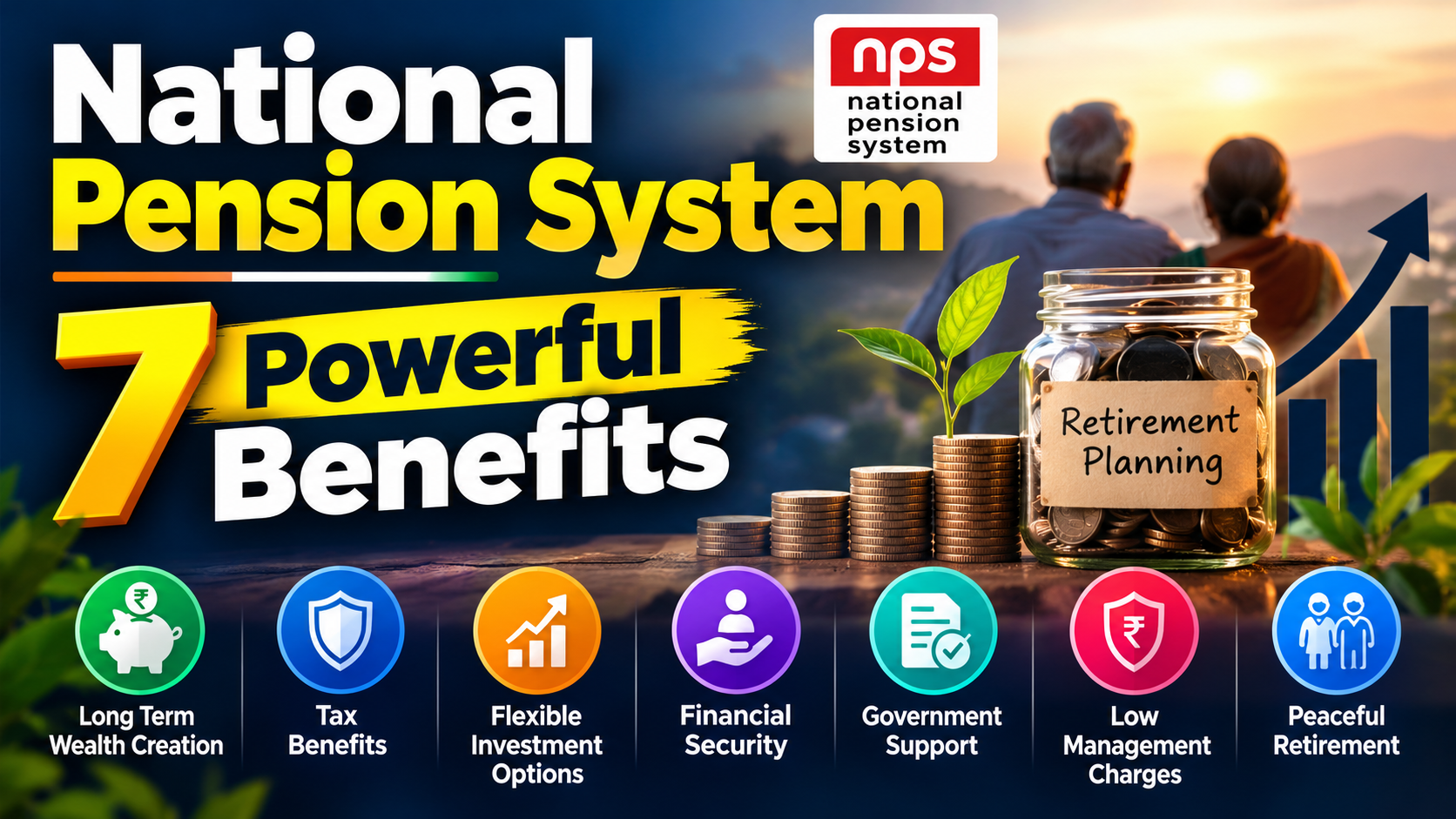
National Pension System 7 Powerful Benefits National Pension System (NPS) can help people build a retirement fund while developing a habit of long-term investing. But before putting your money into any retirement plan, it is important to understand how it works, what benefits it offers, and which limitations you should consider. Retirement planning is not only about saving money. It is about preparing for a future when you may no longer receive a regular salary.
The National Pension System offers investment options linked to market performance, different pension fund choices, and certain tax benefits subject to applicable rules. However, returns are not guaranteed, and withdrawal conditions can affect how and when you access your money. Understanding these details can help you decide whether NPS fits your financial goals.
In this guide, we will explain seven important National Pension System benefits in simple English, along with practical examples, tax considerations, common mistakes, and questions to ask before investing.
Table of Contents
Quick Summary
The National Pension System is a retirement-focused investment scheme designed to help eligible subscribers accumulate money over time. Its main advantages include long-term wealth accumulation, investment choices, professional fund management, potential tax benefits, and a structured retirement withdrawal process. However, it is not a guaranteed-return product. Your investment value can rise or fall with the market, and withdrawal and annuity rules depend on the applicable NPS category and regulations. Before opening an account, consider your retirement age, income, risk tolerance, tax situation, and need for access to your money.
National Pension System 7 Powerful Benefits What Is the National Pension System?

The National Pension System is a defined-contribution retirement scheme regulated by the Pension Fund Regulatory and Development Authority (PFRDA). It allows eligible subscribers to invest money during their working years and build a retirement corpus. The final amount depends on contributions, investment performance, applicable charges, and the withdrawal rules in force when the subscriber exits.
Unlike a traditional pension that promises a fixed benefit under specified conditions, NPS investment returns are market-linked. Your account can invest in different asset classes, including equities, corporate debt, and government securities, depending on the investment option you choose.
The main idea behind the National Pension System is simple: contribute regularly over a long period instead of waiting until retirement to start building financial security.
How Does the National Pension System Work?
You contribute money to your NPS account. The money is invested according to your selected pension fund and investment allocation. Over time, your contributions and investment gains or losses determine the value of your retirement corpus.
When you become eligible to exit, you can use the accumulated amount according to the rules applicable to your account. Depending on the applicable exit category, some money may be available as a lump sum, while some may need to be used to purchase an annuity that can provide regular income.
An annuity is a financial product that pays income according to its selected terms. The amount you receive depends on factors such as the amount used to purchase it, the annuity option, and the provider’s rates.
For current rules, always check the official PFRDA website and the Department of Financial Services NPS information.
National Pension System: 7 Powerful Benefits
The National Pension System offers several features that can make retirement planning more organised. However, the value of each benefit depends on your financial situation, investment choices, tax eligibility, and retirement needs.
1. Long-Term Retirement Wealth Creation
One important benefit of the National Pension System is that it encourages you to build a retirement fund over many years. Starting early gives your contributions more time to grow through investment returns, although growth is never guaranteed.
Consider a hypothetical example. A person contributes ₹3,000 every month for 30 years. Their total contributions would amount to ₹10.8 lakh. If the investment earns positive returns over time, the final corpus could be higher. However, the actual result will depend on market performance, fees, and the investment allocation.
This example is only an illustration, not a forecast of NPS returns.
The practical lesson is that retirement wealth depends on more than the amount you invest. Your contribution level, investment duration, and ability to remain consistent also matter.
People often delay retirement planning because their retirement seems far away. However, beginning with an affordable contribution and reviewing it as income increases can make the process easier to manage.
Practical tip: Estimate your future retirement expenses before deciding how much to contribute. Remember that inflation can reduce the purchasing power of money over time.
2. Choice of Investment Options

The National Pension System provides choices that allow subscribers to align their investments with their risk tolerance and long-term goals. Depending on the applicable NPS option, money can be allocated across asset classes such as equities, corporate debt, and government securities.
Equity investments may offer greater long-term growth potential, but they can also experience larger fluctuations. Debt investments can behave differently, but they are not automatically free from investment risk. Government securities, corporate debt, and equity investments each have their own characteristics.
For example, a younger investor with a long time until retirement may be comfortable with a different asset allocation from someone approaching retirement. Neither approach is automatically correct for everyone. The suitable choice depends on the person’s financial goals, risk tolerance, and circumstances.
The important point is to understand what your chosen investment option actually holds. Do not select an option only because its name sounds safe or because someone claims it will deliver the highest return.
Practical tip: Review your asset allocation periodically. Avoid making frequent changes simply because the market rises or falls over a short period.
3. Potential Tax Benefits

Tax treatment is one reason people consider the National Pension System. Eligible contributions may qualify for deductions under relevant provisions of the applicable income-tax law. Employer contributions may also receive specific tax treatment, subject to the rules and limits that apply to the individual.
However, tax benefits are not identical for every subscriber. They can depend on employment status, contribution type, the chosen tax regime, the financial year, and the applicable statutory provisions.
Before investing for tax reasons, compare the tax treatment of NPS with your other available options. A deduction may reduce taxable income when the conditions are met, but that does not automatically make an investment suitable for your retirement plan.
It is also important to distinguish between the tax treatment of contributions, investment growth, lump-sum withdrawals, and annuity income. These are different matters and may follow different rules.
For the latest requirements, consult the official Income Tax Department website and verify the rules for the relevant assessment year.
Practical tip: Calculate the actual tax benefit you qualify for before deciding how much to invest. Do not contribute more than you can reasonably afford merely to obtain a deduction.
4. Professional Pension Fund Management

The National Pension System allows subscriber contributions to be managed through regulated pension funds. These funds invest according to the applicable investment guidelines and the subscriber’s selected investment arrangement.
This structure can be useful for people who do not want to select and manage every individual security themselves. Instead, they can choose an eligible pension fund and investment option under the scheme’s rules.
However, professional management does not guarantee positive returns. Fund managers make investment decisions within their permitted framework, and the value of market-linked investments can rise or fall.
It is therefore important to understand both the advantages and the limits of professional fund management. The presence of a regulated structure can provide oversight, but it cannot remove market risk or guarantee that your retirement corpus will reach a particular amount.
Before choosing a fund, review its available information, investment approach, charges, and performance over appropriate periods. Past performance can provide context, but it does not guarantee future results.
Practical tip: Judge a retirement investment by whether it suits your long-term plan, not only by which fund has recently delivered the highest return.
5. A Portable Retirement Account

Another useful benefit of the National Pension System is portability. Your NPS account is designed to remain with you when you change employers or move to a different location. This can help maintain continuity in retirement planning instead of requiring you to start again whenever your employment changes.
Imagine someone who changes jobs several times during their career. They may work for one employer for a few years, move to another company, and later become self-employed. An existing NPS account can help them continue their retirement investment journey, subject to the relevant account and employment arrangements.
The government’s Department of Financial Services explains that the Permanent Retirement Account Number (PRAN) is a unique identifier for an NPS subscriber and can be used across employment arrangements where the scheme is supported.
This matters because a retirement plan should fit your working life. Your career may change, but your long-term financial goals can remain the same.
Portability does not mean that every employer automatically contributes to your account. Employer contributions depend on the employer’s scheme and applicable conditions. You should confirm the arrangements whenever you change jobs.
Practical tip: Keep your account information updated and check that your employer has correctly linked your existing PRAN if you move to a job where NPS is offered.
6. A Structured Approach to Retirement Income

The National Pension System is designed to help subscribers prepare for retirement, including the transition from accumulating savings to receiving retirement income. Depending on the applicable exit rules, a subscriber may receive a permitted lump-sum amount and use a portion of the corpus to purchase an annuity.
This structure can encourage people to think about how their savings will support them after regular employment ends. Retirement planning is not complete simply because you have accumulated money. You must also consider how you will use that money to pay for daily expenses over many years.
An annuity can provide payments according to the terms of the selected product. However, the income amount, payment frequency, available options, and treatment of the purchase amount depend on the specific contract.
It is important to understand that an annuity is not the same as a savings account. Access to the purchase amount can be restricted under the chosen terms, and inflation may reduce the purchasing power of a fixed payment.
Before choosing an annuity, compare the available options and read the conditions carefully. Consider whether the expected payments will cover your essential expenses alongside any other retirement income.
Practical tip: Estimate your retirement budget before selecting an annuity. Include housing, food, healthcare, transportation, family responsibilities, and other expected costs.
7. Encourages Financial Discipline

The seventh benefit of the National Pension System is behavioural rather than purely financial. A retirement-focused account can encourage you to set aside money for a specific long-term purpose.
Many people concentrate on immediate expenses and postpone retirement planning. They may intend to invest later, but competing priorities can make it difficult to begin. A regular contribution plan can help turn retirement saving into a routine.
For example, a person could review their monthly budget and choose a contribution that remains manageable after essential expenses and emergency needs are covered. If their income increases in the future, they could reconsider the contribution amount.
The objective is not to invest the maximum possible amount immediately. It is to create a realistic plan that can be maintained over time.
The National Pension System also has withdrawal rules, especially for its pension account. These restrictions can support long-term planning, but they can be inconvenient if you need access to money unexpectedly.
Practical tip: Build a separate emergency fund for unexpected expenses. Do not treat retirement investments as your only source of accessible money.
National Pension System Account Types Explained
Understanding the available account types is important before opening an NPS account. The account rules affect withdrawals, tax treatment, and how the money can be used.
Tier I Account
Tier I is the main individual pension account under NPS. Contributions and withdrawals follow the scheme’s applicable rules, and eligible tax benefits may be available depending on the circumstances and current law.
Because it is intended for retirement planning, Tier I should not be treated like a regular bank account. You should understand the exit and partial-withdrawal conditions before contributing money.
Tier II Account
Tier II is an optional investment account linked to an active Tier I account. It generally allows more flexible withdrawals than Tier I, but it does not carry the same general tax benefits for contributions described for the Tier I pension account. Tax treatment should be checked under the rules applicable to your situation.
The choice between account types depends on your purpose. If you are building a retirement fund, understand the pension account’s restrictions first. If you are considering Tier II for additional investment flexibility, compare it with other available investment options.
Who Can Benefit From the National Pension System?
The National Pension System may be worth considering if you want a dedicated retirement investment and understand that market-linked returns can fluctuate.
It may suit people who want to invest regularly over a long period, employees whose organisations offer NPS, and eligible self-employed people who want to build retirement savings independently.
It may be less suitable as the main home for money you could need soon. People with irregular income may also need to establish a realistic contribution plan that does not interfere with essential expenses.
Before joining, ask yourself three questions. Can I afford to invest this money for the intended period? Do I understand the investment risks? Have I checked the applicable withdrawal and tax rules?
If you cannot answer these questions confidently, take time to understand the scheme before committing money.
National Pension System: An Illustrative Example
Consider a hypothetical individual who starts contributing ₹3,000 every month at age 30 and continues for 30 years. The total amount contributed would be ₹10.8 lakh, excluding any employer contributions.
The final account balance would depend on the investment returns achieved over those 30 years, the selected asset allocation, applicable charges, and the timing of contributions. It could be higher or lower than an assumed projection.
This example highlights an important point: a monthly contribution is only one part of retirement planning. The investor should also consider inflation, future expenses, other retirement assets, and the income they may need after leaving work.
For a more useful estimate, test several return assumptions rather than relying on one optimistic number. Compare the projected corpus with your estimated retirement expenses and review the plan periodically.
Do not assume that the entire accumulated balance will necessarily be available as a lump sum at retirement. The amount available and the portion used for an annuity depend on the applicable exit category and rules.
The purpose of this example is to explain the planning process, not to promise a particular return or retirement income.
Important Limitations of the National Pension System
The National Pension System has useful features, but it is not perfect for every investor. Understanding its limitations is just as important as knowing its benefits.
Market Risk and Uncertain Returns
NPS investments are market-linked. Your corpus may rise or fall depending on the performance of the underlying investments. There is no universal fixed return that every subscriber receives.
A retirement plan based on unrealistic return assumptions can leave you unprepared. Use reasonable scenarios when estimating your future corpus, and remember that actual results may differ.
Withdrawal Restrictions
The Tier I pension account follows specific rules for partial withdrawals, premature exits, and normal exits. These rules have been amended over time, so older articles may not reflect the latest requirements. Check the current regulations before making decisions.\
This is especially important if you expect to need the money for a house, business, education, or other major expense before retirement.
Annuity Income May Be Lower Than Expected
If the applicable rules require you to use part of your corpus to purchase an annuity, the income you receive will depend on the product’s terms and rates when you purchase it.
A large retirement corpus does not automatically translate into a large monthly pension. Compare the available options and understand how payments, survivor benefits, and other conditions work.
Tax Benefits Depend on Your Situation
Do not assume that every contribution automatically qualifies for a tax deduction. Eligibility and limits depend on the applicable law, tax regime, contribution type, and individual circumstances. Tax treatment at withdrawal and during annuity payments also needs to be considered separately.
It Does Not Replace Your Entire Financial Plan
A retirement account is one part of financial planning. You may also need accessible emergency savings, suitable insurance, and investments for goals that occur before retirement.
The key lesson is to choose NPS because it fits your retirement plan, not simply because it offers tax advantages or is widely discussed.
Common National Pension System Mistakes to Avoid
One common mistake is investing without understanding the withdrawal conditions. Before contributing, learn when you can access the money and which rules apply to your account.
Another mistake is selecting an investment option solely because it recently performed well. Past returns do not guarantee future performance, and a choice that suits one investor may not suit another.
Some people also underestimate inflation. A retirement fund that looks substantial today may provide less purchasing power decades later. Estimate future expenses instead of relying only on today’s costs.
A further mistake is investing too much before building accessible emergency savings. If unexpected expenses arise, you may find that your retirement account is not flexible enough for your immediate needs.
Finally, avoid treating a projected return as a promise. Compare multiple scenarios, account for uncertainty, and review your plan as your circumstances change.
How to Get Started With the National Pension System
If you decide that NPS may fit your needs, follow a careful process.
First, read the current scheme information published by the PFRDA and the Department of Financial Services. Confirm the eligibility rules and the available account options.
Second, decide how much you can contribute without compromising essential expenses or emergency savings. A realistic contribution is more useful than an ambitious amount that you cannot maintain.
Third, understand the available pension funds and investment choices. Learn how your chosen allocation balances growth potential and risk.
Fourth, review the applicable fees, withdrawal rules, tax treatment, and retirement exit options. Do not rely only on promotional summaries or outdated online articles.
Finally, keep your account details accurate and review your retirement plan periodically. If your income, family responsibilities, or retirement goals change, reconsider whether your contribution and asset allocation remain appropriate.
Official information is available from the PFRDA and the Department of Financial Services.
Frequently Asked Questions About the National Pension System
What is the National Pension System?
The National Pension System is a retirement-focused, defined-contribution scheme regulated by PFRDA. Subscribers contribute money that is invested according to the selected investment arrangement. The final corpus depends on contributions, investment performance, and applicable charges and rules.
What are the main benefits of the National Pension System?
Its main benefits include long-term retirement saving, a choice of investment options, professional pension fund management, portability, potential tax benefits, and a structured process for retirement withdrawals and income. These features do not guarantee a particular investment return or pension amount.
Are returns from the National Pension System guaranteed?
No. NPS investment returns are market-linked. The value of the account depends on the selected investments and their performance over time. Subscribers should consider the risks before investing.
Can I withdraw money from my NPS account before retirement?
Partial withdrawals and premature exits may be allowed under specified conditions. The rules depend on the applicable account category and current regulations. Check the latest official guidance before planning a withdrawal.
Does the National Pension System provide tax benefits?
Eligible contributions and employer contributions may qualify for tax benefits under applicable provisions. The amount of relief depends on current law, the tax regime, contribution type, and personal circumstances. Verify your eligibility with the official Income Tax Department.
Is the National Pension System suitable for everyone?
No. It may suit eligible people who want to build retirement savings over the long term and understand its market risks and withdrawal conditions. It may not suit someone who needs immediate access to the same money for short-term expenses.
Is NPS the same as a fixed deposit?
No. A fixed deposit and NPS have different structures, risks, access rules, and tax treatment. NPS investments are market-linked, while the return on a fixed deposit depends on the deposit terms offered by the bank or institution.
Conclusion: Is the National Pension System Worth Considering?
The National Pension System can be a useful part of a retirement plan because it encourages long-term contributions, offers investment choices, and provides a regulated structure for accumulating retirement savings.
Its seven important benefits are long-term wealth creation, investment flexibility, potential tax advantages, professional fund management, portability, structured retirement income, and financial discipline.
However, no retirement scheme should be selected based on benefits alone. NPS returns are not guaranteed, withdrawal conditions matter, and tax treatment depends on applicable rules. Your retirement plan should also account for inflation, emergency expenses, and the income you may need after work ends.
Before investing, read the current official scheme information, compare your options, and choose a contribution you can afford to maintain.
The best next step is simple: estimate your future retirement expenses, understand your financial priorities, and decide whether the National Pension System fits your long-term needs.
.
.
AMAZON-https://link.amazon/B01FyO8au
INSTAMOJO-https://imojo.in/r6Csql
REFRANCE- National Pension System 7 Powerful Benefits National Pension System 7 Powerful Benefits National Pension System 7 Powerful Benefits National Pension System 7 Powerful Benefits National Pension System 7 Powerful Benefits National Pension System 7 Powerful Benefits National Pension System 7 Powerful Benefits National Pension System 7 Powerful Benefits National Pension System 7 Powerful Benefits National Pension System 7 Powerful Benefits
National Pension System 7 Powerful Benefits National Pension System 7 Powerful Benefits National Pension System 7 Powerful Benefits National Pension System 7 Powerful Benefits National Pension System 7 Powerful Benefits National Pension System 7 Powerful Benefits National Pension System 7 Powerful Benefits National Pension System 7 Powerful Benefits National Pension System 7 Powerful Benefits National Pension System 7 Powerful Benefits
National Pension System 7 Powerful Benefits National Pension System 7 Powerful Benefits National Pension System 7 Powerful Benefits National Pension System 7 Powerful Benefits National Pension System 7 Powerful Benefits National Pension System 7 Powerful Benefits National Pension System 7 Powerful Benefits National Pension System 7 Powerful Benefits National Pension System 7 Powerful Benefits National Pension System 7 Powerful Benefits
National Pension System 7 Powerful Benefits National Pension System 7 Powerful Benefits National Pension System 7 Powerful Benefits National Pension System 7 Powerful Benefits National Pension System 7 Powerful Benefits National Pension System 7 Powerful Benefits National Pension System 7 Powerful Benefits National Pension System 7 Powerful Benefits National Pension System 7 Powerful Benefits National Pension System 7 Powerful Benefits