
3 Proven Mutual Fund Switch Errors is a topic every investor should understand before making any portfolio changes. Many people assume that switching from one mutual fund to another automatically improves returns. However, I have seen many investors reduce their long-term wealth because they switched funds for the wrong reasons. I have also listened to investment experts explain that a mutual fund switch should be based on data, goals, costs, and portfolio requirements rather than emotions.
In 2026, investors have access to more information than ever before. Despite that, many continue to make avoidable mistakes when changing funds. Whether you invest through SIPs or lump-sum investments, understanding these mistakes can protect your wealth and help you stay focused on your financial goals.
A mutual fund switch can be beneficial when your investment objectives change, when a fund consistently underperforms its benchmark, or when portfolio diversification is required. However, switching simply because of recent performance rankings can be risky. Therefore, learning how to avoid these errors is essential.
Table of Contents
3 Proven Mutual Fund Switch Errors-Why Mutual Fund Switching Requires Careful Planning

Many investors believe that frequent changes lead to better returns. In reality, excessive switching often harms portfolio performance. A well-chosen mutual fund generally requires time to deliver results.
When markets become volatile, investors often panic and move their money from one fund to another. This reaction usually occurs after short-term declines. Unfortunately, selling during temporary weakness and buying after recovery can reduce long-term gains.
I have seen situations where investors exited quality funds after a few months of underperformance only to watch those funds outperform later. Therefore, patience remains one of the most valuable investing skills.
Another important factor is investment objectives. If your goal is long-term wealth creation, your decisions should align with that objective. A switch should support your strategy rather than disrupt it. 3 Proven Mutual Fund Switch Errors
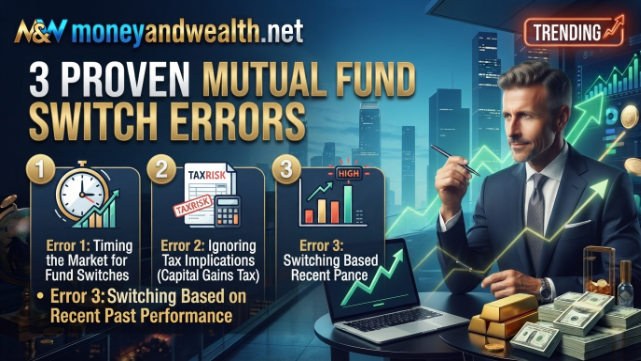
3 Proven Mutual Fund Switch Errors: Error Number 1 – Chasing Recent Performance

The first and perhaps most common mistake is chasing recent returns.
Many investors review annual rankings and immediately transfer their investments into the latest top-performing fund. Although this seems logical, past performance does not guarantee future results.
Fund categories move through cycles. A sector or style that performed exceptionally last year may underperform next year. As a result, investors who chase performance often buy at high valuations and experience disappointing returns later.
Consider an investor who notices a fund delivering exceptional returns over the previous twelve months. Excited by the numbers, the investor switches immediately. However, the fund may have already completed most of its growth cycle.
A better approach involves evaluating: 3 Proven Mutual Fund Switch Errors
Investment Philosophy
Understand how the fund manager invests. Consistent processes often matter more than short-term performance.
Risk-Adjusted Returns
Look beyond absolute returns. Analyze volatility, downside protection, and consistency.
Long-Term Track Record
Evaluate performance across different market environments instead of focusing only on one year.
Benchmark Comparison
Compare the fund with relevant benchmarks and peers over longer periods.
When investors focus only on recent rankings, they ignore important quality indicators. Therefore, avoiding performance chasing can significantly improve investment outcomes.
Signs You Are Chasing Returns
Many investors do not realize they are making this mistake. Some common warning signs include:
Frequently Monitoring Rankings
Checking rankings every week often leads to unnecessary decisions.
Switching After Media Headlines
Financial news frequently highlights top-performing funds. Following headlines alone can be dangerous.
Ignoring Your Original Goal
If your objective has not changed, a switch may not be necessary.
Comparing Only Short-Term Results
One-year performance rarely tells the complete story.
I have seen investors move through multiple funds within a few years simply because they followed recent winners. Unfortunately, this approach often generates lower returns than staying invested in a quality portfolio. 3 Proven Mutual Fund Switch Errors
3 Proven Mutual Fund Switch Errors How To Evaluate A Fund Before Switching
Instead of reacting emotionally, evaluate funds systematically.
Portfolio Quality
Review the underlying holdings and diversification.
Expense Ratio
Lower costs can improve long-term returns.
Fund Manager Experience
Experienced management teams often navigate challenging markets more effectively.
Consistency
Look for funds that deliver reasonable performance across market cycles.
Investment Objective
Ensure the fund matches your financial goals and risk tolerance.
The purpose of investing is not to own the highest-performing fund every year. The objective is achieving your long-term financial goals with acceptable risk.
The Hidden Cost Of Performance Chasing
Performance chasing creates multiple hidden costs.
First, investors may miss future recoveries in the original fund.
Second, repeated transactions can create tax consequences.
Third, emotional decision-making increases stress and uncertainty.
Finally, constant switching makes it difficult to maintain a disciplined investment strategy.
Therefore, before making any changes, ask yourself whether the switch supports your long-term objectives or simply reflects short-term excitement.
The investors who build significant wealth are often those who remain disciplined during periods of uncertainty. They focus on process rather than short-term rankings.
Understanding this principle is the first step in learning how to avoid costly mutual fund switching mistakes.
In the next section, we will discuss the second major mistake that investors make when changing mutual funds and how it can directly affect long-term portfolio growth. 3 Proven Mutual Fund Switch Errors
Avoid 3 Costly Mutual Fund Switch Errors 2026: Error Number 2 – Ignoring Tax And Exit Load Consequences
Many investors spend hours comparing returns but completely ignore taxes and exit loads. This is one of the biggest reasons why a seemingly smart switch can become an expensive decision. When discussing Avoid 3 Costly Mutual Fund Switch Errors 2026, this mistake deserves special attention because it directly impacts the money that remains in your portfolio.
A mutual fund switch is often treated like a simple transfer. However, in most cases, redeeming one fund and investing in another can create a taxable event. Investors sometimes focus entirely on expected future returns while overlooking the immediate costs generated by the switch. As a result, the actual benefit becomes much smaller than anticipated.
I have seen investors switch funds after seeing slightly better performance elsewhere. Later, they realized that taxes and charges had reduced a significant portion of their gains. The difference between expected returns and actual returns surprised them. Therefore, before making any switch, it is important to calculate all associated costs.
Understanding these costs does not mean avoiding every switch. Instead, it means making informed decisions. A switch should create meaningful long-term benefits that outweigh any immediate expenses. If the expected advantage is small, the costs may not justify the change. 3 Proven Mutual Fund Switch Errors
Why Taxes Matter During A Fund Switch
Whenever investors redeem units from a mutual fund, capital gains may arise. These gains can affect overall returns. Many people forget to include this factor when comparing two funds.
Imagine an investor who has accumulated substantial gains over several years. A sudden switch could trigger taxes that reduce the amount available for reinvestment. Consequently, the investor starts the new investment journey with less capital than expected.
This is why professional investors often calculate the after-tax impact before taking action. They understand that preserving capital is just as important as generating returns. 3 Proven Mutual Fund Switch Errors
Exit Loads Can Reduce Your Profit
Another overlooked factor is the exit load.
Some mutual funds charge an exit load if investors redeem units within a specified period. The percentage may appear small, but it can still affect returns, especially for large portfolios.
I have listened to investment professionals emphasize that every cost matters. Even a small deduction can have a noticeable impact when compounded over many years. Therefore, checking exit load conditions should always be part of the decision-making process.
Investors who ignore these charges may believe they are improving their portfolios while unknowingly reducing their overall gains. 3 Proven Mutual Fund Switch Errors
Questions To Ask Before Switching
Before making any change, consider the following questions:
- What is the expected tax impact?
- Does the current fund have an exit load?
- Will the new fund provide enough additional value to justify these costs?
- Is the switch aligned with long-term financial goals?
- Am I reacting emotionally or making a data-driven decision?
These questions can prevent costly mistakes and improve decision quality. 3 Proven Mutual Fund Switch Errors
3 Proven Mutual Fund Switch Errors- Error Number 3 – Switching Without A Clear Investment Objective
The third mistake is switching funds without understanding why the switch is necessary. This error is extremely common because many investors follow trends rather than strategies.
When discussing Avoid 3 Costly Mutual Fund Switch Errors 2026, this mistake often causes the greatest long-term damage. Investors frequently move money between funds without a clear objective. As a result, portfolios become inconsistent and difficult to manage.
Every mutual fund serves a specific purpose. Some focus on growth. Others prioritize stability. Some are designed for income generation, while others target aggressive wealth creation.
If an investor does not understand the role of each fund, switching can create confusion and weaken portfolio structure. 3 Proven Mutual Fund Switch Errors
Define Your Goal First
Before considering any switch, clearly define your objective.
Are you investing for retirement?
Are you building wealth for long-term goals?
Do you need regular income?
Are you seeking diversification?
The answers to these questions determine whether a switch makes sense.
I have seen investors switch from diversified funds to thematic funds simply because recent returns looked attractive. Later, market conditions changed and the portfolio became much riskier than intended.
A clear objective helps investors avoid these mistakes. 3 Proven Mutual Fund Switch Errors
Avoid Emotional Investing
Emotions remain one of the biggest threats to investment success.
Fear and greed often drive switching decisions. During market declines, fear encourages investors to sell. During rallies, greed encourages them to chase high-performing funds.
Neither approach supports long-term wealth creation.
Successful investors follow a structured process. They review performance periodically, evaluate objectives, and make adjustments only when necessary.
Create A Fund Review Framework
A structured review process can reduce unnecessary switching.
Consider reviewing:
- Fund performance over multiple years
- Consistency versus benchmarks
- Portfolio allocation
- Risk levels
- Expense ratios
- Goal alignment
This framework helps investors make logical decisions instead of emotional ones. 3 Proven Mutual Fund Switch Errors
3 Proven Mutual Fund Switch Errors-How Smart Investors Handle Mutual Fund Switching
Smart investors understand that switching is a strategic tool rather than a reaction.
They do not switch because of temporary market noise. Instead, they focus on long-term outcomes. They evaluate data, compare alternatives, and consider costs before taking action.
Many experienced investors follow a simple principle: if the original investment thesis remains valid, there may be no reason to switch.
This mindset prevents unnecessary activity and supports disciplined investing.
I have seen that investors who remain patient often outperform those who constantly adjust their portfolios. Consistency frequently produces better results than frequent changes. 3 Proven Mutual Fund Switch Errors
3 Proven Mutual Fund Switch Errors-Warning Signs That A Switch May Be Necessary
Although unnecessary switching should be avoided, there are situations where a switch may be appropriate.
Some examples include:
Persistent Underperformance
If a fund consistently underperforms its benchmark and peers over an extended period, a review may be warranted.
Change In Investment Strategy
If the fund changes its investment mandate significantly, it may no longer align with your objectives.
Portfolio Rebalancing Needs
Asset allocation changes may require adjustments.
Financial Goal Changes
New goals sometimes require different investment approaches.
The key is ensuring that every switch has a clear rationale. 3 Proven Mutual Fund Switch Errors
My Experience With Mutual Fund Switching Decisions
My experience is that investors often underestimate the importance of patience. I have seen investors become frustrated after a few months of underperformance and immediately search for alternatives.
However, long-term investing rarely rewards impatience.
I have listened to many experienced investors explain that market cycles are normal. Even excellent funds experience temporary periods of weaker performance. Therefore, reacting too quickly can be counterproductive.
I have found in various studies and expert discussions that disciplined investors generally focus on long-term trends rather than short-term fluctuations. This approach reduces emotional decisions and improves consistency.
The most successful investors typically review their portfolios regularly but act selectively. They understand that activity does not always equal progress. 3 Proven Mutual Fund Switch Errors
How To Build A Mutual Fund Switching Checklist In 2026
One of the most effective ways to implement the lessons from Avoid 3 Costly Mutual Fund Switch Errors 2026 is by creating a structured checklist. Many investors make mistakes because they act quickly. A checklist forces you to slow down and evaluate the situation objectively.
Professional investors rarely make decisions based on a single factor. Instead, they review multiple criteria before making portfolio changes. This disciplined process reduces emotional investing and improves long-term outcomes.
Before switching any mutual fund, ask yourself the following:
- Has the fund consistently underperformed for at least three years?
- Has the fund manager changed recently?
- Has the investment strategy changed significantly?
- Does the fund still match my financial goals?
- What are the tax implications?
- Is there an exit load?
- Am I switching because of data or emotions?
- Will the new fund genuinely improve my portfolio?
If most answers support the switch, then the decision may be justified. Otherwise, remaining invested could be the better option.
I have seen that investors who follow a written checklist make fewer mistakes than those who rely solely on market news or social media opinions. 3 Proven Mutual Fund Switch Errors
3 Proven Mutual Fund Switch Errors-During Market Volatility
Market volatility often triggers unnecessary switching activity. When markets fall sharply, investors begin questioning every investment decision. Fear becomes the dominant emotion.
During these periods, many investors abandon long-term plans and move into funds that appear safer. Unfortunately, these decisions often occur near market lows.
A few months later, when markets recover, those same investors move back into growth-oriented funds. This cycle of selling low and buying high can significantly reduce returns.
The principles behind Avoid 3 Costly Mutual Fund Switch Errors 2026 become especially important during volatile periods. Investors should remember that short-term market fluctuations do not automatically indicate that a fund has become unsuitable.
Instead of reacting immediately, consider:
Reviewing The Original Investment Thesis
Why did you invest in the fund originally?
If the reasons remain valid, a switch may not be necessary.
Evaluating Long-Term Performance
Look beyond recent months.
Assess performance across complete market cycles.
Comparing Risk Metrics
Determine whether the fund continues to meet your risk tolerance.
Avoiding Panic Decisions
Temporary market declines are normal.
A disciplined approach often delivers better outcomes than emotional reactions.
I have listened to experienced market participants explain that volatility creates opportunities for patient investors. Therefore, staying focused on long-term goals remains essential. 3 Proven Mutual Fund Switch Errors
3 Proven Mutual Fund Switch Errors-Common Myths About Mutual Fund Switching
Many misconceptions influence investor behavior. Understanding these myths can help avoid costly decisions.
Myth 1: The Highest Returning Fund Is Always The Best Choice
High returns alone do not guarantee suitability.
A fund must also align with your goals, risk profile, and investment horizon.
Myth 2: Frequent Switching Improves Returns
Research and practical experience often show the opposite.
Excessive activity frequently reduces overall performance.
Myth 3: Short-Term Underperformance Means The Fund Has Failed
Even strong funds experience temporary periods of weakness.
Long-term evaluation is usually more meaningful.
Myth 4: Switching Has No Cost
Taxes and exit loads can reduce actual returns.
Ignoring these costs may create unexpected consequences.
Myth 5: Everyone Else Is Switching
Investment decisions should be based on personal objectives, not crowd behavior.
I have seen investors make poor decisions simply because friends, relatives, or online communities recommended a switch. Following the crowd rarely guarantees success. 3 Proven Mutual Fund Switch Errors
3 Proven Mutual Fund Switch Errors-The Importance Of Asset Allocation Before Switching
Asset allocation plays a major role in portfolio performance.
Many investors focus exclusively on individual funds while ignoring overall portfolio structure. However, diversification and allocation often have a greater impact than selecting a specific fund.
Before switching, review your allocation across: 3 Proven Mutual Fund Switch Errors
Equity Funds
Suitable for long-term growth.
Debt Funds
Useful for stability and income generation.
Hybrid Funds
Provide a balance between growth and stability.
International Exposure
Can improve diversification in some portfolios.
Sometimes a perceived fund problem is actually an allocation issue. Therefore, evaluating the entire portfolio before making changes is critical. 3 Proven Mutual Fund Switch Errors
Real-Life Example Of A Costly Switching Mistake
Consider a hypothetical investor named Rahul.
Rahul invested in a diversified equity fund and achieved reasonable returns for several years. One year, another fund delivered exceptional performance and became widely discussed online.
Convinced that he was missing an opportunity, Rahul switched his entire investment.
Unfortunately, the new fund experienced weaker performance over the next two years. Meanwhile, his original fund recovered strongly.
In addition, Rahul paid taxes and exit charges during the switch.
The result was lower returns and unnecessary costs.
I have seen similar situations occur many times. Investors often focus on recent performance while ignoring broader considerations.
This example highlights why Avoid 3 Costly Mutual Fund Switch Errors 2026 is such an important topic for long-term investors. 3 Proven Mutual Fund Switch Errors
Expert Strategies To Avoid Switching Mistakes
Successful investors often follow a few simple strategies.
Strategy 1: Establish Clear Review Dates
Instead of reviewing investments daily, choose quarterly or annual review periods.
This reduces emotional reactions.
Strategy 2: Focus On Long-Term Goals
Every decision should support a specific financial objective.
Strategy 3: Document Every Switch Decision
Write down the reason for each switch.
This creates accountability and improves decision quality.
Strategy 4: Analyze Costs First
Calculate taxes and exit loads before making changes. 3 Proven Mutual Fund Switch Errors
Strategy 5: Diversify Properly
A diversified portfolio often reduces the need for frequent switching.
I have found that investors who follow these principles generally maintain greater consistency and confidence during changing market conditions.Advanced Portfolio Review Framework To Avoid Mutual Fund Switching Mistakes
Investors who successfully implement the principles behind Avoid 3 Costly Mutual Fund Switch Errors 2026 usually follow a structured review framework. Instead of making decisions based on emotions, they analyze measurable factors.
A portfolio review does not need to be complicated. However, it should be thorough enough to identify genuine concerns. The purpose is not to find reasons to switch. The purpose is to determine whether the current investment still supports long-term objectives.
When reviewing a fund, focus on: 3 Proven Mutual Fund Switch Errors
Consistency Of Returns
Consistency is often more important than occasional exceptional performance.
A fund that delivers stable results across different market conditions may be preferable to one that experiences extreme highs and lows.
Risk Management
Examine how the fund performs during market downturns.
Some funds protect capital better during difficult periods.
Portfolio Diversification
Review sector allocation, stock concentration, and overall diversification.
Excessive concentration can increase risk.
Fund Management Stability
Frequent changes in management can affect future performance.
Therefore, understanding who manages the fund remains important.
Expense Efficiency
Even small cost differences can influence long-term outcomes through compounding.
I have seen investors ignore expense ratios because the difference appeared small. However, over many years, those differences can become significant. 3 Proven Mutual Fund Switch Errors
Why Patience Is Often More Profitable Than Switching
One lesson repeatedly emerges when discussing Avoid 3 Costly Mutual Fund Switch Errors 2026: patience frequently outperforms frequent action.
Many investors believe successful investing requires constant adjustments. In reality, some of the best investment decisions involve doing nothing.
Markets naturally move through cycles.
Growth strategies may outperform for several years and then underperform.
Value-oriented approaches may struggle temporarily before recovering.
Sector leadership changes over time.
Therefore, judging a fund based on a short period can be misleading.
I have listened to experienced investors explain that successful wealth creation often depends on remaining invested through both good and difficult periods. Investors who constantly move between funds may miss the benefits of long-term compounding.
Patience does not mean ignoring problems. Instead, it means distinguishing between temporary setbacks and genuine concerns. 3 Proven Mutual Fund Switch Errors
How Technology Influences Mutual Fund Switching Decisions
Technology has made investing more accessible than ever.
Investors can now compare funds, track performance, and execute transactions within minutes. While this convenience offers advantages, it also creates new challenges.
Easy access sometimes encourages excessive activity.
When switching requires only a few clicks, investors may act impulsively.
Financial apps frequently display rankings, performance charts, and trending investments. Although useful, this information can tempt investors to chase short-term results.
The key is using technology as a research tool rather than a trigger for emotional decisions.
Before acting on information obtained through investment platforms, ask:
- Does this information support my long-term strategy?
- Am I reacting to recent performance?
- Have I evaluated the costs?
- Does the switch improve diversification?
These questions help maintain discipline. 3 Proven Mutual Fund Switch Errors
Avoid 3 Costly Mutual Fund Switch Errors 2026 For SIP Investors
Systematic Investment Plan investors face unique challenges.
Because SIPs involve regular investments, market fluctuations often create emotional reactions. During market corrections, some investors stop SIPs or switch funds prematurely.
This can be a costly mistake.
SIPs are designed to benefit from long-term investing and cost averaging. Temporary volatility is part of the process.
When evaluating SIP investments, consider: 3 Proven Mutual Fund Switch Errors
Goal Alignment
Does the fund still support the intended financial goal?
Time Horizon
Long-term goals generally require a longer evaluation period.
Fund Quality
Has the fund maintained a disciplined investment approach?
Performance Relative To Expectations
Compare actual performance with realistic expectations rather than market hype.
I have seen SIP investors achieve excellent results simply by remaining consistent while others switched repeatedly and experienced disappointing outcomes. 3 Proven Mutual Fund Switch Errors
Behavioral Biases That Cause Switching Mistakes
Human psychology plays a major role in investing.
Several behavioral biases contribute to poor switching decisions.
Recency Bias
Investors give excessive importance to recent events.
A fund that performed well recently appears more attractive even if long-term performance is average.
Herd Mentality
People often follow the crowd.
If everyone appears to be investing in a particular fund, investors may feel pressure to do the same.
Loss Aversion
Losses often feel more painful than gains feel rewarding.
As a result, investors sometimes switch prematurely to avoid discomfort.
Overconfidence
Some investors believe they can consistently identify future winners.
This confidence can lead to excessive portfolio changes.
Understanding these biases improves decision-making and supports better investment outcomes. 3 Proven Mutual Fund Switch Errors
Pro Tips Most Investors Ignore
Many discussions about mutual funds focus on returns. However, successful investors often pay attention to factors that receive less attention.
Review Portfolio Overlap
Multiple funds may own many of the same underlying investments.
Therefore, adding another fund may not increase diversification.
Focus On Process Rather Than Predictions
Predicting short-term market movements is difficult.
Evaluating investment processes is usually more productive.
Track Decisions
Maintain a record of why you invested and why you switched.
This habit improves accountability.
Avoid Information Overload
Too much information can create confusion.
Focus on data that genuinely influences investment outcomes.
Maintain Realistic Expectations
Every investment experiences periods of underperformance.
Unrealistic expectations often lead to unnecessary changes.
I have found that investors who follow these principles generally make calmer and more rational decisions. 3 Proven Mutual Fund Switch Errors
Future Trends Affecting Mutual Fund Investors In 2026 And Beyond
The investment landscape continues to evolve.
Several trends may influence future switching decisions.
Increased Transparency
Investors have access to more information than ever before.
This can improve decision quality when used correctly.
Greater Focus On Costs
Expense awareness continues to grow.
Investors increasingly evaluate net returns rather than headline performance.
Digital Advisory Services
Technology-driven advisory platforms are becoming more common.
These tools may help investors maintain discipline.
Enhanced Portfolio Analytics
Advanced analytics allow investors to evaluate risk and diversification more effectively.
While these developments create opportunities, the core principles remain unchanged.
Successful investing still depends on discipline, patience, and objective decision-making.
IT IS IMPORTANT 3 Proven Mutual Fund Switch Errors
Frequently Asked Questions
What Is The Biggest Mutual Fund Switching Mistake?
The biggest mistake is chasing recent performance without evaluating long-term suitability, risk, and costs.
Should I Switch Funds After One Year Of Underperformance?
Not necessarily. Evaluate performance across multiple years and market cycles before making a decision.
Do Mutual Fund Switches Trigger Taxes?
In many situations, redeeming units may create taxable gains. Investors should evaluate the tax impact before switching.
How Often Should I Review My Mutual Funds?
Most investors benefit from quarterly or annual reviews rather than frequent monitoring.
Is Switching From A Regular Fund To A Direct Fund A Good Idea?
In some cases, lower expenses can improve long-term returns. However, investors should assess their individual circumstances before making changes.
Key Takeaways From Avoid 3 Costly Mutual Fund Switch Errors 2026
The lessons from Avoid 3 Costly Mutual Fund Switch Errors 2026 are straightforward but powerful.
Avoid chasing recent performance.
Understand taxes and exit loads.
Always maintain a clear investment objective.
Review portfolios systematically.
Stay patient during volatility.
Focus on long-term wealth creation rather than short-term rankings.
I have seen that investors who follow these principles generally experience fewer regrets and better investment outcomes. While no strategy guarantees success, disciplined decision-making can significantly improve the probability of achieving financial goals.
Most importantly, remember that investing is a marathon rather than a sprint. The goal is not to find the perfect fund every year. The goal is to build sustainable wealth through thoughtful, consistent, and informed decisions.
Avoid 3 Costly Mutual Fund Switch Errors 2026 should serve as a reminder that successful investing often depends more on avoiding mistakes than on finding shortcuts. Patience, research, and discipline remain some of the most valuable tools available to any investor. 3 Proven Mutual Fund Switch Errors
Conclusion
Avoid 3 Costly Mutual Fund Switch Errors 2026 is ultimately about protecting long-term wealth.
Many investors believe that finding the next top-performing fund is the secret to success. However, real-world experience often shows that avoiding major mistakes can be even more valuable.
The three critical errors are:
- Chasing recent performance.
- Ignoring taxes and exit loads.
- Switching without a clear investment objective.
By avoiding these mistakes, investors can create stronger portfolios and make more informed decisions.
I have seen that disciplined investors typically focus on goals, risk management, and consistency rather than short-term market excitement. They understand that successful investing is not about constant activity. It is about making thoughtful decisions that support long-term financial objectives.
The next time you consider changing a mutual fund, take a moment to review your reasons carefully. Analyze costs, evaluate goals, assess performance across complete market cycles, and ensure that the decision genuinely improves your strategy.
In many situations, the best investment move is not switching at all. Instead, it is remaining committed to a well-designed plan and allowing compounding to work over time.
That simple principle can make a significant difference in long-term wealth creation and help investors truly Avoid 3 Costly Mutual Fund Switch Errors 2026 while building a more successful financial future. 3 Proven Mutual Fund Switch Errors