
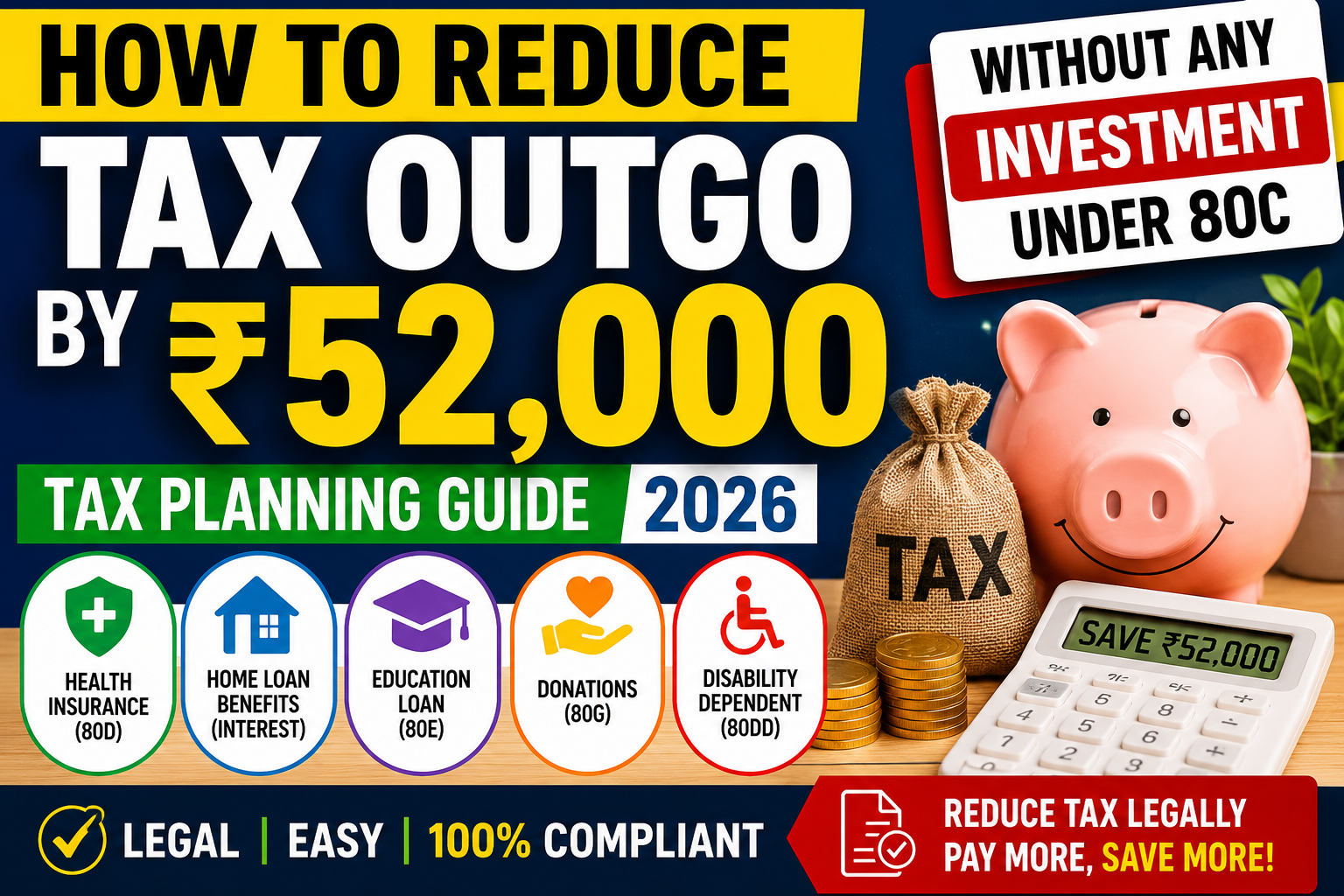
How Smartly Reduce Tax Outgo By ₹52000 In 2026 Without Any Investment Under 80C is a question that many salaried employees ask every year while filing their income tax returns. Most taxpayers believe that tax saving is possible only through investments under Section 80C. However, that is not completely true. I have seen many professionals who managed to legally reduce their tax liability without locking money into traditional tax-saving investments.
If you are someone who wants to keep liquidity, avoid long lock-in periods, and still reduce taxes legally, this guide can help you understand practical options available under Indian tax laws. The good part is that many of these benefits are already available to salaried individuals, but they often remain unused because people are unaware of them.
Why Understanding How To Reduce Tax Outgo By ₹52000 Without Any Investment Under 80C Matters
Many employees rush at the end of the financial year to buy tax-saving products. In most cases, these investments are made only to save tax and not because they align with long-term financial goals.
Understanding How To Reduce Tax Outgo By ₹52000 Without Any Investment Under 80C can help you retain flexibility while optimizing your tax position. Instead of locking money into products you may not need, you can use deductions, exemptions, and allowances that already exist in the tax framework.
Moreover, smart tax planning improves cash flow. When your monthly tax burden reduces, you can redirect that money toward emergency funds, mutual funds, or debt reduction.
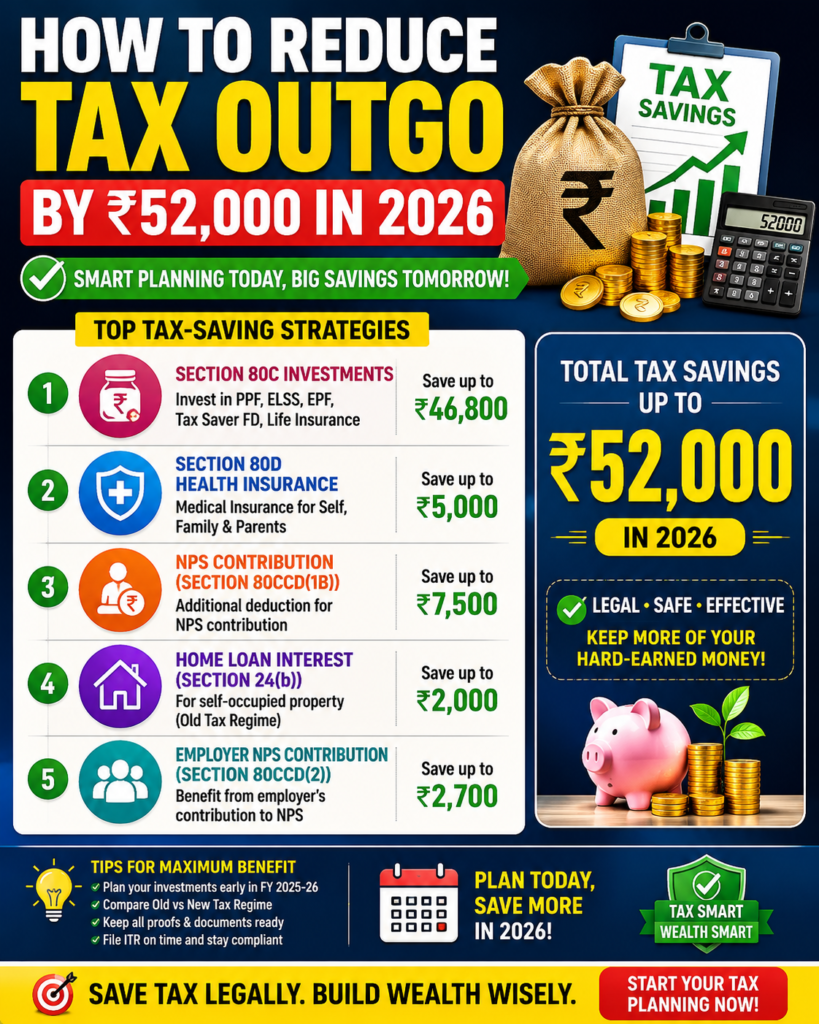
Table of Contents
House Rent Allowance Can Significantly Reduce Tax
One of the most powerful ways related to How To Reduce Tax Outgo By ₹52000 Without Any Investment Under 80C is claiming House Rent Allowance or HRA.
If you live in rented accommodation and receive HRA as part of your salary package, a portion of the allowance can become tax-free.
Many salaried employees fail to submit rent receipts on time. As a result, they lose valuable tax benefits. I have personally observed employees paying thousands in extra taxes simply because they ignored HRA documentation.
The amount of exemption depends on salary structure, rent paid, and city of residence. For people living in metro cities, the benefit can be substantial.
Standard Deduction Offers Automatic Tax Relief
When discussing How To Reduce Tax Outgo By ₹52000 Without Any Investment Under 80C, the standard deduction deserves special attention.
The government provides a standard deduction for eligible salaried taxpayers. This deduction directly reduces taxable income without requiring any investment.
The biggest advantage is simplicity. There is no paperwork, no proof submission, and no lock-in period. The deduction automatically lowers taxable income and reduces tax liability.
For many individuals, this forms the foundation of tax planning before considering other deductions.
How Smartly Reduce Tax Outgo By ₹52000 In 2026-Leave Travel Allowance Can Help Lower Taxes
Another useful strategy for How To Reduce Tax Outgo By ₹52000 Without Any Investment Under 80C is Leave Travel Allowance or LTA.
If your employer provides LTA and you undertake eligible travel within India, reimbursement can qualify for tax exemption under specified conditions.
Families who already travel for vacations can use this benefit efficiently. Instead of spending additional money solely for tax purposes, they can align travel plans with available exemptions.
Maintaining travel tickets and records becomes important for claiming this benefit.
Home Loan Interest Deduction
A frequently overlooked method connected with How To Reduce Tax Outgo By ₹52000 Without Any Investment Under 80C is home loan interest deduction.
While principal repayment generally falls under Section 80C, interest paid on a housing loan may qualify for separate tax benefits under applicable provisions.
For homeowners, this can substantially reduce taxable income. The deduction becomes especially valuable during the early years of a home loan when interest payments are higher.
Deduction For Education Loan Interest
Individuals paying education loan interest can also benefit when exploring How To Reduce Tax Outgo By ₹52000 Without Any Investment Under 80C.
Unlike many investment-based deductions, this benefit relates directly to interest paid on eligible education loans.
Students pursuing higher education or parents supporting educational goals can potentially lower taxable income through this route.
Because there is no upper monetary cap in certain situations, the benefit can become meaningful over time.
Health Insurance Paid By Employer
A smart but often ignored aspect of How To Reduce Tax Outgo By ₹52000 Without Any Investment Under 80C involves employer-provided benefits.
Some organizations offer group health insurance plans. Employees receiving this coverage may enjoy indirect financial advantages because they avoid separate insurance expenses.
Additionally, employer-structured benefits can sometimes improve overall tax efficiency depending on compensation design.
Reviewing your salary structure annually is therefore essential.
Smart Salary Restructuring
How To Reduce Tax Outgo By ₹52000 Without Any Investment Under 80C often depends on salary structure rather than additional investments.
Many companies allow employees to choose flexible benefit plans. Components such as meal benefits, telephone reimbursements, internet reimbursements, and other eligible allowances may improve tax efficiency.
I have seen professionals reduce annual tax liability significantly simply by restructuring salary components during appraisal discussions.
Always consult HR or a qualified tax professional before making changes.
Common Mistakes That Increase Tax Liability
Many taxpayers fail to benefit from How To Reduce Tax Outgo By ₹52000 Without Any Investment Under 80C because of avoidable mistakes.
The most common errors include:
- Ignoring HRA eligibility.
- Missing LTA claims.
- Not reviewing salary structure.
- Choosing the wrong tax regime.
- Delaying tax planning until March.
- Failing to maintain documents.
- Not understanding available deductions.
Avoiding these mistakes can often save more money than chasing complex tax strategies.
Real-Life Example
Consider a salaried employee earning ₹10 lakh annually.
The employee receives HRA, qualifies for standard deduction, claims eligible home loan interest, and utilizes available salary allowances. Without investing a single rupee under Section 80C, taxable income may reduce considerably.
As a result, overall tax savings can approach the level discussed in this article, depending on individual circumstances and prevailing tax rules.
This example demonstrates why understanding How To Reduce Tax Outgo By ₹52000 Without Any Investment Under 80C is important for working professionals.
Advanced Tax Planning Tips
People who successfully implement How To Reduce Tax Outgo By ₹52000 Without Any Investment Under 80C generally follow a few habits.
They review salary structures annually.
They compare old and new tax regimes before filing returns.
They maintain proper records throughout the year.
They understand employer-provided benefits.
They stay updated on tax law changes.
Most importantly, they plan taxes throughout the year rather than waiting until the deadline approaches.
How To Reduce Tax Outgo By ₹52000 Without Any Investment Under 80C: Detailed Tax Planning Strategies
Many people think tax planning starts and ends with Section 80C. However, when I speak with salaried employees, I often notice that they focus only on ELSS, PPF, life insurance, or tax-saving fixed deposits. As a result, they miss several legitimate opportunities available outside Section 80C. Understanding How To Reduce Tax Outgo By ₹52000 Without Any Investment Under 80C requires looking at the complete tax picture rather than a single section of the Income Tax Act.
Tax planning should never be a last-minute exercise. The most successful taxpayers begin planning at the start of the financial year. They review salary structures, estimate taxable income, compare tax regimes, and maintain records throughout the year. This proactive approach often creates better tax outcomes than rushing to purchase investments in March.
Another important point is liquidity. Many taxpayers prefer keeping cash available for emergencies, business opportunities, or family needs. In such situations, learning How To Reduce Tax Outgo By ₹52000 Without Any Investment Under 80C becomes extremely valuable because it allows tax savings without locking funds into long-term products.
How To Reduce Tax Outgo By ₹52000 Without Any Investment Under 80C Through the Correct Tax Regime
One of the most overlooked factors in tax planning is selecting the appropriate tax regime. Every year, taxpayers have an opportunity to compare available tax structures and choose the one that offers lower liability according to their financial situation.
I have personally seen cases where employees selected a tax regime without any calculations. Later, they discovered they could have saved thousands of rupees simply by choosing the alternative option. Therefore, before filing returns, always compare total tax liability under both systems.
The right choice depends on factors such as:
- Salary income
- House rent allowance
- Home loan interest
- Professional deductions
- Other exemptions available
This simple comparison often becomes a major part of How To Reduce Tax Outgo By ₹52000 Without Any Investment Under 80C because the savings generated can be significant.
Using Employer Benefits To Reduce Taxes
Most employees receive more than basic salary. Employers frequently provide additional benefits that can improve tax efficiency.
These benefits may include:
- Mobile reimbursement
- Internet reimbursement
- Food benefits
- Travel reimbursements
- Professional development expenses
- Health-related benefits
Unfortunately, many employees ignore these components. They focus only on gross salary and fail to understand how compensation structure affects taxation.
When discussing How To Reduce Tax Outgo By ₹52000 Without Any Investment Under 80C, optimizing employer-provided benefits is often one of the easiest methods because no additional investment is required.
How To Reduce Tax Outgo By ₹52000 Without Any Investment Under 80C Through Smart Documentation
Tax deductions and exemptions become useful only when supported by proper documentation.
Many taxpayers lose benefits because they cannot produce supporting records. This happens more frequently than people realize.
For example:
- Missing rent receipts
- Lost travel tickets
- Incomplete employer declarations
- Incorrect salary proofs
- Unavailable loan statements
I have observed employees paying higher taxes despite being eligible for exemptions simply because they lacked documentation.
A dedicated folder for tax documents can solve this problem. Store rent receipts, salary slips, bank statements, loan certificates, and reimbursement proofs throughout the year.
Good record keeping is an underrated but essential part of How To Reduce Tax Outgo By ₹52000 Without Any Investment Under 80C.
Importance Of Reviewing Form 16
Form 16 serves as a critical document for salaried taxpayers. It contains important information regarding salary income and tax deducted at source.
Before filing returns, review Form 16 carefully.
Check:
- Salary details
- Tax deducted
- Allowances
- Exemptions
- PAN information
Any error should be corrected immediately with the employer.
A simple review can prevent unnecessary tax payments and ensure maximum utilization of available benefits.
How To Reduce Tax Outgo By ₹52000 Without Any Investment Under 80C Through Family Tax Planning
Family tax planning is another area that many people ignore.
While every financial decision should be genuine and legally compliant, understanding how family finances affect taxation can create opportunities for efficient planning.
For example:
- Proper ownership of assets
- Correct reporting of income
- Education-related expenses
- Housing-related arrangements
These considerations may help improve overall household tax efficiency.
However, always ensure compliance with applicable tax laws and avoid artificial arrangements created solely for tax avoidance.
Why Early Tax Planning Works Better
Most taxpayers begin tax planning during January, February, or March. Unfortunately, this approach limits available options.
People who start in April enjoy several advantages:
- More preparation time
- Better documentation
- Improved salary planning
- Accurate tax projections
- Reduced last-minute stress
Early planning makes How To Reduce Tax Outgo By ₹52000 Without Any Investment Under 80C much easier because decisions are based on strategy rather than panic.
Advanced Insights On How To Reduce Tax Outgo By ₹52000 Without Any Investment Under 80C
Experienced taxpayers often follow a systematic approach.
First, they estimate annual income.
Second, they identify available exemptions.
Third, they compare tax regimes.
Fourth, they organize supporting documents.
Finally, they review calculations before filing.
This process reduces mistakes and increases the probability of maximizing legitimate tax benefits.
I have noticed that disciplined taxpayers usually pay less tax than equally earning individuals who ignore planning. The difference is not income. The difference is awareness and execution.
The Role Of Financial Literacy
Financial literacy plays a major role in tax savings.
People frequently spend hours searching for investment products but very little time understanding tax rules.
Learning basic tax concepts can provide long-term benefits because tax planning becomes easier every year.
Knowledge helps you:
- Identify opportunities
- Avoid mistakes
- Improve cash flow
- Build wealth faster
- Make better financial decisions
That is why understanding How To Reduce Tax Outgo By ₹52000 Without Any Investment Under 80C should be viewed as part of overall financial education rather than merely a tax-saving exercise.
Common Myths About Tax Saving
Several myths prevent taxpayers from optimizing their taxes.
Myth 1: Only Section 80C Saves Tax
This is incorrect.
Multiple deductions, exemptions, and salary benefits exist outside Section 80C.
Myth 2: Tax Planning Is Only For High Earners
Wrong.
Even middle-income salaried employees can benefit significantly from proper planning.
Myth 3: Tax Planning Is Complicated
Most tax-saving opportunities involve basic awareness and documentation.
Myth 4: Tax Saving Means Buying Products
Not necessarily.
Many tax benefits do not require new investments.
Understanding these myths is important when learning How To Reduce Tax Outgo By ₹52000 Without Any Investment Under 80C because misconceptions often lead to poor decisions.
A Practical Annual Tax Planning Checklist
To successfully implement How To Reduce Tax Outgo By ₹52000 Without Any Investment Under 80C, follow this annual checklist:
- Review salary structure in April.
- Estimate annual taxable income.
- Compare tax regimes.
- Maintain rent receipts.
- Preserve travel records.
- Collect loan statements.
- Track reimbursements.
- Verify Form 16.
- Review deductions before filing.
- File returns before deadlines.
This checklist may appear simple, but consistent execution often creates meaningful tax savings.
Expert Observation
Financial experts frequently emphasize that tax planning should support overall financial goals.
A tax-saving strategy that hurts liquidity or creates unnecessary commitments may not always be the best option.
That is why many professionals prefer exploring How To Reduce Tax Outgo By ₹52000 Without Any Investment Under 80C before purchasing tax-saving products. This approach allows them to preserve flexibility while still reducing tax liability legally.
In the next section, we will cover a detailed case study, advanced salary restructuring examples, high-income employee tax planning techniques, and additional FAQs to further strengthen your understanding of How To Reduce Tax Outgo By ₹52000 Without Any Investment Under 80C.
Detailed Case Study: How To Reduce Tax Outgo By ₹52000 In 2026 For A Salaried Employee
Understanding How To Reduce Tax Outgo By ₹52000 In 2026 becomes easier when we look at a practical example. Suppose Rahul is a salaried employee earning ₹12 lakh annually. Like many professionals, he believed that tax saving was possible only through Section 80C investments. However, after reviewing his salary structure and available exemptions, he discovered multiple opportunities.
Rahul claimed House Rent Allowance based on actual rent payments. He utilized the standard deduction available to salaried taxpayers. He also claimed eligible Leave Travel Allowance and reviewed his home loan interest deduction. These benefits collectively reduced his taxable income significantly. The result was a substantial reduction in tax liability without making any additional investment under Section 80C.
This example demonstrates that How To Reduce Tax Outgo By ₹52000 In 2026 is not about finding loopholes. Instead, it is about understanding the tax rules and using them effectively. Many taxpayers focus only on tax-saving products while ignoring deductions already available to them.
Another lesson from Rahul’s experience is the importance of planning. Because he started tax planning at the beginning of the financial year, he had enough time to organize documents and maximize eligible benefits. Taxpayers who delay planning often miss opportunities that could help them achieve How To Reduce Tax Outgo By ₹52000 In 2026.
How To Reduce Tax Outgo By ₹52000 In 2026 Through Salary Restructuring
Salary restructuring remains one of the most effective methods for How To Reduce Tax Outgo By ₹52000 In 2026. Many employers offer flexible compensation structures that allow employees to optimize taxation.
A properly structured salary package may include various allowances and reimbursements. While the exact benefits depend on company policy and applicable tax rules, reviewing the compensation structure annually can lead to significant savings.
I have seen employees receive salary hikes but fail to review how the increase affects taxation. As a result, they end up paying more tax than necessary. A discussion with HR during appraisal season can often create better tax efficiency.
When evaluating How To Reduce Tax Outgo By ₹52000 In 2026, employees should carefully review:
- Salary components
- Allowances
- Employer-provided benefits
- Reimbursements
- Taxable and non-taxable portions
A thoughtful salary structure can contribute substantially toward achieving How To Reduce Tax Outgo By ₹52000 In 2026.
Why Documentation Is Essential For How To Reduce Tax Outgo By ₹52000 In 2026
Many tax benefits are lost because taxpayers fail to maintain records. Even when individuals qualify for exemptions, missing documents can prevent successful claims.
For effective implementation of How To Reduce Tax Outgo By ₹52000 In 2026, keep records such as:
- Rent receipts
- Salary slips
- Loan certificates
- Travel tickets
- Employer declarations
- Reimbursement proofs
Proper documentation not only supports deductions but also reduces stress during tax filing season. Organized taxpayers generally achieve better results when pursuing How To Reduce Tax Outgo By ₹52000 In 2026.
High-Income Professionals And How To Reduce Tax Outgo By ₹52000 In 2026
High-income professionals often face higher tax liabilities. Therefore, they have even greater motivation to understand How To Reduce Tax Outgo By ₹52000 In 2026.
Many professionals assume that higher income automatically means higher taxes. While tax liability does increase with income, effective planning can still improve outcomes.
Successful professionals usually:
- Review taxes quarterly
- Compare tax regimes annually
- Track deductions regularly
- Consult qualified experts when necessary
- Maintain proper financial records
These habits help them implement How To Reduce Tax Outgo By ₹52000 In 2026 consistently year after year.
Another advantage of regular tax reviews is that changes in tax rules can be incorporated early. Waiting until the filing deadline often results in missed opportunities.
Common Errors That Prevent How To Reduce Tax Outgo By ₹52000 In 2026
Many taxpayers unknowingly increase their tax burden through simple mistakes.
One common error is assuming that payroll calculations are always perfect. While payroll systems are generally accurate, employees should still verify tax computations independently.
Another mistake involves ignoring Form 16 details. Taxpayers sometimes discover discrepancies after filing returns, creating unnecessary complications.
A third mistake is failing to compare tax regimes. This single oversight can significantly affect tax liability and reduce the effectiveness of How To Reduce Tax Outgo By ₹52000 In 2026.
Additional mistakes include:
- Missing deadlines
- Ignoring eligible exemptions
- Losing supporting documents
- Delaying tax planning
- Not reviewing salary structure
Avoiding these errors can improve the success rate of How To Reduce Tax Outgo By ₹52000 In 2026.
Expert Tax Planning Habits For How To Reduce Tax Outgo By ₹52000 In 2026
Experts often follow a disciplined process rather than searching for last-minute solutions.
The process usually begins with estimating annual income. After that, they identify available exemptions and deductions. They then compare tax liabilities under different scenarios and maintain documentation throughout the year.
This systematic approach transforms How To Reduce Tax Outgo By ₹52000 In 2026 from a stressful annual task into a routine financial activity.
I have noticed that financially disciplined individuals rarely struggle during tax season. They know where documents are stored, understand their salary structure, and regularly monitor tax-related changes.
These habits create long-term advantages that extend beyond taxation. Better planning improves overall financial management and supports wealth creation.
Frequently Asked Questions About How To Reduce Tax Outgo By ₹52000 In 2026
Is How To Reduce Tax Outgo By ₹52000 In 2026 possible without Section 80C investments?
Yes. Various exemptions, deductions, salary benefits, and tax planning strategies may help reduce tax liability without making additional investments under Section 80C.
Does HRA help with How To Reduce Tax Outgo By ₹52000 In 2026?
Yes. Eligible taxpayers receiving House Rent Allowance can claim exemptions that reduce taxable income.
Can salary restructuring support How To Reduce Tax Outgo By ₹52000 In 2026?
In many cases, yes. Reviewing salary components and employer-provided benefits can improve tax efficiency.
Why is documentation important for How To Reduce Tax Outgo By ₹52000 In 2026?
Proper documentation supports deductions and exemptions. Missing records can result in lost tax benefits.
Should I compare tax regimes for How To Reduce Tax Outgo By ₹52000 In 2026?
Absolutely. Comparing available tax regimes can help identify the option that minimizes overall tax liability.
Final Thoughts On How To Reduce Tax Outgo By ₹52000 In 2026
The biggest misconception in tax planning is believing that tax saving always requires investments. In reality, How To Reduce Tax Outgo By ₹52000 In 2026 often begins with understanding deductions, exemptions, salary benefits, and available tax provisions.
The taxpayers who successfully achieve How To Reduce Tax Outgo By ₹52000 In 2026 are usually not financial experts. They simply stay organized, review their finances regularly, and plan ahead.
If you want to implement How To Reduce Tax Outgo By ₹52000 In 2026, start by reviewing your salary structure, evaluating available exemptions, organizing documents, and comparing tax regimes. Small actions taken consistently throughout the year can create meaningful tax savings while keeping your finances flexible and aligned with your long-term goals.
Advanced Tax Saving Blueprint: How To Reduce Tax Outgo By ₹52000 In 2026
When discussing How To Reduce Tax Outgo By ₹52000 In 2026, most people focus only on deductions. However, experienced taxpayers know that successful tax planning involves a combination of income management, exemption utilization, salary optimization, and proper record keeping. The objective of How To Reduce Tax Outgo By ₹52000 In 2026 is not merely reducing taxes. The real objective is keeping more of your income legally while maintaining financial flexibility.
One important lesson I have learned from observing successful professionals is that they review their tax situation multiple times during the year. They do not wait until March. This habit alone helps them identify opportunities related to How To Reduce Tax Outgo By ₹52000 In 2026 before it becomes too late.
For example, if an employee discovers in January that important documents are missing, there may not be enough time to correct the issue. In contrast, someone who reviews taxes quarterly can fix problems early and improve their chances of achieving How To Reduce Tax Outgo By ₹52000 In 2026.
Monthly Strategy For How To Reduce Tax Outgo By ₹52000 In 2026
A practical approach to How To Reduce Tax Outgo By ₹52000 In 2026 is breaking the process into monthly actions.
April is the ideal month to estimate annual income.
May can be used to review salary components.
June is a good time to organize rent documentation.
July can focus on reimbursement tracking.
August allows taxpayers to review employer benefits.
September is useful for checking tax projections.
October helps identify potential gaps.
November provides an opportunity to compare tax scenarios.
December can be dedicated to document verification.
January and February are ideal for final adjustments.
March should focus on ensuring all eligible benefits have been properly claimed.
Following this schedule makes How To Reduce Tax Outgo By ₹52000 In 2026 far easier than trying to solve everything during the last few weeks of the financial year.
Why Most People Fail At How To Reduce Tax Outgo By ₹52000 In 2026
Many taxpayers struggle with How To Reduce Tax Outgo By ₹52000 In 2026 because they believe tax planning is complicated. In reality, the biggest obstacles are lack of awareness and delayed action.
Common reasons include:
- Not understanding tax rules.
- Ignoring available exemptions.
- Missing documentation.
- Choosing the wrong tax regime.
- Failing to review salary structures.
- Waiting until the last moment.
I have personally seen individuals with identical salaries pay very different amounts of tax. The difference was not income. The difference was planning.
Those who understand How To Reduce Tax Outgo By ₹52000 In 2026 generally start early and remain organized throughout the year.
How To Reduce Tax Outgo By ₹52000 In 2026 Without Locking Money
A major advantage of learning How To Reduce Tax Outgo By ₹52000 In 2026 is that it helps maintain liquidity.
Many tax-saving products require long lock-in periods. While such products can be useful in certain situations, they are not always suitable for everyone.
Young professionals may need liquidity for:
- Career opportunities
- Business ideas
- Emergency funds
- Home purchases
- Family expenses
Therefore, understanding How To Reduce Tax Outgo By ₹52000 In 2026 without relying entirely on locked investments can provide greater financial freedom.
Professional Tax Planning Checklist For How To Reduce Tax Outgo By ₹52000 In 2026
Every taxpayer aiming for How To Reduce Tax Outgo By ₹52000 In 2026 should maintain a simple checklist.
Check salary structure.
Review Form 16 carefully.
Track rent payments.
Maintain travel records.
Store reimbursement documents.
Compare tax regimes.
Verify employer declarations.
Review annual tax calculations.
Confirm deductions and exemptions.
File returns accurately.
This checklist may seem basic, but consistency is often the secret behind successful implementation of How To Reduce Tax Outgo By ₹52000 In 2026.
Real-World Insights On How To Reduce Tax Outgo By ₹52000 In 2026
I have observed several taxpayers who dramatically improved their financial outcomes after learning How To Reduce Tax Outgo By ₹52000 In 2026.
One professional discovered that HRA benefits had never been claimed correctly. Another found salary components that could be optimized. A third taxpayer realized the chosen tax regime was increasing overall liability.
In each case, the solution was not a complex financial product. Instead, it was awareness and proper execution.
This highlights an important principle. How To Reduce Tax Outgo By ₹52000 In 2026 often depends more on understanding the rules than purchasing additional investments.
Long-Term Benefits Of How To Reduce Tax Outgo By ₹52000 In 2026
The benefits extend beyond immediate tax savings.
Taxpayers who master How To Reduce Tax Outgo By ₹52000 In 2026 often develop stronger financial habits.
These habits include:
- Better budgeting
- Improved documentation
- Increased financial awareness
- More informed decision-making
- Greater wealth-building discipline
As a result, the impact of How To Reduce Tax Outgo By ₹52000 In 2026 can continue for many years rather than just one tax season.
Expert-Level Tips For How To Reduce Tax Outgo By ₹52000 In 2026
Experts frequently recommend several advanced practices.
First, review tax liability every quarter.
Second, maintain digital copies of all documents.
Third, monitor salary revisions carefully.
Fourth, understand available exemptions before making financial decisions.
Fifth, compare tax outcomes under different scenarios.
These strategies consistently improve the effectiveness of How To Reduce Tax Outgo By ₹52000 In 2026.
Another useful practice is maintaining a dedicated tax folder. This simple habit saves significant time and reduces the risk of losing critical records.
Final Expert Conclusion On How To Reduce Tax Outgo By ₹52000 In 2026
The journey toward How To Reduce Tax Outgo By ₹52000 In 2026 begins with awareness and ends with disciplined execution. Taxpayers who understand available exemptions, organize documentation, review salary structures, and compare tax regimes place themselves in a stronger financial position.
Most importantly, How To Reduce Tax Outgo By ₹52000 In 2026 is not about aggressive tax avoidance. It is about making full use of legitimate provisions available under the law. When approached correctly, How To Reduce Tax Outgo By ₹52000 In 2026 can improve cash flow, strengthen financial planning, and help individuals retain more of their hard-earned income.
Those who consistently follow these principles often find that How To Reduce Tax Outgo By ₹52000 In 2026 becomes easier every year because the habits developed through tax planning also improve overall financial management and long-term wealth creation.
How Smartly Reduce Tax Outgo By ₹52000 In 2026: Expert Tax Planning Strategies
When people search for How Smartly Reduce Tax Outgo By ₹52000 In 2026, they are usually looking for practical and legal ways to save tax without making financial mistakes. The good news is that How Smartly Reduce Tax Outgo By ₹52000 In 2026 is achievable for many salaried employees and taxpayers who understand the available deductions, exemptions, and tax planning opportunities.
The biggest mistake taxpayers make while trying to learn How Smartly Reduce Tax Outgo By ₹52000 In 2026 is waiting until the end of the financial year. Smart tax planning starts at the beginning of the year. If you truly want to understand How Smartly Reduce Tax Outgo By ₹52000 In 2026, you need a systematic approach rather than last-minute decisions.
Why Understanding How Smartly Reduce Tax Outgo By ₹52000 In 2026 Is Important
Many taxpayers believe tax saving is only about buying tax-saving investments. However, How Smartly Reduce Tax Outgo By ₹52000 In 2026 involves much more than investments. It includes salary restructuring, exemptions, deductions, documentation, and proper tax regime selection.
I have personally seen employees reduce their tax liability significantly after understanding How Smartly Reduce Tax Outgo By ₹52000 In 2026. In many cases, they were already eligible for benefits but never claimed them properly.
The key advantage of learning How Smartly Reduce Tax Outgo By ₹52000 In 2026 is that you keep more of your hard-earned income while remaining fully compliant with tax laws.
House Rent Allowance And How Smartly Reduce Tax Outgo By ₹52000 In 2026
One of the most effective methods related to How Smartly Reduce Tax Outgo By ₹52000 In 2026 is House Rent Allowance (HRA).
If you live in rented accommodation and receive HRA from your employer, you may qualify for tax exemption on a portion of that allowance. Many salaried individuals fail to submit rent receipts and therefore lose valuable tax benefits.
When evaluating How Smartly Reduce Tax Outgo By ₹52000 In 2026, HRA should be among the first items you review because the exemption can significantly reduce taxable income.
Standard Deduction And How Smartly Reduce Tax Outgo By ₹52000 In 2026
Another important factor in How Smartly Reduce Tax Outgo By ₹52000 In 2026 is the standard deduction.
The standard deduction directly reduces taxable income without requiring any investment. There is no paperwork, no lock-in period, and no complicated process.
Because of its simplicity, the standard deduction forms a foundation for How Smartly Reduce Tax Outgo By ₹52000 In 2026 and should always be considered during tax planning.
Salary Restructuring For How Smartly Reduce Tax Outgo By ₹52000 In 2026
A properly designed salary structure can play a major role in How Smartly Reduce Tax Outgo By ₹52000 In 2026.
Many organizations provide flexible compensation structures that include reimbursements and allowances. Employees who review their salary package regularly often discover opportunities to improve tax efficiency.
I have seen professionals achieve How Smartly Reduce Tax Outgo By ₹52000 In 2026 simply by discussing compensation components with their HR department.
When reviewing salary structures for How Smartly Reduce Tax Outgo By ₹52000 In 2026, examine every component carefully and understand its tax implications.
Choosing The Right Tax Regime For How Smartly Reduce Tax Outgo By ₹52000 In 2026
One of the most overlooked aspects of How Smartly Reduce Tax Outgo By ₹52000 In 2026 is selecting the appropriate tax regime.
Every taxpayer should compare tax liability under available tax regimes before filing returns. The choice that works best for one individual may not work for another.
People often assume they have selected the correct regime without performing calculations. This mistake can increase tax liability and reduce the effectiveness of How Smartly Reduce Tax Outgo By ₹52000 In 2026.
A proper comparison can save thousands of rupees and strengthen your overall strategy for How Smartly Reduce Tax Outgo By ₹52000 In 2026.
Documentation And How Smartly Reduce Tax Outgo By ₹52000 In 2026
Documentation is a critical component of How Smartly Reduce Tax Outgo By ₹52000 In 2026.
Many taxpayers lose deductions because they cannot provide supporting records.
Essential documents include:
- Rent receipts
- Salary slips
- Form 16
- Loan statements
- Travel records
- Reimbursement proofs
Maintaining organized records throughout the year significantly improves your chances of successfully implementing How Smartly Reduce Tax Outgo By ₹52000 In 2026.
Common Mistakes That Hurt How Smartly Reduce Tax Outgo By ₹52000 In 2026
Several mistakes can reduce the effectiveness of How Smartly Reduce Tax Outgo By ₹52000 In 2026.
These include:
- Delaying tax planning
- Ignoring salary structure
- Missing HRA claims
- Choosing the wrong tax regime
- Poor record keeping
- Failing to review Form 16
Avoiding these errors is often just as important as identifying tax-saving opportunities.
Real-Life Example Of How Smartly Reduce Tax Outgo By ₹52000 In 2026
Consider a salaried employee earning ₹12 lakh annually.
The employee receives HRA, claims standard deduction, reviews home loan interest eligibility, and optimizes salary components. Through proper planning, taxable income reduces significantly.
This demonstrates how How Smartly Reduce Tax Outgo By ₹52000 In 2026 can become a realistic goal without relying solely on investment-based deductions.
The lesson is simple. How Smartly Reduce Tax Outgo By ₹52000 In 2026 is not about complicated financial products. It is about understanding available tax provisions and using them effectively.
Expert Tips For How Smartly Reduce Tax Outgo By ₹52000 In 2026
Experts recommend several habits for taxpayers focused on How Smartly Reduce Tax Outgo By ₹52000 In 2026.
- Start tax planning in April.
- Review taxes quarterly.
- Keep digital copies of documents.
- Compare tax regimes annually.
- Understand salary structure.
- Track eligible deductions.
- Verify tax calculations before filing.
These practices consistently improve results and support How Smartly Reduce Tax Outgo By ₹52000 In 2026 over the long term.
Final Thoughts On How Smartly Reduce Tax Outgo By ₹52000 In 2026
The path to How Smartly Reduce Tax Outgo By ₹52000 In 2026 begins with awareness, planning, and discipline. Taxpayers who understand deductions, exemptions, salary benefits, and documentation requirements are usually in a stronger position than those who wait until the filing deadline.
Most importantly, How Smartly Reduce Tax Outgo By ₹52000 In 2026 is about legal and responsible tax planning. By reviewing your finances regularly, maintaining proper records, and using available tax benefits effectively, you can move closer to achieving How Smartly Reduce Tax Outgo By ₹52000 In 2026 while strengthening your overall financial health and long-term wealth-building strategy.
Frequently Asked Questions
Can I reduce tax without investing under Section 80C?
Yes. Several deductions, exemptions, and salary benefits can help reduce tax liability without requiring investments under Section 80C.
Is HRA useful for tax saving?
Yes. Eligible taxpayers paying rent can claim HRA exemption and reduce taxable income.
Does standard deduction require investment?
No. Standard deduction is available without any investment requirement.
Can education loan interest reduce taxes?
Yes. Eligible education loan interest payments may qualify for tax benefits under applicable provisions.
Should I choose the old or new tax regime?
The answer depends on your income structure, deductions, and exemptions. Comparing both options before filing is advisable.
Conclusion
How To Reduce Tax Outgo By ₹52000 Without Any Investment Under 80C is not just a theoretical concept. Many salaried taxpayers can legally lower their tax burden through HRA, standard deduction, LTA, home loan interest benefits, education loan deductions, and salary restructuring strategies.
The key is awareness and timely planning. Instead of rushing into investments solely for tax purposes, evaluate all available exemptions and deductions first. A thoughtful tax strategy can improve cash flow, increase financial flexibility, and help you keep more of your hard-earned income while staying fully compliant with tax laws.