
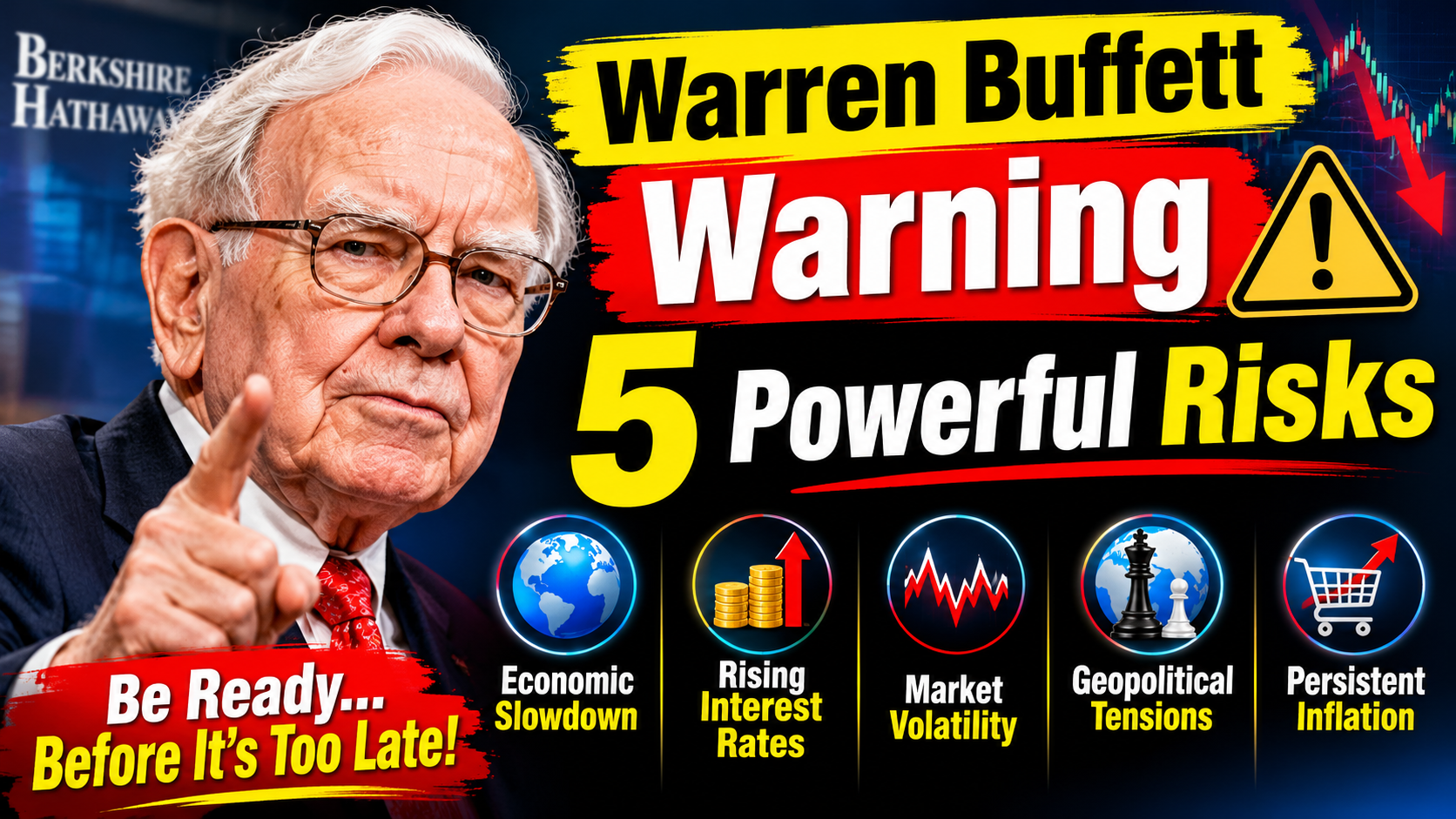
Warren Buffett Warning 5 Powerful Risks- Warren Buffett Warning is an important subject for anyone who wants to understand investing, protect their money, and build long-term wealth. Warren Buffett is widely known for his disciplined approach to investing. However, his success is not simply about finding stocks that increase in price. It is also about understanding what can go wrong before putting money into an investment.
Many people enter the financial markets with one major expectation: making money quickly. They see rising stock prices, successful investors, and attractive returns. As a result, they sometimes forget that every investment carries some level of risk. A company can lose its competitive position, a stock can become overpriced, and borrowed money can turn a temporary market decline into a serious financial problem.
The most interesting part of Buffett’s investing philosophy is that he gives considerable attention to avoiding unnecessary mistakes. He does not believe that investors need to participate in every market opportunity. Sometimes, refusing to invest in something you do not understand is a better decision than chasing an attractive return.
This Warren Buffett Warning explores five important investment risks based on principles discussed in Berkshire Hathaway’s shareholder letters. These lessons can help beginners and experienced investors think more carefully about their financial decisions.
Table of Contents
Quick Summary: 5 Warren Buffett Investment Warnings
| Investment Risk | Why It Matters |
|---|---|
| Investing without knowledge | You may misunderstand the business and its risks. |
| Using excessive debt | Borrowing can magnify financial losses. |
| Paying too much | Even a good company can become a poor investment at an excessive price. |
| Ignoring financial complexity | Difficult financial products can hide risks. |
| Chasing short-term profits | Emotional decisions can damage long-term results. |
The central lesson is simple: successful investing is not only about earning returns. It is also about understanding risk, protecting capital, and making decisions with patience.
Warren Buffett Warning 5 Powerful Risks-Understanding the Warren Buffett Warning

Before discussing the five risks, it is important to understand why Warren Buffett’s approach is different from the behaviour of many market participants.
Buffett does not treat a stock as just a number moving up and down on a computer screen. He considers a stock to represent partial ownership of an actual business. Therefore, he studies the company’s earning potential, financial position, management, and future business prospects.
This way of thinking changes the entire investment process. Instead of asking whether a stock might rise tomorrow, an investor starts asking whether the underlying business can create value over several years.
In Berkshire Hathaway’s 2013 shareholder letter, Buffett explained the importance of staying within one’s circle of competence. His approach was to avoid businesses whose future earnings he could not reasonably estimate. 巴菲特致股东信+1
This principle is especially important today because investors receive information from countless sources. Financial news, social media, market commentary, and online discussions can create pressure to act quickly.
However, having access to more information does not automatically mean having better investment knowledge.
A person may know the name of hundreds of companies but still fail to understand how those businesses make money. Another investor may understand only a few industries but make more thoughtful decisions because of that knowledge.
That is why the Warren Buffett Warning is not simply about avoiding market crashes. It is about recognising the risks that can quietly damage an investment long before an investor notices the problem.
1. Investing in Businesses You Do Not Understand

One of the most important lessons behind the Warren Buffett Warning is that investors should understand what they are buying. Many people purchase shares simply because a company is popular, its stock price is rising, or someone on social media has recommended it. They may not know how the company earns money, what its major expenses are, or whether its business model can survive future competition.
This creates a serious problem. When investors do not understand a business, they cannot properly evaluate its strengths and weaknesses. They may mistake temporary popularity for long-term business success. A company can attract millions of customers today but still struggle to generate sustainable profits tomorrow.
Why Your Circle of Competence Matters
Buffett has repeatedly discussed the importance of staying within your circle of competence. This means understanding the boundaries of your knowledge and recognising which businesses you can reasonably evaluate.
For example, imagine two investors looking at a technology company. The first investor purchases its shares because everyone is discussing it. The second investor studies its products, revenue sources, competition, financial statements, and business model before making a decision.
Both investors may purchase the same stock, but their decisions are based on completely different levels of understanding.
The first investor depends heavily on market excitement. The second has a better foundation for evaluating the business.
This does not mean that investors must understand every technical detail of a company. However, they should understand the basic reasons why the business earns money and what could threaten its future.
How to Avoid This Investment Risk
Before making an investment decision, consider these questions:
- What products or services does the company sell?
- How does the company generate revenue?
- Is the business consistently profitable?
- What makes its products or services competitive?
- Can the business survive changing market conditions?
- What could cause its earnings to decline?
If you cannot answer the basic questions, spending more time learning may be better than making an immediate investment.
The first Warren Buffett Warning teaches an important lesson: you do not need to understand every business in the market. You need to recognise the businesses you can understand and evaluate.
2. Using Too Much Borrowed Money

The second important Warren Buffett Warning concerns financial leverage. Borrowed money can make financial success appear faster, but it can also increase the damage when an investment moves in the wrong direction.
Many investors focus on the potential returns from borrowing money. They imagine that if an investment increases in value, they will earn more than they could have earned using their own capital.
However, they sometimes ignore the other side of the calculation. Borrowing creates financial obligations that do not disappear simply because the market falls.
In his 2010 Berkshire Hathaway shareholder letter, Buffett discussed how leverage can magnify gains but also produce devastating losses. He explained why financial strength and avoiding excessive debt are important to long-term survival.
Why Leverage Can Become Dangerous
Consider a simple example.
Imagine an investor who puts their own money into an investment. If the investment loses value, the investor experiences a loss.
Now imagine another investor who uses borrowed money to increase the size of the same investment. If the market moves against them, the loss can become much more difficult to manage because the borrowed amount still needs to be repaid.
Interest expenses and repayment obligations can create additional pressure.
The problem becomes more serious when investors depend on rising prices to maintain their financial position. A market decline can expose weaknesses that were not obvious during favourable conditions.
The Difference Between Growth and Financial Survival
A common mistake is measuring investment success only by the returns earned during good market conditions.
A better approach is to consider whether an investment strategy can survive difficult conditions too.
Financial survival matters because wealth creation usually requires time. A strategy that produces attractive returns for a short period but exposes an investor to excessive financial risk may not be sustainable.
The Warren Buffett Warning here is straightforward: never evaluate an investment strategy only by looking at its possible profits. Understand the financial obligations and possible losses as well.
3. Buying Good Companies at Excessively High Prices

One of the most misunderstood lessons in value investing is that a good company is not automatically a good investment at every price.
Investors sometimes become so excited about a successful business that they forget to evaluate its valuation. They assume that a strong company will always produce strong investment returns, regardless of how much they pay for its shares.
This is where the Warren Buffett Warning becomes particularly relevant.
A company may have excellent management, a strong brand, loyal customers, and healthy earnings. However, if investors pay an excessively high price, their future returns may disappoint.
Why Investment Price Matters
Imagine a business that is worth approximately $100 based on a reasonable assessment of its future earning potential.
An investor purchases its shares at $80. Another investor purchases the same shares at $180.
Both investors own part of the same business. However, their starting prices are very different.
If the company’s underlying value grows over time, the first investor may achieve a satisfactory return. The second investor may need to wait much longer before the investment becomes attractive.
This illustrates an important difference between business quality and investment valuation.
Buffett discussed this issue directly in Berkshire Hathaway’s 2014 shareholder letter. He explained that even a sound investment can become speculation when purchased at an unusually high price.
Why Market Popularity Can Mislead Investors
When a stock becomes popular, investors sometimes stop asking whether its current price makes sense.
They focus on how much the price has increased and assume that the trend will continue.
However, the stock market does not guarantee that a successful company will always be available at an attractive valuation.
A disciplined investor evaluates the business and the price separately.
The Warren Buffett Warning teaches that investment quality depends on more than finding a famous company. The price paid also plays an important role in determining potential returns.
4. Ignoring the Hidden Risks of Complex Financial Products

The fourth Warren Buffett Warning is about investments that appear attractive but are difficult to understand.
Financial markets offer many products that promise different types of returns. Some are simple, while others involve complicated structures, multiple financial obligations, and risks that are not immediately visible.
The problem is that investors sometimes judge a financial product by its advertised benefits instead of understanding how it actually works.
A product may look safe because it has an attractive name, professional presentation, or an impressive history. However, these things do not automatically make an investment safe.
Why Financial Complexity Can Become a Problem
Imagine an investor considering a financial product that promises attractive returns. The investor understands the expected return but does not understand the underlying assets, fees, conditions, or possible losses.
In this situation, the investor is making a decision without understanding the complete financial picture.
Complexity can make it difficult to identify where the real risks exist.
Warren Buffett has expressed concerns about financial instruments whose risks can become difficult to measure, particularly when market conditions change.
The important lesson is that investors should not confuse complicated financial structures with superior investment opportunities.
Questions to Ask Before Investing
Before considering a complicated financial product, understand:
- What assets does the product hold?
- How does it generate returns?
- What fees and expenses apply?
- What conditions could cause losses?
- Can you withdraw your money when needed?
- Who manages the investment?
- Are the risks clearly explained?
If the answers are unclear, take time to learn before making a decision.
The Warren Buffett Warning is not that every complicated investment is necessarily bad. It is that investors should not commit money to something they cannot properly understand.
5. Chasing Short-Term Profits Instead of Building Long-Term Wealth

The fifth Warren Buffett Warning concerns impatience.
Many investors enter the stock market because they want quick results. They watch daily price movements, follow popular market discussions, and become emotionally involved with every change in their investments.
This behaviour can turn investing into a cycle of excitement, fear, and repeated decision-making.
However, building wealth through businesses is generally a long-term process. Companies need time to develop products, increase sales, improve operations, and generate profits.
Investors who constantly focus on short-term movements may overlook the actual performance of the businesses they own.
Why Short-Term Thinking Creates Problems
Imagine an investor purchasing shares in a financially strong company.
A few weeks later, the stock price declines because of negative market sentiment. The investor becomes worried and sells the shares without examining whether the company’s underlying business has changed.
Later, the market recovers.
The original decision was driven primarily by short-term emotions rather than a careful evaluation of the investment.
This example does not mean that every falling stock should be held. Sometimes, a price decline reflects genuine business problems. The important point is to understand the reason behind the decline instead of reacting automatically.
The Importance of Patience
Buffett’s investing philosophy places considerable importance on business quality, reasonable valuation, and long-term ownership.
Patience does not mean ignoring mistakes or holding every investment forever. It means giving a good investment enough time to produce results while remaining alert to changes in the business.
The Warren Buffett Warning here is simple: do not allow daily market excitement to replace careful financial thinking.
Practical Lessons From the Five Warren Buffett Warnings
Understanding investment risks is useful, but applying these lessons is even more important.
The following framework can help investors evaluate financial decisions more carefully.
1. Understand Before You Invest
Do not purchase an investment simply because it is popular. Learn how the underlying business operates and where its earnings come from.
2. Evaluate Financial Strength
Look beyond revenue growth. Understand debt, cash flow, profitability, and the company’s ability to manage difficult business conditions.
3. Consider the Price
A successful company can still be an expensive investment. Compare the purchase price with a reasonable estimate of its underlying business value.
4. Read the Complete Investment Conditions
Understand fees, restrictions, risks, and possible losses before choosing a financial product.
5. Develop a Long-Term Perspective
Avoid making decisions based entirely on daily price movements. Focus on the underlying investment and whether your original reasons for investing remain valid.
These five principles are not a guarantee of investment success. They are a way to make financial decisions with greater awareness.
A Simple Example: Two Investors, Two Different Decisions

Consider two fictional investors, Alex and David. Both have the same amount of money available for investment.
Alex follows popular market discussions. Whenever a company becomes popular, he becomes interested in purchasing its shares. He does not spend much time understanding the business or checking its valuation.
David follows a different approach. He studies businesses, examines their financial position, considers valuation, and avoids investments he cannot understand.
After some time, both investors face a difficult market environment.
Alex becomes concerned because several investments have fallen in price. He starts questioning his decisions because he never had a clear understanding of the businesses.
David also experiences market uncertainty. However, he has a better understanding of why he selected his investments. He reviews the financial condition of each business and considers whether the original investment reasons remain valid.
This example does not suggest that David will always earn more money. Even careful investors make mistakes and experience losses.
The difference is in their decision-making process.
Alex depends heavily on market popularity. David depends more on research, valuation, and an understanding of risk.
That is the deeper message behind the Warren Buffett Warning: investment decisions should come from understanding rather than excitement.
Advanced Investment Lessons Most Beginners Overlook
Protecting Capital Is Different From Avoiding Every Loss

Some investors believe that successful investing means never experiencing a loss. This is not realistic.
Stock prices fluctuate, businesses face unexpected problems, and economic conditions change.
The more useful goal is to understand the risks being taken and avoid unnecessary exposure to permanent financial damage.
A temporary decline in market price and a permanent loss of business value are not necessarily the same thing.
For example, a strong business may experience a temporary fall in its share price without suffering an equivalent decline in its earning potential.
On the other hand, a company can experience a serious deterioration in its business even when its stock price has not yet fully reflected the problem.
Investors should understand this difference.
Cash and Financial Flexibility Matter
Another important lesson from Berkshire Hathaway’s financial philosophy is the value of maintaining financial strength.
Businesses need enough financial flexibility to manage difficult conditions and take advantage of opportunities.
The same general principle applies to personal financial planning.
People should understand their financial obligations before committing money to investments. Money needed for essential expenses should not be treated as freely available investment capital.
Financial flexibility can help prevent unnecessary pressure during uncertain periods.
Good Decisions Do Not Always Produce Immediate Results
A carefully researched investment can still perform poorly over a short period.
Similarly, an investment made without proper research can sometimes produce a profit.
This is why judging decisions only by their immediate financial results can be misleading.
A better approach is to evaluate the quality of the decision-making process.
Did the investor understand the business? Was the valuation reasonable? Were the risks considered? Was the decision based on reliable information?
These questions provide a stronger foundation for evaluating investment discipline.
What Warren Buffett’s Investment Philosophy Teaches About Wealth Creation
The broader lesson behind the Warren Buffett Warning is that wealth creation requires more than finding investments with attractive returns.
It requires understanding how money is put to work.
A person who studies businesses, understands financial risks, and makes informed decisions may develop a stronger foundation for long-term wealth creation.
Buffett’s approach also highlights the importance of simplicity.
Investors do not need to understand every new financial product or participate in every market opportunity. In his 2013 shareholder letter, Buffett explained that many non-professional investors could benefit from owning a diversified, low-cost index fund rather than trying to select individual winning stocks. 巴菲特致股东信
This is an important distinction.
His philosophy does not require every investor to become an expert stock picker. It encourages people to recognise their limitations and choose an investment approach they can understand.
Wealth creation is not about constantly doing something with money. Sometimes, the better decision is to avoid unnecessary activity, reduce costs, and allow a sensible long-term strategy to work.
Common Investment Mistakes to Avoid
Even investors who understand basic financial concepts can make mistakes when emotions influence their decisions.
Here are some common mistakes worth recognising.
Following Popular Opinions Without Research
A popular company is not automatically a good investment. Always understand the business independently.
Ignoring Valuation
Business quality and purchase price are two different things. Both deserve attention.
Underestimating Debt
Debt creates financial obligations. Investors should understand how borrowing affects the financial position of a business or investment.
Expecting Guaranteed Returns
No stock market investment can promise a guaranteed positive return. Be careful with claims that suggest otherwise.
Making Decisions Through Fear and Excitement
Emotional decisions can weaken investment discipline. Take time to understand the situation before acting.
Ignoring the Importance of Diversification
Putting all available investment money into one company or industry can create unnecessary concentration risk. Diversification can help manage some investment risks, although it cannot eliminate losses.
Frequently Asked Questions About Warren Buffett Warning
1. What Is the Main Warren Buffett Warning for Investors?
The main lesson is to understand the risks before investing. Investors should avoid businesses they cannot understand, excessive financial leverage, unreasonable valuations, complicated products they cannot evaluate, and decisions driven by short-term excitement.
2. Why Does Warren Buffett Recommend Investing in Businesses You Understand?
Understanding a business helps investors evaluate how it generates money, what makes it competitive, and what could affect its future earnings. This approach can reduce decisions based purely on market popularity or speculation.
3. Why Does Warren Buffett Warn Against Excessive Debt?
Borrowed money creates financial obligations. When investments or businesses perform poorly, debt can increase financial pressure and magnify losses. Therefore, understanding leverage is an important part of financial risk management.
4. Can a Good Company Be a Bad Investment?
Yes. A financially strong company can become an unattractive investment when its shares are purchased at an excessively high price. Investment valuation matters because the price paid affects potential returns.
5. What Can Beginners Learn From Warren Buffett?
Beginners can learn to understand investments before committing money, avoid unnecessary complexity, consider valuation, maintain patience, and recognise the limits of their knowledge.
How to Apply Warren Buffett’s Investment Principles in Everyday Financial Decisions
The Warren Buffett Warning becomes more useful when investors apply its lessons to real financial decisions. Understanding investment theory is one thing, but using that knowledge when money is involved requires discipline.
A practical approach is to develop a simple investment evaluation process. Instead of immediately purchasing an investment, take time to understand its purpose, potential returns, financial risks, and suitability for your situation.
The Five-Question Investment Test
Before making an investment decision, consider these five questions:
- Understanding: Can I explain how this business or investment generates money?
- Financial strength: Does the business have a reasonable financial position?
- Valuation: Am I paying a sensible price?
- Risk: What could go wrong, and how much could I lose?
- Time: Am I making this decision based on a sensible long-term plan?
These questions do not remove investment uncertainty. However, they can help prevent careless decisions.
Warren Buffett Warning: Why Avoiding Mistakes Matters More Than Following Trends
Financial markets regularly introduce new investment opportunities. Some become popular because of technological developments, economic changes, or strong business growth.
However, popularity and investment quality are not the same.
An investor who follows every market trend may end up purchasing assets without understanding their underlying value. This can create a portfolio that depends more on excitement than financial analysis.
The Warren Buffett Warning encourages a different mindset. Investors should understand that missing an opportunity is not necessarily a financial mistake. Making an investment without understanding its risks can be much more damaging.
For example, imagine a new industry attracting significant attention. Investors may expect every company operating in that industry to become successful. But different businesses have different management teams, financial conditions, competitive advantages, and earning potential.
Therefore, evaluating individual businesses matters more than simply following an industry trend.
Final Investment Checklist
Use this checklist as a simple reminder before making investment decisions.
- Understand the business or financial product.
- Examine the company’s financial statements.
- Consider debt and cash flow.
- Evaluate the investment price.
- Understand possible losses.
- Avoid relying entirely on social media opinions.
- Maintain financial flexibility.
- Consider diversification.
- Review your investment reasons periodically.
- Never assume that past performance guarantees future returns.
The most valuable lesson from the Warren Buffett Warning is that good investing requires both knowledge and restraint.
Building wealth is not a competition to make the fastest investment decision. It is a process of making informed decisions, understanding uncertainty, and giving sound financial strategies enough time to work.
Conclusion: The Biggest Warren Buffett Warning Is About Avoiding Unnecessary Mistakes
The Warren Buffett Warning provides an important lesson for anyone interested in investing and long-term wealth creation.
Successful investing is not simply about finding companies whose stock prices are rising. It requires understanding businesses, evaluating financial strength, considering valuation, and recognising risks that may not be immediately visible.
The five risks discussed in this article highlight five important areas of investment discipline: lack of knowledge, excessive debt, overvaluation, financial complexity, and short-term thinking.
None of these lessons can guarantee profits or prevent every investment loss. However, understanding them can help investors make more informed decisions.
One important idea stands out from Buffett’s philosophy: you do not need to participate in every opportunity to build wealth.
Sometimes, avoiding a bad investment decision is just as important as finding a good investment.
Take time to learn, examine the facts, understand the risks, and make financial decisions based on knowledge rather than excitement.
AFFILIATE- https://link.amazon/B08KzJuC9
REFRANCE- Warren Buffett Warning 5 Powerful Risks Warren Buffett Warning 5 Powerful Risks Warren Buffett Warning 5 Powerful Risks
Warren Buffett Warning 5 Powerful Risks Warren Buffett Warning 5 Powerful Risks Warren Buffett Warning 5 Powerful Risks Warren Buffett Warning 5 Powerful Risks Warren Buffett Warning 5 Powerful Risks Warren Buffett Warning 5 Powerful Risks Warren Buffett Warning 5 Powerful Risks Warren Buffett Warning 5 Powerful Risks
Warren Buffett Warning 5 Powerful Risks Warren Buffett Warning 5 Powerful Risks Warren Buffett Warning 5 Powerful Risks
Warren Buffett Warning 5 Powerful Risks Warren Buffett Warning 5 Powerful Risks Warren Buffett Warning 5 Powerful Risks Warren Buffett Warning 5 Powerful Risks Warren Buffett Warning 5 Powerful Risks Warren Buffett Warning 5 Powerful Risks Warren Buffett Warning 5 Powerful Risks Warren Buffett Warning 5 Powerful Risks