

Proven Financial Advisor Red Flags 2026-3 Warning Sign Your Financial Advisor Is Giving Wrong Advice Wrong Advice Choosing a financial advisor can be one of the most important decisions in your wealth-building journey. A good advisor helps you create long-term financial security, while a poor advisor can quietly damage your portfolio, increase your costs, and delay your financial goals.
Many investors assume that every financial advisor acts in their best interest. Unfortunately, that is not always true. Some advisors prioritize commissions, push unsuitable products, or make promises that sound attractive but are unrealistic.
If you notice any of the following warning signs, it may be time to review the advice you are receiving.
Table of Contents
Proven Financial Advisor Red Flags 2026-3 Warning Sign Your Financial Advisor Is Giving Wrong Advice-Why Trusting The Wrong Financial Advisor Can Be Costly
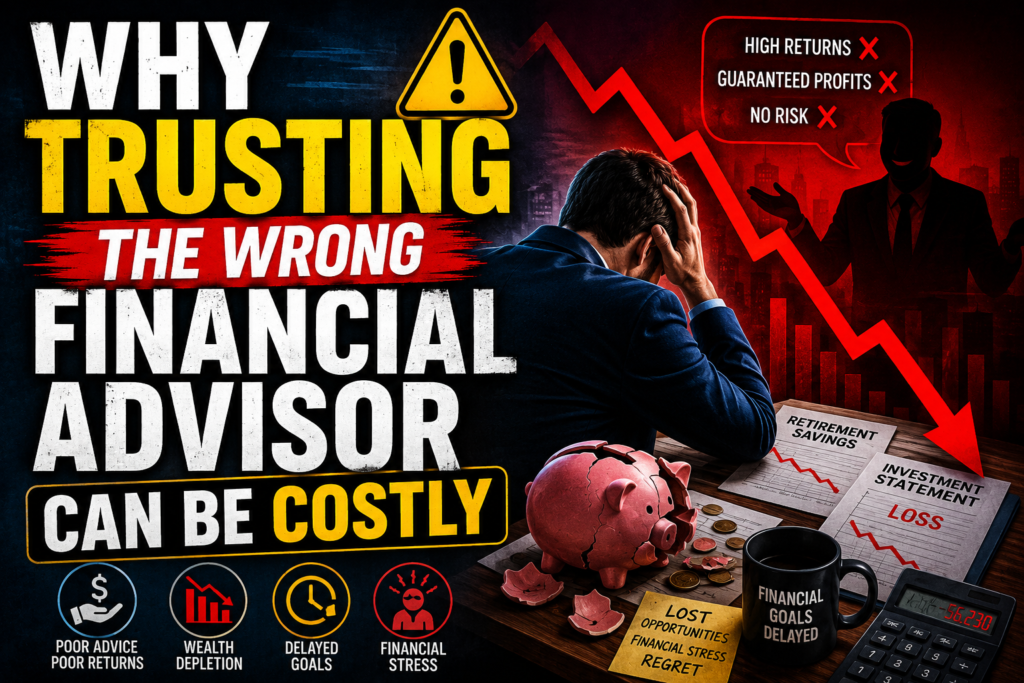
Financial mistakes often take years to become visible. By the time investors realize something is wrong, they may have already lost significant wealth through:
- High fees
- Poor investment choices
- Excessive risk
- Missed growth opportunities
- Tax inefficiencies
Even a small mistake compounded over many years can have a major impact on your future wealth.
That is why identifying Financial Advisor Wrong Advice early can protect both your money and your financial goals.
Proven Financial Advisor Red Flags 2026-3 Warning Sign Your Financial Advisor Is Giving Wrong Advice-Dangerous Signal #1 – They Push Products More Than Financial Planning

One of the biggest red flags is when every meeting ends with a product recommendation.
Instead of discussing your goals, income, expenses, risk tolerance, and future plans, the advisor immediately recommends:
- Insurance policies
- Structured products
- High-commission mutual funds
- Investment-linked insurance plans
- Complex financial products
A professional advisor should first understand your situation before recommending any solution.
Questions A Good Advisor Should Ask
- What are your financial goals?
- When do you need the money?
- What is your risk tolerance?
- What are your current investments?
- Do you have emergency savings?
If these questions are rarely discussed, the focus may be on selling rather than advising.
Proven Financial Advisor Red Flags 2026-3 Warning Sign Your Financial Advisor Is Giving Wrong Advice-Why This Is Dangerous
When advisors earn commissions from product sales, conflicts of interest can arise.
The recommended product may benefit the advisor more than the investor.
Over time this can lead to:
- Lower investment returns
- Higher fees
- Unnecessary insurance costs
- Poor portfolio diversification
Your financial plan should drive product selection—not the other way around.
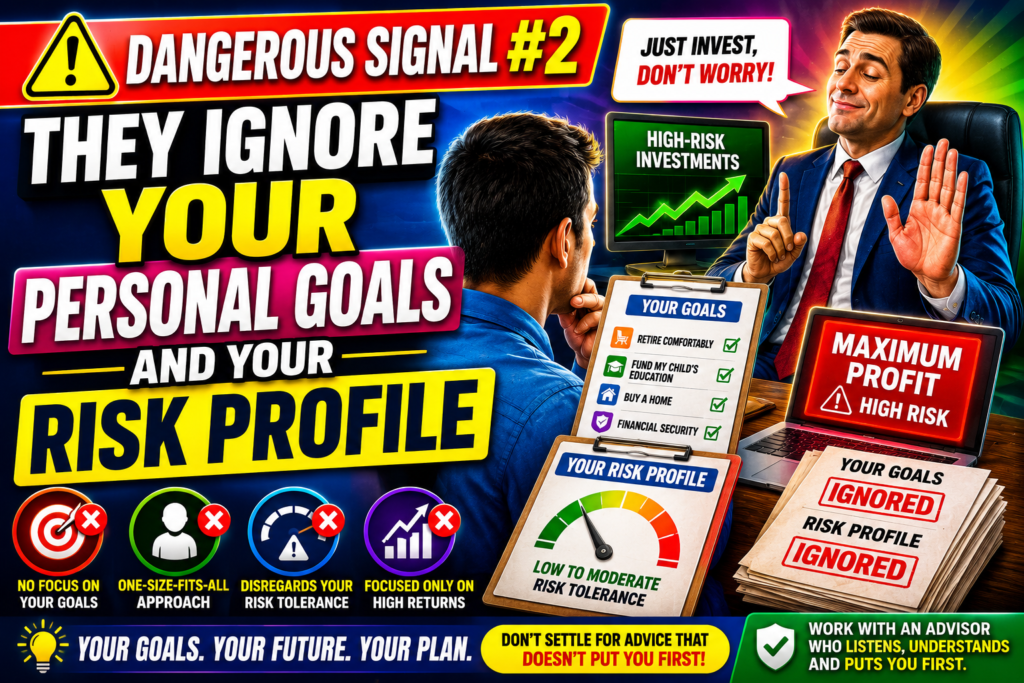
Dangerous Signal – They Ignore Your Personal Goals And Risk Profile
3 Warning Sign Your Financial Advisor Is Giving Wrong Advice-Every investor is different.
A 25-year-old professional investing for retirement has completely different needs from a 60-year-old retiree seeking income and capital protection.
If your advisor gives identical recommendations to everyone, that is a serious warning sign.
Examples Of Poor Advice
An advisor recommends:
- Aggressive small-cap funds to a retiree
- Conservative fixed deposits to a young investor
- High-risk stocks without assessing risk tolerance
- Long lock-in products despite short-term goals
These recommendations may not align with your actual financial needs.
Why Risk Profile Matters
A portfolio should reflect:
- Investment horizon
- Financial goals
- Income stability
- Risk tolerance
- Existing assets
Ignoring these factors can create unnecessary stress during market downturns.
For example, if an investor cannot tolerate a 30% portfolio decline, placing most of their money into highly volatile investments is inappropriate.
A quality advisor creates a strategy that matches both your financial goals and emotional comfort level.
Signs They Are Ignoring Your Needs
- No detailed financial planning discussion
- No risk assessment questionnaire
- Generic investment recommendations
- Little interest in your future goals
- No periodic review meetings
Financial planning should always be personalized.
Proven Financial Advisor Red Flags 2026-3 Warning Sign Your Financial Advisor Is Giving Wrong Advice-Dangerous Signal – They Promise Unrealistic Returns
This is perhaps the most dangerous signal of all.
No advisor can accurately predict future market returns.
Markets are influenced by:
- Economic conditions
- Interest rates
- Corporate earnings
- Global events
- Investor sentiment
Anyone guaranteeing extraordinary returns should immediately raise concerns.
Common Promises To Be Careful About
- “This investment cannot lose money.”
- “You will definitely earn 20% every year.”
- “This stock will double in six months.”
- “Guaranteed market-beating returns.”
- “There is zero risk.”
Professional advisors discuss probabilities and risks.
Unprofessional advisors often focus only on potential rewards.
Proven Financial Advisor Red Flags 2026-3 Warning Sign Your Financial Advisor Is Giving Wrong Advice-The Reality Of Investing
Successful investing is based on:
- Discipline
- Diversification
- Patience
- Risk management
- Long-term thinking
There are no shortcuts to sustainable wealth creation.
Investors who chase unrealistic promises often become victims of poor decisions or speculative investments.
3 Warning Sign Your Financial Advisor Is Giving Wrong Advice-Additional Red Flags You Should Never Ignore
Beyond the three major warning signs, there are several smaller signals that may indicate poor-quality advice.
Lack Of Transparency
A trustworthy advisor clearly explains:
- Fees
- Commissions
- Risks
- Investment strategy
If explanations are vague or confusing, ask more questions.
Frequent Buying And Selling
Excessive trading may generate fees without improving returns.
A long-term strategy generally requires thoughtful adjustments rather than constant changes.
Poor Communication
An advisor should be accessible and responsive.
If calls, emails, and questions regularly go unanswered, it may indicate a lack of commitment to client service.
Pressure Tactics
Be cautious if you hear:
- “You must invest today.”
- “This offer expires tonight.”
- “Don’t think too much.”
Sound financial decisions should never be rushed.
Proven Financial Advisor Red Flags 2026-3 Warning Sign Your Financial Advisor Is Giving Wrong Advice-How To Verify Whether Your Advisor’s Advice Is Correct
If you suspect Financial Advisor Wrong Advice, take the following steps.
Get A Second Opinion
Consult another qualified advisor and compare recommendations.
Different perspectives can reveal potential issues.
Review Costs Carefully
Understand:
- Advisory fees
- Fund expense ratios
- Insurance charges
- Transaction costs
High fees can significantly reduce long-term returns.
Ask For Written Explanations
A professional advisor should be able to explain:
- Why an investment is suitable
- Expected risks
- Time horizon
- Potential outcomes
Compare Advice With Your Goals
Every recommendation should support a specific financial objective.
If you cannot clearly connect an investment to your goals, ask why it was recommended.
Proven Financial Advisor Red Flags 2026-3 Warning Sign Your Financial Advisor Is Giving Wrong Advice- What A Good Financial Advisor Actually Does
The best advisors focus on helping clients achieve meaningful financial outcomes rather than selling products.
A quality advisor typically:
- Creates a personalized financial plan
- Reviews goals regularly
- Explains risks honestly
- Maintains transparency
- Encourages disciplined investing
- Focuses on long-term wealth creation
- Adjusts strategies when life circumstances change
Good advice often sounds practical and realistic rather than exciting and aggressive.
Frequently Asked Questions (FAQs)
1. How do I know if my financial advisor is giving me wrong advice?
Some common warning signs include:
- Constant product selling
- Unrealistic return promises
- Lack of transparency about fees
- Ignoring your financial goals
- No discussion about risks
- Frequent portfolio changes without explanation
If you notice several of these signs together, it may be worth seeking a second opinion.
2. Can a financial advisor guarantee investment returns?
No.
Legitimate financial advisors cannot guarantee stock market returns or future investment performance. Markets are unpredictable, and all investments carry some level of risk.
Anyone promising guaranteed high returns should be approached with caution.
3. Should I ask my advisor about commissions?
Absolutely.
Investors should always understand:
- Advisory fees
- Product commissions
- Transaction charges
- Fund management expenses
Transparency is a key characteristic of trustworthy financial advice.
4. How often should a financial advisor review my portfolio?
Most investors benefit from a review at least once or twice a year.
Additional reviews may be necessary when:
- Major life changes occur
- Income changes significantly
- Market conditions shift dramatically
- Financial goals evolve
Regular reviews help keep investments aligned with your objectives.
5. Is it okay to change financial advisors?
Yes.
If your advisor consistently provides poor service, lacks transparency, or recommends unsuitable investments, changing advisors may be the right decision.
Your financial future is too important to remain with someone you do not trust.
Proven Financial Advisor Red Flags 2026-3 Warning Sign Your Financial Advisor Is Giving Wrong Advice – Real-Life Example: How Wrong Advice Can Cost Lakhs
Imagine two investors, Rahul and Amit.
Both invest ₹10 lakh for 15 years.
Rahul’s Advisor
- Focuses on long-term planning
- Uses diversified investments
- Keeps costs low
- Reviews goals regularly
Average annual return: 12%
After 15 years:
₹10 lakh grows to approximately ₹54.7 lakh.
Amit’s Advisor
- Frequently changes investments
- Sells high-commission products
- Focuses on short-term market predictions
- Charges higher fees
Average annual return after costs: 8%
After 15 years:
₹10 lakh grows to approximately ₹31.7 lakh.
Difference
The gap exceeds ₹23 lakh.
This example demonstrates how advisor quality can significantly impact wealth creation over time.
Proven Financial Advisor Red Flags 2026-3 Warning Sign Your Financial Advisor Is Giving Wrong Advice-Financial Advisor Wrong Advice Checklist
Use this quick checklist to evaluate your advisor.
Green Flags ✅
- Understands your goals
- Explains risks clearly
- Transparent about fees
- Encourages diversification
- Focuses on long-term planning
- Reviews your portfolio regularly
Red Flags ❌
- Guarantees high returns
- Pushes products aggressively
- Avoids fee discussions
- Uses pressure tactics
- Ignores risk tolerance
- Recommends identical solutions to everyone
The more red flags you identify, the more carefully you should review the advice you are receiving.
Proven Financial Advisor Red Flags 2026-3 Warning Sign Your Financial Advisor Is Giving Wrong Advice-Key Lessons Every Investor Should Remember
Successful investing is not about finding secret strategies.
Instead, long-term wealth creation usually comes from:
- Consistent investing
- Asset allocation
- Diversification
- Cost control
- Tax efficiency
- Patience
- Disciplined decision-making
A good financial advisor helps investors stay focused on these fundamentals.
A poor advisor often distracts investors with sales pitches, predictions, and unrealistic expectations.
Proven Financial Advisor Red Flags 2026-3 Warning Sign Your Financial Advisor Is Giving Wrong Advice- How To Perform Your Own Financial Advisor Audit
Most investors review their investments but rarely review the person giving the advice. Conducting a yearly advisor audit can help ensure your financial plan remains on track.
Step 1: Review Portfolio Performance
Ask yourself:
- Is my portfolio performing in line with my goals?
- Am I taking an appropriate level of risk?
- Has my advisor explained recent performance clearly?
- Are my investments diversified?
Remember that short-term underperformance does not automatically mean bad advice. Focus on long-term results and strategy.
Step 2: Analyze Total Costs
Many investors underestimate how much fees affect long-term returns.
Review:
- Advisory fees
- Mutual fund expense ratios
- Insurance charges
- Transaction fees
- Tax impact
Even a 1% difference in annual costs can reduce your final wealth significantly over decades.
Step 3: Check Goal Alignment
Your financial plan should evolve as your life changes.
Important life events include:
- Marriage
- Children
- Home purchase
- Career changes
- Business ownership
- Retirement planning
A good advisor updates your strategy when your circumstances change.
Step 4: Evaluate Communication Quality
Ask:
- Does my advisor respond promptly?
- Are explanations easy to understand?
- Do I receive regular updates?
- Am I comfortable asking questions?
Trust and communication are critical components of a successful advisor relationship.
The Difference Between Salespeople And Advisors
One of the biggest challenges for investors is distinguishing between genuine advisors and financial salespeople.
Financial Salesperson
Typically focuses on:
- Product promotion
- Commission generation
- Short-term sales targets
- Urgent investment decisions
Common phrases:
- “This is a limited-time opportunity.”
- “Everyone is buying this.”
- “Act quickly before it’s too late.”
Financial Advisor
Typically focuses on:
- Goal-based planning
- Risk management
- Long-term wealth creation
- Financial education
Common phrases:
- “Let’s understand your goals first.”
- “Here’s the risk involved.”
- “Let’s compare multiple options.”
The difference may seem subtle, but it can have a major impact on your financial future.
Proven Financial Advisor Red Flags 2026-3 Warning Sign Your Financial Advisor Is Giving Wrong Advice-Financial Advisor Wrong Advice: Top Mistakes Investors Make
Sometimes investors unintentionally contribute to poor outcomes.
Chasing High Returns
Many people choose advisors based solely on performance promises.
This often leads to excessive risk-taking.
Ignoring Fees
Small fees can compound into large amounts over time.
Always understand exactly what you are paying.
Following Advice Blindly
Even excellent advisors can make mistakes.
Investors should stay informed and ask questions.
Reacting Emotionally
Fear during market declines and greed during rallies often lead to poor decisions.
A disciplined plan usually produces better long-term results.
Proven Financial Advisor Red Flags 2026-3 Warning Sign Your Financial Advisor Is Giving Wrong Advice-Building A Strong Advisor-Investor Relationship
The best financial relationships are partnerships.
Be Honest About Your Goals
Clearly communicate:
- Retirement objectives
- Income needs
- Major purchases
- Risk tolerance
- Family responsibilities
The more information your advisor has, the better the guidance can be.
Schedule Regular Reviews
At least annually, discuss:
- Portfolio performance
- Goal progress
- Asset allocation
- Tax planning
- Risk exposure
Regular reviews help prevent small problems from becoming large ones.
Keep Learning
Financial education empowers investors.
You don’t need to become an expert, but understanding basic concepts such as:
- Asset allocation
- Diversification
- Inflation
- Tax efficiency
- Risk management
can help you identify poor advice more easily.
Long-Term Wealth Creation Requires Good Advice
Building wealth is not about finding the perfect stock or predicting market movements.
Instead, it usually depends on:
- Consistent investing
- Patience
- Diversification
- Cost management
- Tax planning
- Emotional discipline
A competent advisor helps investors remain focused on these proven principles.
Summary: The 3 Dangerous Signals You Should Never Ignore
Signal #1: Product Pushing
If recommendations always revolve around selling products rather than solving financial problems, be cautious.
Signal #2: Ignoring Your Personal Situation
Advice should be tailored to your goals, timeline, and risk tolerance.
Signal #3: Unrealistic Promises
Any advisor guaranteeing extraordinary returns should raise immediate concerns.
Proven Financial Advisor Red Flags 2026-3 Warning Sign Your Financial Advisor Is Giving Wrong Advice-Action Plan: What To Do If You Suspect Financial Advisor Wrong Advice
Recognizing a problem is only the first step. The next step is taking action before poor advice causes significant financial damage.
Review All Existing Investments
Start by creating a complete list of:
- Mutual funds
- Stocks
- Bonds
- Insurance policies
- Retirement accounts
- Alternative investments
For each investment, ask:
- Why was it purchased?
- What purpose does it serve?
- What are the costs involved?
- Does it still fit my goals?
Many investors discover they own products they do not fully understand.
Request Written Recommendations
Whenever your advisor suggests a new investment, ask for documentation explaining:
- Expected benefits
- Potential risks
- Investment horizon
- Cost structure
- Alternative options
Written recommendations create transparency and accountability.
Get An Independent Review
One of the smartest moves an investor can make is obtaining a second opinion.
An independent review can help identify:
- Excessive fees
- Portfolio overlap
- Unnecessary products
- Concentration risk
- Tax inefficiencies
Even if the original advice is sound, a second perspective can provide valuable insights.
Avoid Making Emotional Decisions
Discovering that you may have received poor advice can be frustrating.
However, avoid:
- Selling everything immediately
- Making drastic changes overnight
- Chasing new investment trends
- Seeking revenge through risky investments
Instead, create a structured transition plan.
Warning Signs During Advisor Meetings
Pay close attention during conversations.
Positive Indicators
Your advisor:
- Asks thoughtful questions
- Explains recommendations clearly
- Discusses risks openly
- Encourages long-term thinking
- Reviews your financial goals
Negative Indicators
Your advisor:
- Interrupts frequently
- Avoids difficult questions
- Focuses only on returns
- Uses high-pressure sales tactics
- Discourages second opinions
These behaviors often reveal the true quality of the advice being provided. Proven Financial Advisor Red Flags 2026
Why Transparency Matters So Much
Transparency is the foundation of trust.
You should clearly understand:
What You Own
Investors should never be confused about their holdings.
What You Pay
Every fee should be disclosed.
What Risks Exist
Every investment carries risk.
What Returns Are Reasonable
Expectations should be realistic and evidence-based.
When transparency is missing, poor advice often follows. Proven Financial Advisor Red Flags 2026
Proven Financial Advisor Red Flags 2026-3 Warning Sign Your Financial Advisor Is Giving Wrong Advice- Financial Advisor Wrong Advice And Retirement Planning
Retirement planning is one area where bad advice can be especially costly.
Common mistakes include:
- Underestimating inflation
- Taking excessive risk near retirement
- Holding too much cash for decades
- Ignoring tax planning
- Failing to diversify income sources
A quality retirement strategy balances growth, income, and risk management. Proven Financial Advisor Red Flags 2026
3 Warning Sign Your Financial Advisor Is Giving Wrong Advice How Technology Helps Investors Verify Advice
Today’s investors have access to more information than ever before.
Useful resources include:
- Portfolio analysis tools
- Retirement calculators
- Expense ratio comparison tools
- Financial education websites
- Investment research platforms
Technology cannot replace professional advice, but it can help investors ask better questions. Proven Financial Advisor Red Flags 2026
Characteristics Of Highly Successful Investors
Many successful investors share similar habits.
They Stay Patient
Wealth creation usually takes years, not weeks.
They Focus On Process
Good decisions matter more than short-term results.
They Control Costs
Reducing fees can significantly improve long-term outcomes.
They Continue Learning
Financial knowledge compounds just like investments.
They Seek Objective Advice
They value advisors who challenge assumptions rather than simply agree with them. Proven Financial Advisor Red Flags 2026
Investor Protection Rules To Follow
Consider adopting these personal rules:
Rule #1
Never invest under pressure.
Rule #2
Never invest in something you cannot explain simply.
Rule #3
Always understand fees before investing.
Rule #4
Seek a second opinion on major financial decisions.
Rule #5
Focus on long-term goals rather than short-term market noise.
These simple rules can help prevent many costly mistakes. Proven Financial Advisor Red Flags 2026
Final Investor Checklist
Before acting on any recommendation, ask:
✅ Does this align with my goals?
✅ Do I understand the risks?
✅ Do I understand the fees?
✅ Is the expected return realistic?
✅ Have alternatives been discussed?
✅ Am I comfortable with this decision?
If the answer to any of these questions is “No,” take additional time before proceeding. Proven Financial Advisor Red Flags 2026
Conclusion
Spotting Financial Advisor Wrong Advice early can save you from costly mistakes and years of lost financial progress. The three biggest warning signs are clear: advisors who push products instead of planning, ignore your personal goals and risk profile, or promise unrealistic returns.
Your advisor should act as a guide, educator, and long-term partner—not as a salesperson. The best financial relationships are built on trust, transparency, and a shared commitment to achieving your financial goals.
Before making any major investment decision, ask questions, understand the risks, and ensure every recommendation serves your interests first. By staying informed and vigilant, you can build a stronger portfolio, make smarter financial decisions, and move confidently toward a secure and prosperous financial future.
The difference between excellent advice and poor advice can amount to lakhs or even crores of rupees over a lifetime. By recognizing these three dangerous signals—product pushing, ignoring your personal goals, and promising unrealistic returns—you can avoid costly mistakes and protect your financial future.
The best financial advisors act as trusted partners who prioritize your interests, communicate transparently, and help you build wealth through disciplined long-term investing. Staying alert to these warning signs can help you make smarter decisions, preserve your hard-earned money, and create a more secure, prosperous, and successful financial future. Proven Financial Advisor Red Flags 2026